Get Full Government Meeting Transcripts, Videos, & Alerts Forever!
Get email alerts on the K12 Curriculum World History topic
No spam. Unsubscribe anytime.
Parents, teachers and AP instructors debate whether world history requirement can be met by AP Human Geography
Summary
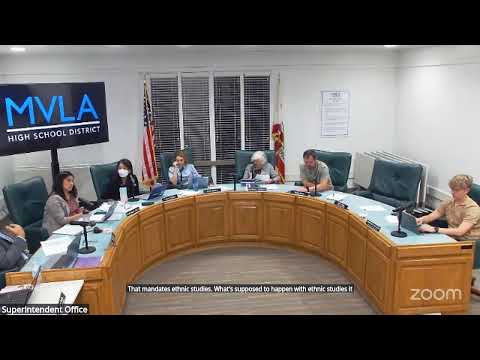
At a May 5 study session the Mountain View–Los Altos Union High School District heard an extended presentation from AP instructors and multiple public commenters about whether AP Human Geography should count in place of a ninth‑grade world history course now replaced by ethnic studies.
Trustees and district staff heard more than an hour of public comment and a multi‑course presentation on May 5 as the district reviewed how four courses offered to sophomores satisfy the state’s world history, culture and geography graduation requirement.
The panel of teachers and multiple public commenters pressed the board to clarify whether students who take AP Human Geography will get the same historical foundation as students who previously took a ninth‑grade world history course, which the district replaced with an ethnic studies course for the current freshman class.
Why it matters: parents, retired teachers and AP instructors told the board the change could reduce students’ exposure to core historical narratives and primary‑source analysis that many colleges expect; district presenters said all four pathways meet state standards in different ways and emphasized that AP European History and AP World History carry historical thinking skills, while AP Human Geography emphasizes spatial analysis.
What presenters and commenters said - “I just want to speak in favor of allowing students freshman year to take … world history instead of ethnic studies,” said Todd Volker during public comment, citing concerns about preparation for AP‑level courses. - Jackie Stevens, introduced as a recently retired 30‑year public school teacher, cited California law and the state course framework and told the board, “geography is not the same as history … geography is an addition to history, not a replacement,” and referenced Education Code section 51225 to argue students must receive world history instruction. - Kevin Hyken, representing MBLA’s AP European History program, said AP European “is really a world history class with Europe at its center,” and described how the course aligns with the California world history framework beginning with material the framework treats from about 1750 onward. - Brooke Meghan Hinkley, AP World History teacher, described the course’s chronological structure and said AP World History “begins to dovetail with the state standards” in units that align to the modern world framework and include the Enlightenment, industrialization, imperialism and the world wars. - Kelly Coble, AP Human Geography teacher at Los Altos High School, said AP Human Geography has become an entry point for students new to AP coursework and that the class “fulfills the UC A‑G a‑g requirement” while focusing on spatial thinking, data interpretation and thematic approaches that connect past processes to present patterns. Coble said MBLA’s Human Geography enrollment includes students from underrepresented groups and “we maintain a high pass rate — over 50% higher than the national average and over half of our students regularly scoring 5,” which she attributed to the class’s design and supports.
Discussion vs. decision: the session was a study session; trustees asked questions but took no formal action. Board members asked how each course meets the “global geographic scope” specified in the state framework, how the move of a world history course from ninth to tenth grade affects student preparation for AP courses, and whether the district should adopt a single pathway for all students.
Supporting details and data: the district presented a comparative spreadsheet (posted on the board agenda) that lists themes, time periods, enrollment and sections for each pathway; presenters said the four courses provide multiple “access points” for students to meet the world history, culture and geography requirement.
Next steps: trustees requested follow‑up materials, including the survey results the district is collecting and clarifications about alignment with state frameworks; several trustees said they want the board to consider the input and timing before changing graduation requirements or course counting for 2025‑26.
Ending: trustees did not adopt a policy or change at the May 5 meeting; the board asked staff to return with additional information on curricular alignment, enrollment impacts and timing for any implementation changes.