Get Full Government Meeting Transcripts, Videos, & Alerts Forever!
Get email alerts on the Code Enforcement topic
No spam. Unsubscribe anytime.
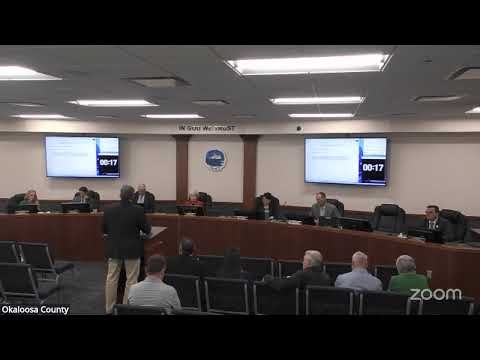
Okaloosa commissioners approve two lien actions, debate changes to code-enforcement waiver policy
Summary
The Okaloosa County Board of County Commissioners approved a release and a reduction of code-enforcement liens but rejected a proposed 60‑day moratorium on new lien-waiver applications after divided votes. Commissioners and staff agreed to develop better cost-tracking for enforcement work and to review policy changes.
The Okaloosa County Board of County Commissioners on a 4‑0 vote approved a complete release of a code‑enforcement lien (item 12) and on a separate 4‑0 vote approved a substantial reduction of another lien (item 13), while a later motion to impose a 60‑day moratorium on accepting new lien‑waiver applications failed after a tied vote.
The approvals came after extended discussion about how the county records and recovers costs tied to code enforcement, and whether past practices have allowed large lien balances to be waived without fully accounting for staff time and other費s. Commissioner Goodwin, who pulled both items from the consent agenda for discussion, asked staff to investigate whether surplus proceeds from a recent tax‑deed sale had been distributed to the correct parties and requested a follow‑up report to the board.
Why it matters: Commissioners said the county has in some cases waived sizable lien amounts without capturing the total cost — including staff time, legal work and other administrative expenses — and they want a clearer, repeatable method to ensure taxpayers are not subsidizing the enforcement of property standards.
Board discussion and staff response Commissioner Goodwin asked county staff to verify whether proceeds from a tax‑deed sale related to item 12 had been distributed correctly and, if necessary, whether the county retained any in personam claim. After the request, staff indicated they would coordinate with the clerk’s office to trace any surplus funds and return recommendations to the board.
Commissioner Goodwin argued the county should not routinely waive large lien amounts: “We were just waiving $20, $30, $4,050,000 sometimes hundreds of thousands of dollars for 0,” he said, adding that waiving significant liens without accounting for costs undercuts the purpose of enforcement. He and other commissioners said many of the liens at issue stem from prolonged, egregious conditions that affect neighbors and require multiple site visits, notices and hearings.
County staff and other commissioners said the county already logs many discrete costs — mileage, personnel time, publication and filing fees — but lacks a standardized way to monetize legal and administrative time across older, multi‑year cases. A staff speaker recommended building on existing tracking tools used for emergency response to capture enforcement costs going forward and suggested calculating a standardized legal/administrative charge or an average rate for older cases.
Motions and votes - Motion to approve item 12 (complete release of lien) with staff directed to investigate distribution of any surplus funds from the tax‑deed sale: passed 4‑0. (The board unencumbered the property while reserving the county’s ability to pursue claims against an estate if surplus proceeds are identified.) - Motion to approve item 13 (reduction in code‑enforcement lien): passed 4‑0. Staff said the ledger numbers supporting item 13 were definitive and that reconstructing all historical entries to compute additional costs would be difficult and likely not worth the effort for that case. - Motion to impose a 60‑day moratorium on accepting new lien waiver applications while staff implements a cost‑tracking framework: failed on a tied vote (2‑2), so the moratorium was not adopted.
Next steps and context Staff committed to return to the board within approximately 60 days with a proposal for a standardized way to capture and present the county’s enforcement costs, including options such as a standardized legal charge or an average administrative rate. Commissioners suggested staff should also consider whether the current fine and fee structure needs adjustment to reduce the need for future waivers.
The debate followed repeated examples where lien balances outgrew property values, and where commissioners said existing practice allowed disproportionate write‑offs. Commissioners repeatedly emphasized the distinction between discussion (policy options and system design) and formal action (the approved releases and reductions), and they reserved the right to revisit policy changes after staff returns with concrete costing methods.
Ending Staff will report back to the board with detailed proposals for cost tracking and any recommended changes to lien‑waiver policy; in the meantime, the approved releases will stand as voted.