Get Full Government Meeting Transcripts, Videos, & Alerts Forever!
Get email alerts on the Ems Response And Dispatch topic
No spam. Unsubscribe anytime.
Committee reviews emergency response data, discusses EMS response times and NextGen 911 texting
Summary
County emergency-response leaders told the Public Safety Committee May 6 that EMS response times have been stable, described dispatch policies that limit initial acknowledgement to four minutes, and said the county is testing text-to-911 as part of a statewide ESInet project.
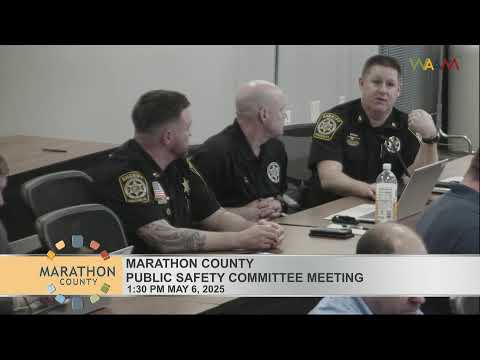
The Marathon County Public Safety Committee reviewed emergency response data May 6 and heard county emergency staff summarize recent operational changes and the limits of local control over response times.
Captain Bill Bridal (Captain Berto in packet), Marathon County Sheriff's Office, told the committee the response-time data provided were for EMS only and that those times have been "pretty stable for the last several years." He said the emergency system requires an acknowledgement within four minutes and an additional four minutes to be en route, for an eight-minute target from time of call to units en route; if a page is not acknowledged within four minutes, the system automatically dispatches a mutual-aid agency sooner.
Administrator Lance Leonard described investments the county has made in radio and backup dispatch capability, including a physical redundant dispatch center at the juvenile detention center and a virtual backup through an arrangement with Langlade County. "We've created a redundant dispatch center in the event that our current dispatch center is compromised," Leonard said, adding the county used ARPA funds for some work on redundancy.
Committee members and emergency staff discussed a strategic-plan goal to lower countywide response times by the end of 2024; staff said local operational changes had been implemented but achieving materially lower times would likely require a broader change — for example, a county role in delivery of EMS services — and that such a change would involve complex legal, fiscal and municipal considerations. Leonard said state statute provides a levy exception that could allow counties to take on EMS delivery costs, but that municipalities and providers view the issue differently.
Staff described prior operational changes meant to improve outcomes, including adding radio channels, creating a metro radio channel, and adding staff in dispatch following a 2007 staffing study and later updates. A county communications official said the center runs near three to four positions short at times and that new hires sometimes do not complete training because of the high multitasking demands.
On technology, staff said Marathon County is participating in the state's ESInet (emergency services IP network) rollout that brings automatic location and caller information to neighboring centers and enables text-to-911. "Yesterday, AT&T did the test and we were able to receive and transmit their text," a communications official said; testing with other carriers is pending before the county goes live for text-to-911.
Committee members asked whether the county could do more to reduce response times; staff said there is no single county-board action that will immediately lower times and that previous county actions included funding additional dispatch positions and a uniform addressing initiative intended to improve location accuracy. The committee did not take formal action; staff were invited to return with additional operational detail or to discuss the policy implications of countywide EMS as a potential future work plan item.