Get Full Government Meeting Transcripts, Videos, & Alerts Forever!
Get email alerts on the Workers Compensation topic
No spam. Unsubscribe anytime.
House advances bill directing secretary to update workers' compensation medical fee schedule
Summary
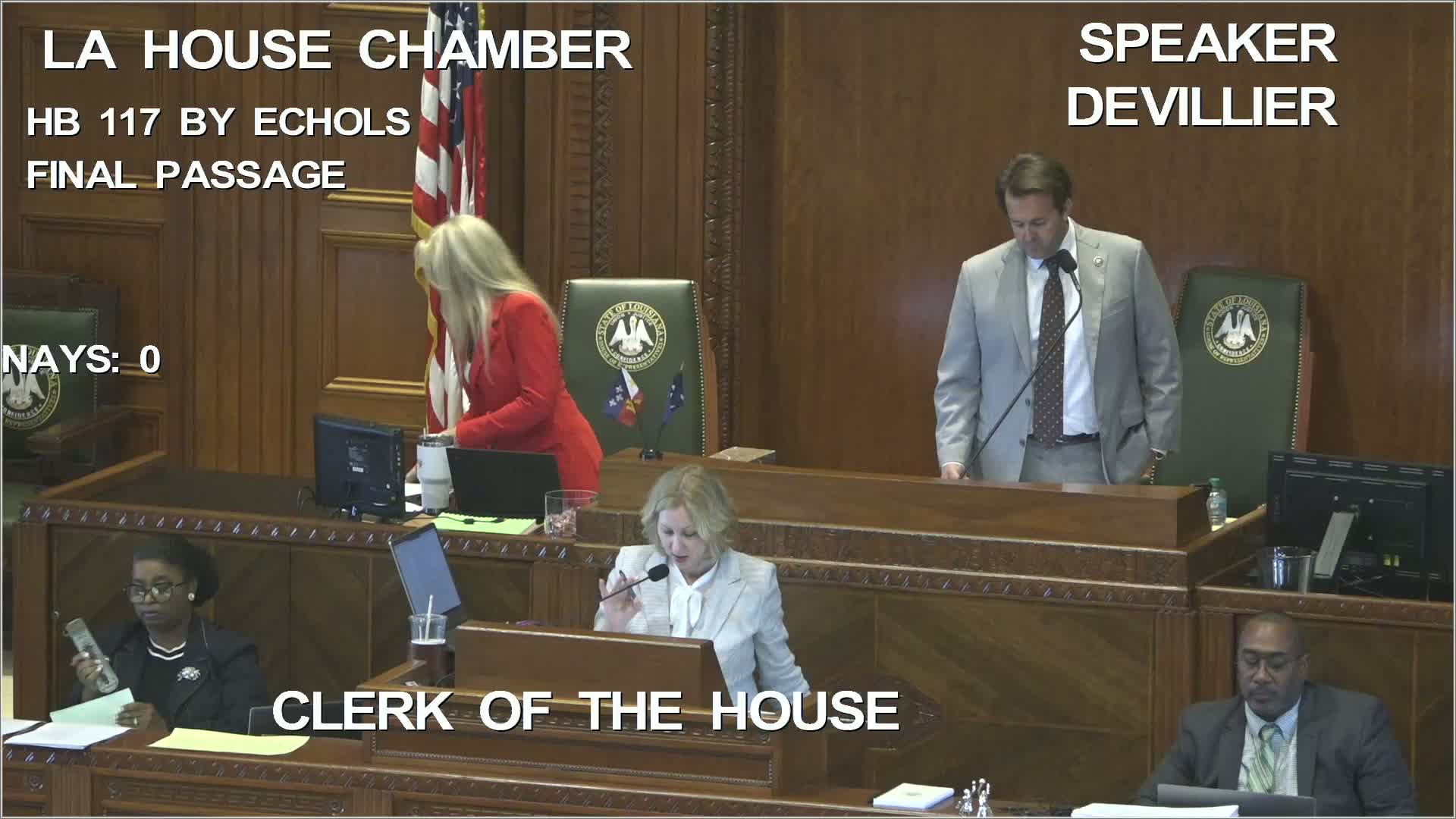
The Louisiana House on April 30 approved House Bill 117, directing the state secretary to update the workers' compensation medical reimbursement schedule and to promulgate a new fee schedule based on comparisons with similar regional states.
Representative Echols asked the House to approve House Bill 117, a measure directing the state to update its workers' compensation medical reimbursement schedule and to authorize the assistant secretary to promulgate that schedule.
Supporters said the existing fee schedule has not been updated in decades and hampers access to providers. "This is a bill that we passed last year, exact same bill that would allow the secretary to establish an updated fee schedule for the state and reduce administrative burden by providers," Representative Echols said on the House floor.
The bill instructs the secretary to compare Louisiana to "similar regional states" and to produce a schedule intended to make reimbursement rates more competitive in the South. Echols told members Louisiana currently ranks near the top nationally for workers' compensation costs and that modernizing reimbursement would help businesses and could expand the pool of providers willing to accept workers' compensation cases.
Opponents and questioners urged caution. Representative Willard pressed for detail about which "similar characteristics" should govern comparisons and whether Medicare-based formulas would be used; Echols responded that the secretary would review regional medical-cost benchmarks rather than adopt Medicare directly. Representative Laura Bedaine and other members raised concerns about implementation timelines and about whether the secretary could meet a near-term deadline cited in the fiscal note.
Echols acknowledged an administrative cost for the work, noting a fiscal estimate "indicating that it would cost maybe a hundred thousand dollars" to develop and implement the schedule; he said the department told the committee it could meet the statutory timeline. Members also questioned whether updating the schedule could raise fees for certain specialties; Echols said fee increases would be driven by data and by equipment or supply-cost changes, and that the bill is intended to improve access to care.
The House debated oversight questions, including who would appoint participants to the stakeholder group that helps develop recommendations. Echols said the bill assigns that role to the secretary and specifies the types of stakeholders to recruit; members pressed for additional procedural safeguards and committee oversight during implementation.
After extended floor discussion and a roll-call vote that followed a quorum lockout, the House recorded 61 yeas and 26 nays and the bill "finally passes." The measure will move on to the next stage of consideration.
Discussion vs. decision: The House decision was to pass HB 117 on final passage. The debate produced directions for executive-branch implementation (secretary-led stakeholder group, timeline) and requests for committee oversight, but it did not amend or delay the directive to promulgate a new reimbursement schedule.
What happens next: The secretary designated in the bill will carry out the study and rulemaking called for in the measure; the legislature retains the opportunity to review proposed rules and the new schedule when submitted.