Get Full Government Meeting Transcripts, Videos, & Alerts Forever!
Get email alerts on the Neighborhood Planning topic
No spam. Unsubscribe anytime.
Council directs staff to finalize Garden Hills neighborhood action plan after study-session presentation
Summary
City planning staff presented a draft strategic neighborhood action plan for Garden Hills, highlighting long-standing drainage needs, planned stormwater basins and a new neighborhood park. Council directed staff to finalize the plan, hold a plan commission public hearing May 7 and return for council consideration May 27.
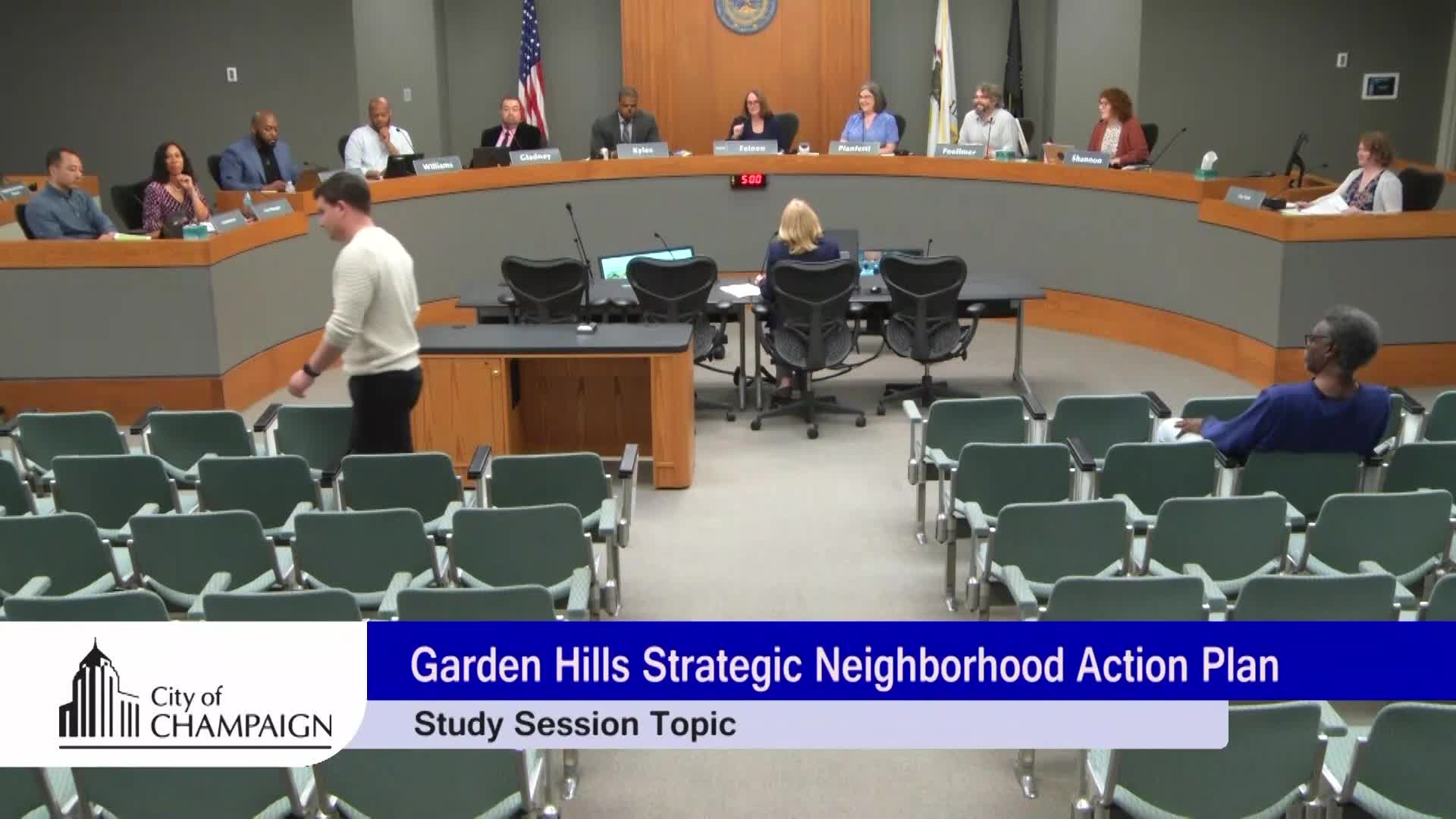
Planning staff presented a draft Garden Hills Strategic Neighborhood Action Plan at the Champaign City Council study session on April 22 and council members unanimously directed staff to finalize the document and pursue the next public-review steps.
Planning Manager Lacey Rainslow said the plan’s study-area boundary matches the tax-increment finance district boundary “so that over time, as goals and actions are identified, that perhaps the revenues from that TIF might be able to be used to complete those programs.” She told the council the plan bundles long-standing infrastructure needs, housing concerns and neighborhood programming into a single roadmap for action.
The draft responds to decades of attention to drainage and related infrastructure: Rainslow noted the neighborhood’s first drainage study was completed in 1982 and a more recent study in 2015 identified the Hedgerow Road site as the best location for stormwater basins. The city used a temporary engagement site, the Hedge Pop Park, on the larger Hedgerow site—described in staff remarks as more than 8 acres and roughly three-quarters of a mile long—to host outreach and youth activities during design work.
Rainslow said the stormwater retrofit design was adapted to include neighborhood amenities: raised crosswalks and raised intersections at key crossing points, sidewalks, bump-outs to shorten crossing distances, walking paths around basins, a splash-play feature, a playground, a basketball court, fitness stations, a reading circle and picnic areas. Staff described the permanent park footprint for neighborhood use as roughly an acre within the larger basin area.
The presentation paired qualitative feedback from residents with neighborhood-level data. Rainslow reported that about 65% of Garden Hills households have one or no car, about 40% of homes are owner-occupied, the neighborhood’s median household income is roughly $43,000 (compared with about $75,000 citywide), the neighborhood contains nearly 5,000 residents and roughly 2,200 housing units. Staff also said residents are twice as likely to receive SNAP benefits than citywide averages, and cited concerns raised about housing condition, asthma-related emergency visits and displacement risk as infrastructure investments proceed.
Rainslow briefed the council on partnerships and funding: the plan packages infrastructure work with the city’s Complete Streets policy requirements (sidewalks, street trees and lighting when streets are rebuilt), notes that American Rescue Plan Act (ARPA) one-time funds accelerated work, and highlights opportunities to use TIF revenues where appropriate. She said earlier project outreach included Spanish-language materials and bilingual staff to improve engagement.
Council members asked how the plan addresses displacement and homeownership pathways. Rainslow said those topics need further analysis. “That particular issue needs more analysis to determine what is the right fit for our community,” she said, explaining staff had recommended a citywide housing study and additional stakeholder engagement to identify program options.
Council members also pressed for continued coordination with the Champaign Park District on programming at the permanent park site and with the Champaign-Urbana Mass Transit District on placing shelters where sidewalk improvements create ADA-accessible pads. Rainslow said preliminary coordination with MTD has identified potential shelter locations; she noted some arterial streets near Garden Hills—Bloomington Road, Prospect Avenue and Mattis Avenue—are under Illinois Department of Transportation jurisdiction and would require additional cooperation for corridor-level changes.
After staff comments and extended council discussion, the council signaled unanimous support for staff to finalize the draft plan, address council comments and proceed with a plan commission public hearing scheduled for May 7 and potential council adoption on May 27. Council members and staff emphasized implementation will be phased and contingent on funding and intergovernmental agreements.
The plan lists 10 priority actions, led by sidewalk and intersection improvements, redevelopment analysis for commercial/industrial parcels, a communitywide housing study, tenant and property-improvement programs, programming partnerships for park activation, and further analysis of emergency-call data through public-safety partners. Implementation tasks include stakeholder interviews, continued outreach and coordination with Park District programming and with departments for infrastructure design and funding.