Get Full Government Meeting Transcripts, Videos, & Alerts Forever!
Get email alerts on the Hate Incident Response topic
No spam. Unsubscribe anytime.
State Police describe new HEART unit, outreach and a planned hate‑incident portal as reports of antisemitic crimes rise
Summary
The Massachusetts State Police outlined the mission and early progress of HEART (Hate Crimes Awareness and Response Team), partnerships with community groups and federal agencies, and plans for a CJIS‑based hate‑incident reporting portal.
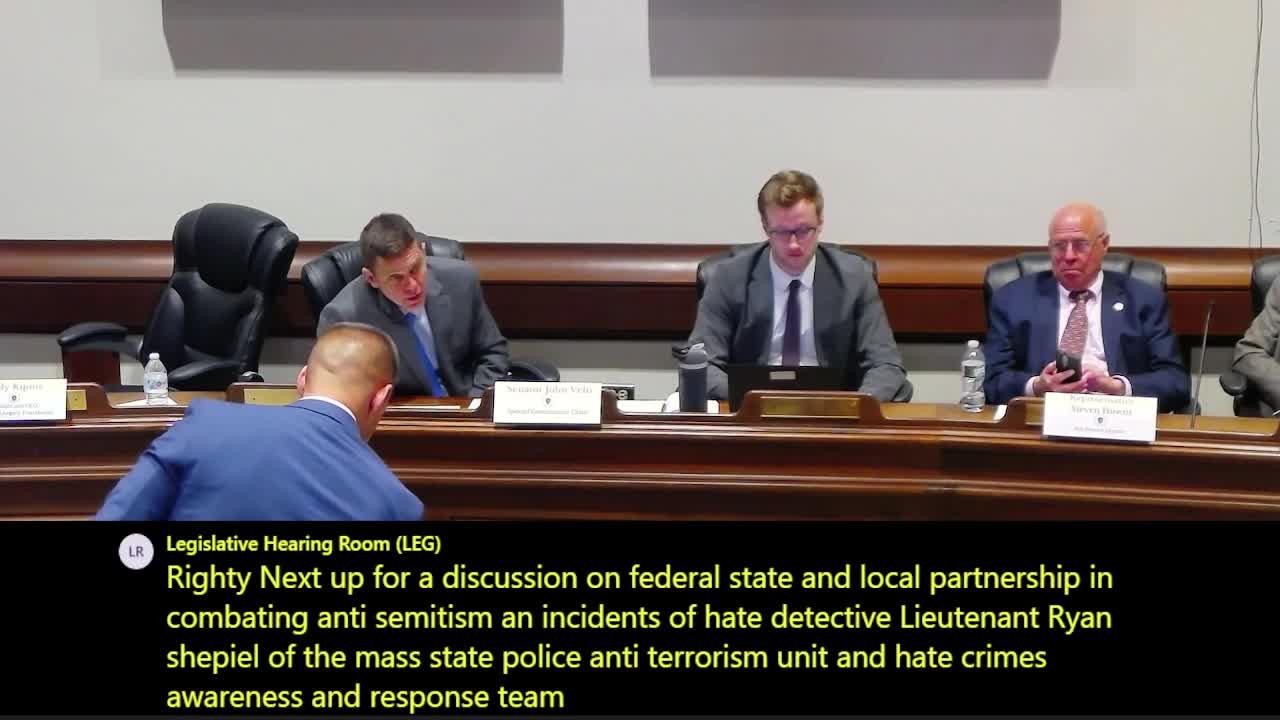
Detective Lieutenant Ryan Seapial, commander of the Anti‑Terrorism Unit’s HEART team, told the Special Commission on Antisemitism that the unit is building statewide capacity to track hate incidents, support local investigations, and coordinate with federal and community partners.
Seapial said HEART has contacted 399 agencies to confirm civil‑rights officers, created a Microsoft Teams page to share training and resources, and is developing a CJIS‑based hate‑incident reporting portal with a tentative live date of June 24, 2025. He described HEART’s partnerships with the ADL, Secure Community Network, Combined Jewish Philanthropies, local police departments, the FBI, and federal civil‑rights prosecutors. He credited those partnerships with investigative and community outcomes, including the arrest in a plot to shoot people outside a synagogue in which HEART assisted federal and local partners.
Seapial said HEART has one sergeant and five troopers assigned geographically (one each in Worcester, Lowell, Lakeville, and two in Chelsea) and that the unit uses NIBRS data while building improved reporting capacity. He provided NIBRS counts showing a year‑over‑year increase in reported antisemitic hate crimes in the Commonwealth: 51 (2020), 68 (2021), 123 (2023), and 147 (2024), with a limited current figure due to reporting lags. Seapial emphasized training for patrol officers and civil‑rights officers, victim resources and referrals, and the unit’s role as a “force multiplier” for local investigations.
In questions, commissioners asked about geographic coverage, the portal’s reporting requirements, and outreach to smaller or rural communities. Seapial said there is coverage across the state — including ATU resources based out of Springfield — and that the portal will include fields for residence status to help analysts track whether incidents involve in‑state residents or external agitators. He said there is no statutory mandate for local departments to notify HEART, making outreach and relationships central to improving reporting.