Get Full Government Meeting Transcripts, Videos, & Alerts Forever!
Get email alerts on the Hate Crime Law topic
No spam. Unsubscribe anytime.
Essex County prosecutor outlines federal and Massachusetts statutes used to prosecute bias‑motivated crimes
Summary
Essex County Assistant District Attorney Dave O'Sullivan briefed the commission on federal and state hate‑crime statutes, their elements, and practical limits prosecutors face when pursuing bias‑motivated offenses.
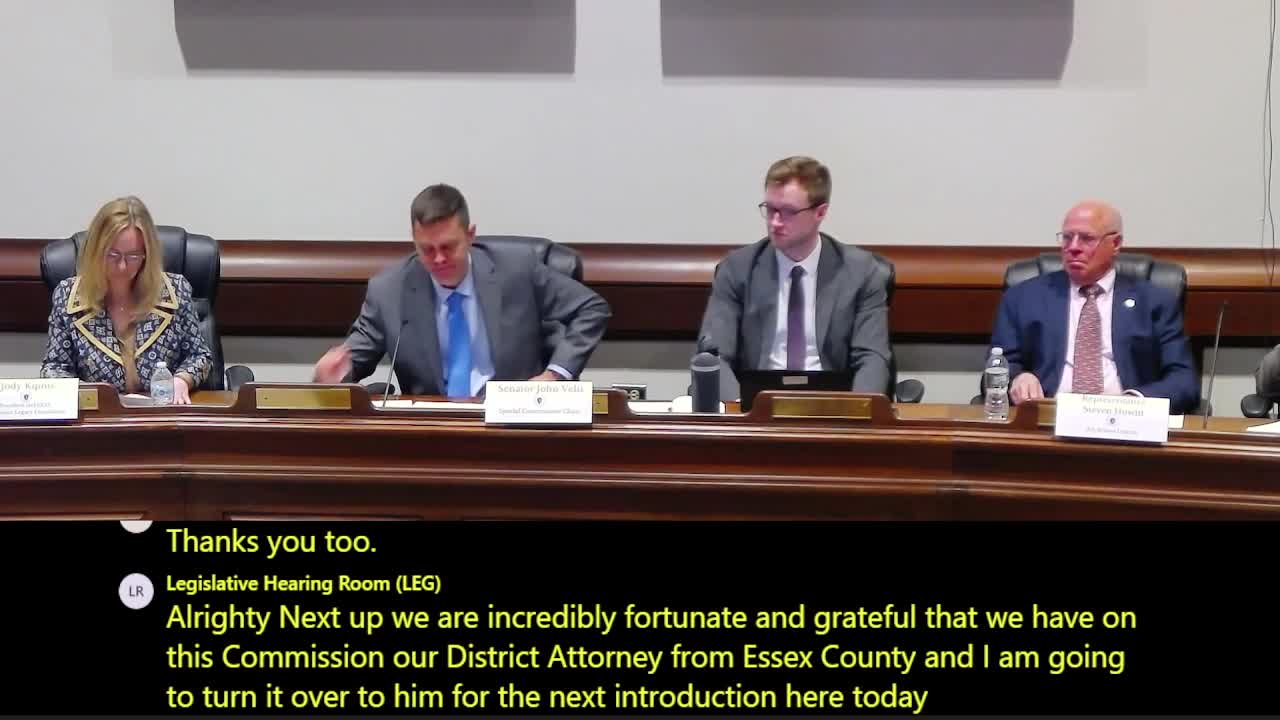
Dave O’Sullivan, Deputy Chief of Appeals in the Essex County District Attorney’s Office, told the Special Commission on Antisemitism that federal and Massachusetts statutes offer a range of criminal tools for bias‑motivated offenses but that each has different elements and practical limits.
O’Sullivan reviewed federal statutes including the federal Hate Crime Act (18 U.S.C. §249) and the civil‑rights violation statute (18 U.S.C. §245), noting that federal prosecution sometimes requires written certification by the U.S. attorney general if the state has not pursued the case. He described other federal tools — conspiracy and color‑of‑law provisions, the Church Arson Prevention Act, the Freedom to Access Clinic Entrances statute, and the Hate Crime Statistics Act — and said those statutes provide enhanced penalties in specific circumstances.
On Massachusetts law, O’Sullivan summarized the State’s hate‑crime framework and reporting statutes (G.L. c. 22C §§32–35) and explained that the Commonwealth’s civil‑rights violation statute (G.L. c. 265 §37) and the assault‑and‑battery‑to‑intimidate statute (G.L. c. 265 §39) can be charged in bias‑motivated cases. He said Chapter 22C categorizes and tracks hate crimes but “does not create a freestanding crime” or specify penalties; instead, bias motivation generally enhances penalties for underlying offenses.
O’Sullivan addressed the tension between First Amendment speech protections and criminal liability, citing Brandenburg v. Ohio as the standard for incitement that may be prosecuted if it is intended and likely to produce imminent lawless action. He also discussed the “terroristic threat” statute and explained his office’s reading that those statutes do not automatically satisfy the state’s 58A dangerousness detention criteria because they may be satisfied by threats against property rather than force against a person.
Commissioners posed hypotheticals about whether specific conduct (for example, a defendant wearing a Confederate flag while assaulting a Black person, or yelling “Hitler should have finished the job” at a Jewish victim) would be chargeable under state hate‑crime statutes. O’Sullivan said these scenarios would likely be examined closely and, depending on the facts, could be charged under G.L. c. 265 §37 or §39, but stressed the need to review each case’s facts before charging decisions.
He urged improved training for front‑line officers and better victim‑centered processes to increase reporting and improve prosecutors’ ability to prove motive and sustain prosecutions. O’Sullivan also flagged statutory and investigative gaps — for example, reporting inconsistencies to the state’s NIBRS system and limits on present statutory predicates for pretrial dangerousness detentions — that affect how prosecutors pursue bias‑motivated crimes.