Get Full Government Meeting Transcripts, Videos, & Alerts Forever!
Get email alerts on the Ccrc Entrance Fees topic
No spam. Unsubscribe anytime.
Commission hears calls for clearer rules on CCRC entrance‑fee refunds, reserves and ownership changes
Summary
Commission members, providers and advocates debated whether state rules should require clearer refund timelines, minimum reserve levels and stronger protections when CCRCs sell or change ownership; providers warned that rigid rules could hinder development.
Commissioners and stakeholders at the special commission on continuing‑care retirement communities spent substantial time debating entrance fees, refund timing and protections for residents when a community changes ownership or closes.
Several attendees said contract language on refunds can be vague. “When does that get returned and under what conditions does that get returned? And that is not clearly defined by the state,” said a representative of MALCRA during public comment. Commissioners and operators agreed that disclosure at admission is common, but the terms and timing of refunds vary by community.
Some members urged minimum reserve requirements to ensure timely repayment. “It would not be unreasonable for us to recommend that any existing CCRC should have should maintain a reserve sufficient to provide timely reimbursement,” said John (participant), arguing that withholding refunds until another resident’s entrance fee is collected can resemble a Ponzi‑like practice.
Operators cautioned that rigid payback timelines could threaten development and ongoing operations. “If it’s guaranteed to be paid back in 60 days . . . you’d put the community in jeopardy quickly,” said a CCRC operator (Jim, participant), noting that entrance‑fee models often fund capital and that rapid repayment requirements can create liquidity pressures for a community.
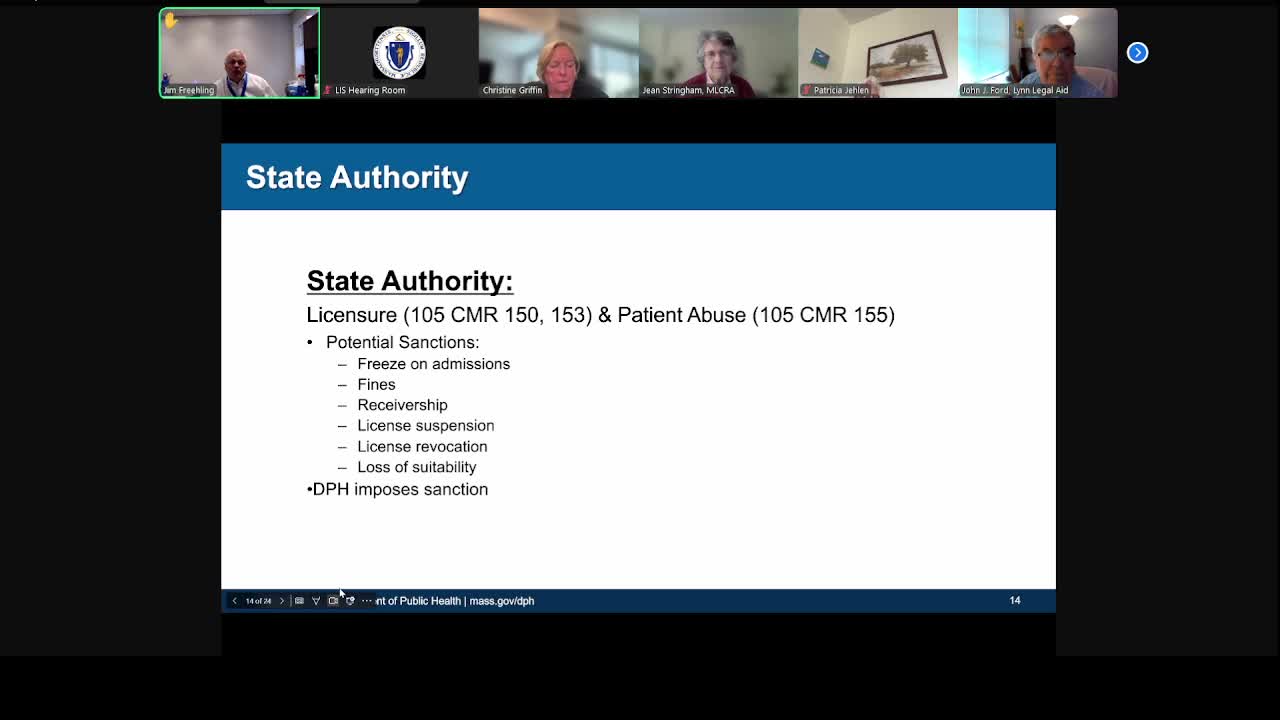
Panelists also discussed ownership transfers and closures. Participants noted a high national profile for sales that reduced refund percentages or raised fees after a purchase; one participant referenced a widely reported sale in which a new owner increased monthly charges and changed refund terms. The group discussed state procedures for licensed nursing‑facility closures, which must follow DPH’s closure and transfer rules, and flagged the larger problem that those rules do not fully address what happens to residents living in the independent portion of a community if on‑site skilled nursing is eliminated.
Commission members requested further analysis: a count of how many CCRCs have on‑site nursing homes, a list of nonprofit versus for‑profit CCRCs, and documentation on the causes of recent receiverships. A participant cited a state tally: “out of the 29 CCRCs, 22 are nonprofit. So there’s 7 that are for profit,” and DPH staff said they would provide data on how many CCRCs have licensed nursing components.
Why it matters: Entrance fees and refund rules govern large sums paid by older adults and their families. Ambiguous contract terms and changes after sales can materially affect residents’ finances and the financial stability of communities.