Get Full Government Meeting Transcripts, Videos, & Alerts Forever!
Get email alerts on the Ccrc Regulation Oversight topic
No spam. Unsubscribe anytime.
Commission: Massachusetts oversight of continuing-care retirement communities is patchwork of state and federal rules
Summary
State and federal officials told a legislative special commission that oversight of continuing-care retirement communities (CCRCs) in Massachusetts is split among multiple agencies and laws, leaving gaps in consumer protections and inconsistent disclosures about services and care levels.
At a meeting of the special commission on continuing-care retirement communities, researchers and state officials described a fragmented oversight framework that leaves some CCRC services regulated and others exempt.
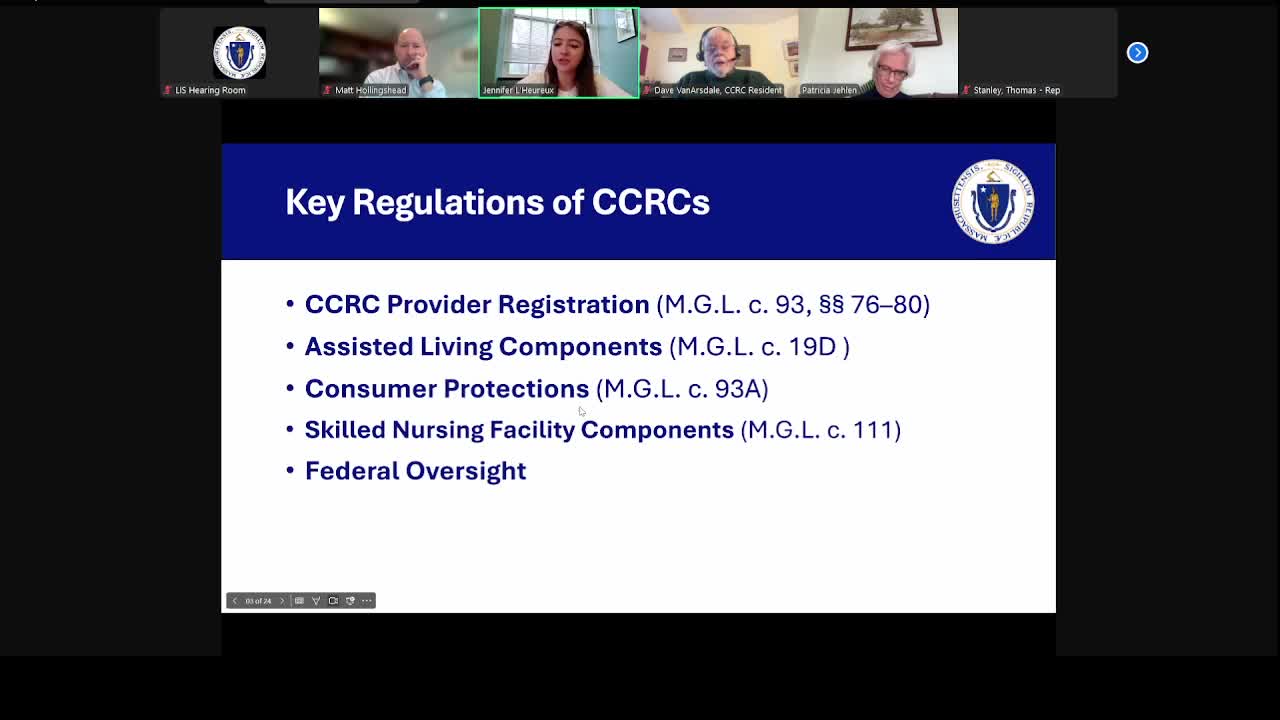
Representatives from the Executive Office of Aging and Independence, the Attorney General’s Office and the Department of Public Health told the panel that different parts of a typical CCRC—independent housing, assisted-living–style services and licensed nursing facilities—are governed under different rules and by different agencies.
The distinction matters because state assisted-living regulations do not automatically apply to CCRCs. “Our assisted living regulations, 650,112, specifically exempt CCRCs,” said Shavonn Coyle, a lawyer with the Executive Office of Aging and Independence. Coyle said the office nevertheless requires CCRCs to file marketing materials, contracts and disclosure statements and posts those documents on the agency website when communities forward changes.
The Attorney General’s Office emphasized consumer-protection statutes. “CCRCs must comply with the Massachusetts consumer protection laws, which prohibit unfair or deceptive business practices in their marketing, in their contract terms, and also in their delivery of services,” said Jennifer Larew, researcher for the joint committee on aging and independence, referencing the state consumer-protection framework cited to chapter 93 and related authority in the discussion.
Nursing facilities associated with some CCRCs are separately licensed and certified. “We at the division of health care facility licensure and certification . . . oversee nursing facilities,” said Steve Davis of the Department of Public Health (DPH). He told commissioners that DPH conducts federal certification surveys for CMS, generally on a 9–15 month cadence, and that DPH regulates roughly 350 nursing homes (and about 58 stand‑alone rest homes) in the Commonwealth. Davis also said about 17 nursing homes were in receivership at the time of the meeting.
Panelists and members repeatedly noted the absence of a single, consistent definition or regulatory framework that makes it easy for consumers to compare CCRCs. “I don’t think we have any framework that has encouraged that or required that to happen,” said Secretary Lipson, urging more consistent disclosure so prospective residents could compare which communities provide on‑site skilled nursing, contractual relationships with off‑site providers, or other services.
Commission members and agency staff outlined the enforcement tools that do exist: DPH licensing and surveys for nursing facilities, AG enforcement under consumer‑protection law, and the community care ombudsman program that assists older adults across settings. They also flagged limitations: the Executive Office’s posting of disclosure statements does not amount to state vetting of every claim, and assisted‑living regulations apply only where a CCRC markets assisted‑living units separately from the CCRC contract.
The commission scheduled follow‑up work on financial viability, disclosures and consumer protections at its next meeting and set a public hearing for June 16. Staff said slides and the posted disclosure statements would be circulated to commissioners.
Why it matters: The split oversight affects what protections and complaint pathways are available to residents and prospective residents. Consumers may see different rules and recourse depending on whether services are held out as assisted living, are part of the CCRC contract, or fall under a licensed nursing facility.