Get Full Government Meeting Transcripts, Videos, & Alerts Forever!
Get email alerts on the Fafsa Completion topic
No spam. Unsubscribe anytime.
Advocates push universal FAFSA completion policy, citing unclaimed federal aid and completion gaps
Summary
Witnesses urged the committee to support H1467/S921 to require students be offered FAFSA completion or opt‑out at graduation, citing Massachusetts students left more than $63 million in federal aid unclaimed and completion gaps between high‑ and low‑income districts.
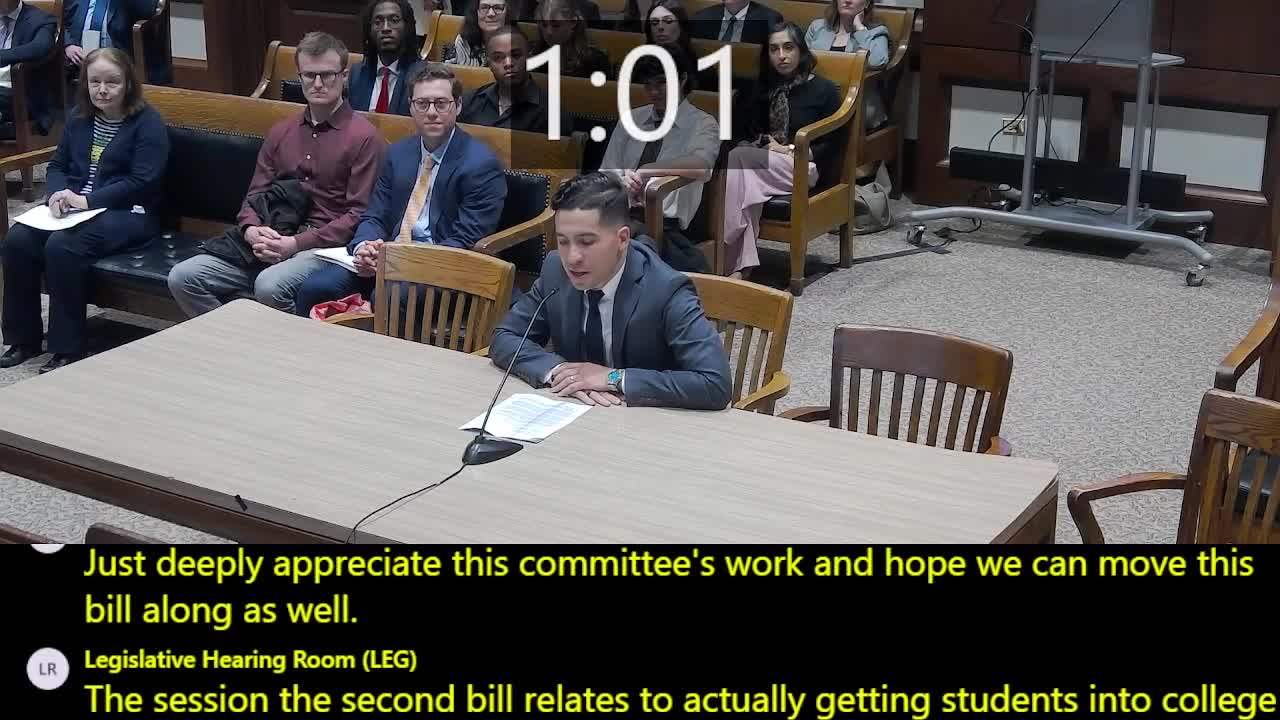
Representative Vargas and other sponsors described H1467/S921 as a policy to facilitate student financial assistance by ensuring students either complete the FAFSA or explicitly opt out prior to high‑school graduation.
“Students and families need support with financial aid applications,” Demi Stolz, Massachusetts policy director at U Aspire, told the committee. Stolz said the bill creates a FAFSA trust fund (when funded) to support workshops and application assistance for students often without family experience of college application processes.
Witnesses cited recent data showing FAFSA completion rates have fallen statewide and that Massachusetts students left roughly $63,000,000 in federal aid unclaimed in a recent year. Ed Trust Massachusetts’ Shanti Lopes told the panel that FAFSA completion in the state peaked near 60% and has fallen to about 52%, with larger drops since 2019; she said Louisiana’s universal FAFSA policy led to double‑digit completion gains after implementation.
Advocates emphasized equity. Stolz said fewer than 38% of low‑income students completed FAFSA last year (testimony) and that the result was unclaimed federal and state aid that would otherwise help students attend college. Sponsors explained the bill seeks a low‑burden approach: students would be required to fill out the form or opt out and would not have to state a reason for opting out.
Committee members and witnesses discussed the effect of the federal FAFSA redesign, which several witnesses said made the form easier to complete after an initial bumpy rollout, but they stressed the need for in‑person help for first‑generation families, translation and targeted outreach.
No committee vote was recorded at the hearing; witnesses asked the committee to report the bill favorably and to consider funding a state trust for application assistance and support.