Get Full Government Meeting Transcripts, Videos, & Alerts Forever!
Get email alerts on the Early College topic
No spam. Unsubscribe anytime.
Lawmakers, advocates press to scale early college programs to reach tens of thousands of students
Summary
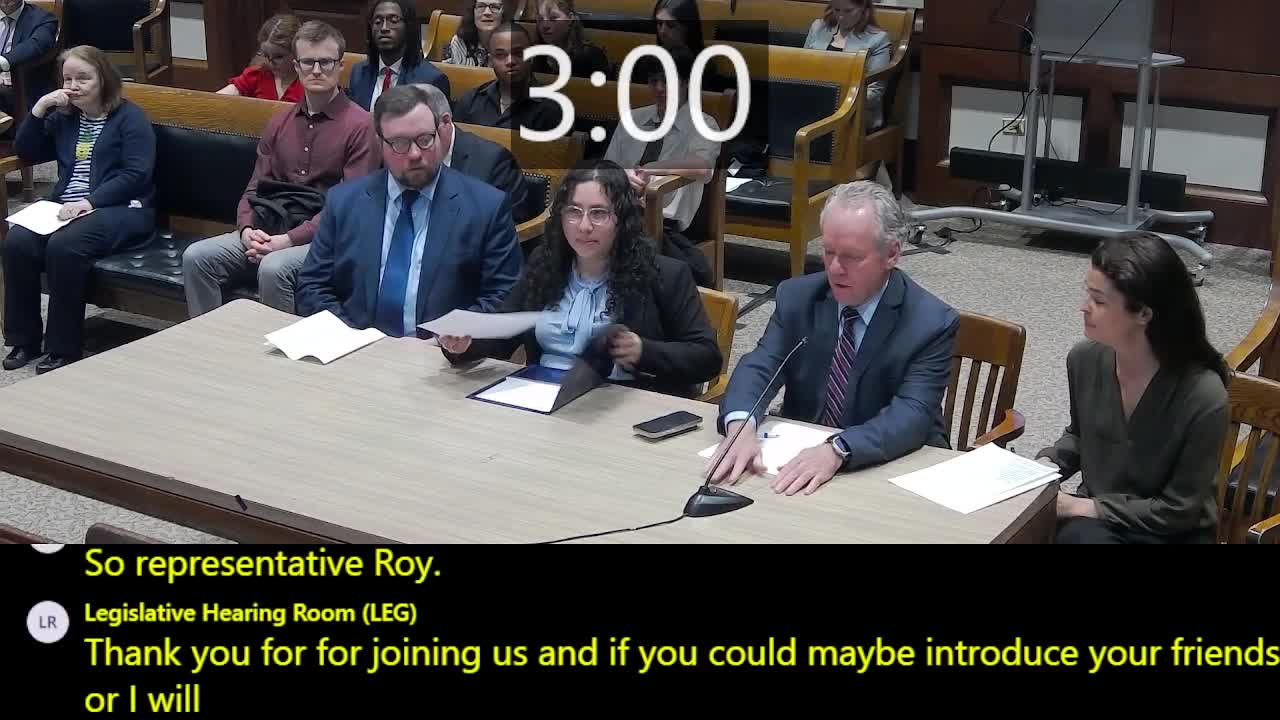
Representative Roy told the Joint Committee on Higher Education he filed H1455, “an act relative to college and high school,” as a “road map for success” to expand college‑level opportunities for high school students across the Commonwealth.
Representative Roy told the Joint Committee on Higher Education he filed H1455, “an act relative to college and high school,” as a “road map for success” to expand college‑level opportunities for high school students across the Commonwealth.
The bill would expand designated early college partnerships, create governance and funding structures, and aim to increase degree attainment, reduce the cost of higher education and strengthen career pathways, supporters said.
Chastity Mosley, deputy director of the Massachusetts Alliance for Early College, told the committee the alliance represents more than 120 organizations and described early college as “the most effective program we have to successfully break these silos” between K‑12 and higher education. “Graduates are two times as likely to earn a college degree,” she said, while noting the program currently serves roughly 9,000 students across about 55 partnerships.
Melanie Serene Aldana, an early college graduate who testified to the panel, described one student’s experience: “One program gave me a shot. One opportunity changed the way I saw my future,” she said, and urged lawmakers to expand the program so others get similar “one chance.”
Business and workforce representatives urged closer ties to industry. James Michalowski, director of policy for the Massachusetts Business Alliance for Education, recommended more career‑themed early college programs aligned with regional labor market needs, saying employers need graduates with “skills and knowledge needed to enter their industries.”
On scaling, witnesses and committee members discussed concrete targets and costs. Alliance witnesses said state planning documents envision reaching about 22,000–25,000 students by 2030 by adding roughly 40 partnerships and increasing participation within existing partnerships; one witness estimated that reaching tens of thousands of students at scale could cost on the order of “somewhere around $60,000,000” overall. Tripp Jones, an adviser to the alliance, added that hybrid instructional models and public‑private partnerships could help expand capacity without requiring traditional expansion of campus seats.
Committee members and witnesses also pressed for statutory protections on credit transfer and consistency across institutions. One member noted the risk that a student could earn AP or early college credit at a local institution but face different transfer policies at another public university, and urged uniform standards for accepting credits so students are not “caught on the switches.” Witnesses and bill sponsors said the bill would create a governance structure and data collection to track growth, costs and student outcomes.
Supporters framed the bill as an equity measure: testimony highlighted that low‑income and first‑generation students are less likely to earn college credentials, and that early college can substantially increase degree attainment for those groups. Witnesses recommended embedding research and accountability into the statute to monitor impacts, funding needs and workforce alignment.
The committee did not vote on the bill at the hearing. Sponsors and advocates requested follow‑up staff work on costs, transfer protections, and a multi‑year implementation plan.
Ending: Sponsors asked the committee for “favorable action” and invited further technical meetings on funding and implementation to align early college with workforce needs and institutional capacity.