Get Full Government Meeting Transcripts, Videos, & Alerts Forever!
Get email alerts on the Workforce Data Sharing topic
No spam. Unsubscribe anytime.
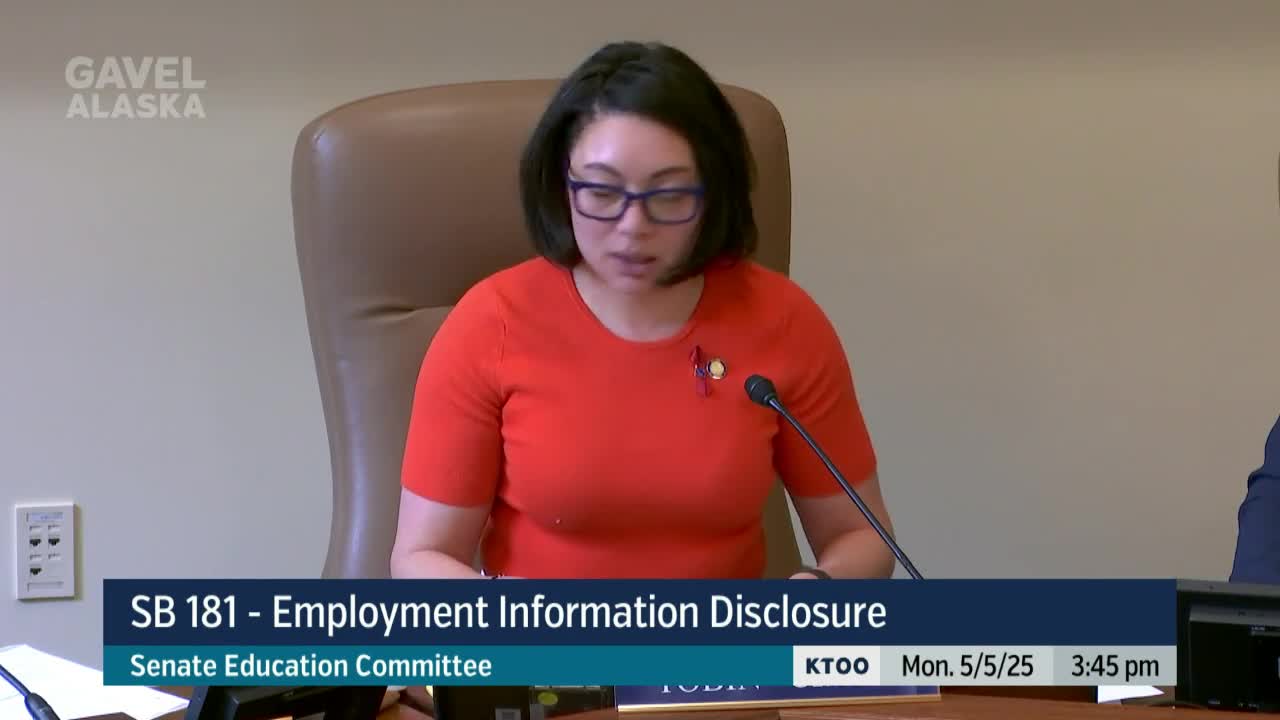
Senate committee hears testimony on bill to streamline state labor data sharing with University of Alaska
Summary
Senate Education Committee heard experts and labor officials on SB 181, which would authorize the University of Alaska and the Department of Labor to share unemployment-insurance-based employment microdata for research while requiring cost recovery; committee set the bill aside for later consideration.
Juneau — The Senate Education Committee heard invited testimony on Senate Bill 181 on Feb. 5, a measure sponsored by the Joint Task Force on Evaluating Alaska's Seafood Industry that would create statutory authority for the University of Alaska and the Department of Labor and Workforce Development to share detailed employment records for research.
Supporters said the change would let state researchers use Department of Labor microdata to analyze program outcomes and economic effects in Alaska more quickly. Brett Watson, an economist at the University of Alaska Anchorage's Institute for Social and Economic Research, told the committee the bill would “streamline data access for researchers working on Alaska specific policy issues.”
The bill would make it easier for university researchers and state economists to link unemployment-insurance administrative records — which include employer reports of worker counts, Social Security numbers and wages — to study outcomes such as program returns on investment, workforce impacts and fisheries-related labor trends. Watson said federal sources such as the U.S. Census and Bureau of Labor Statistics often lack the sample size or timeliness to analyze many Alaska communities, and that SB 181 would “unlock the value of existing data that the state is already producing.”
Dan Robinson, research chief at the Alaska Department of Labor and Workforce Development, described the source of the data and its existing uses, saying the records are collected under state unemployment insurance reporting and are used for program administration and verification tasks including public assistance and child support. Robinson noted Alaska’s datasets are “richer than normal” because of local administrative features and said the department has provided data to university researchers under ad hoc arrangements but that statutory authority would simplify collaboration.
Coloma Harbor, director of the Division of Employment and Training Services, walked the committee through the fiscal note and said the bill itself carries a 0 fiscal note for the department but that the federal grant that helps run unemployment insurance cannot pay for data-sharing costs. Harbor told the committee that any outside agency or university that requests access would need to cover the department’s costs through interagency receipts and that similar agreements have ranged from about $1,300 up to nearly $50,000 depending on volume and frequency.
Tim Lampkin, staff to the task force, said he would “look forward to working on it going forward,” after the invited testimony concluded. The committee opened and then closed public testimony on SB 181 with no members of the public speaking, and the chair set the bill aside for consideration at a later date.
Discussion versus decision: the hearing consisted of invited testimony and explanation of the fiscal implications; the committee took no formal vote on SB 181 and did not adopt any amendments at this meeting. The committee did ask witnesses to follow up with cost and operational details before further action.
Implementation details and next steps were left unspecified: Harbor said the exact cost would depend on the amount of data and frequency of sharing and that the University of Alaska would need to provide funding for any data-exchange arrangement. The department and university will need to negotiate interagency agreements to cover technical and confidentiality safeguards before access would begin.
Background: SB 181 stems from recommendations of the Joint Task Force on Evaluating Alaska's Seafood Industry (Fishforce). Proponents said the ability to link program inputs and long-term outcomes will help lawmakers evaluate the return on investment of education and workforce programs when crafting future budgets and policy.