Get Full Government Meeting Transcripts, Videos, & Alerts Forever!
Get email alerts on the Sewer Services Outside Limits topic
No spam. Unsubscribe anytime.
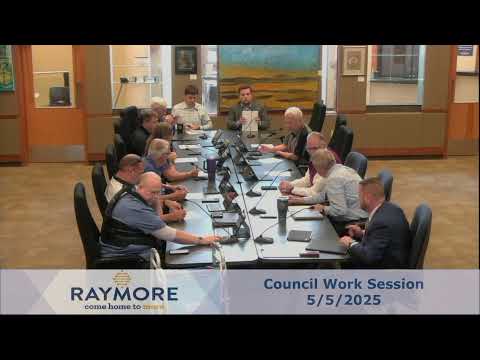
Raymore staff ask council to set rules for city sewer hookups outside city limits
Summary
City staff asked the Raymore City Council on May 5 for direction to standardize agreements and city-code language allowing property owners outside the city to connect to Raymore sanitary sewer lines, seeking to require waivers of protest against future annexation and to create consistent application forms and payback rules.
Raymore City staff asked the City Council on May 5 for direction to develop standardized agreements and city-code changes that would govern provision of sanitary sewer service to properties outside city limits.
City staff said the issue has come up repeatedly and that the city already serves some noncontiguous properties. “We do have an established rate for properties that are outside the city limits,” Mr. Gress, a city staff member, told the council, citing the city’s current charge of $9.32 per 1,000 gallons for in‑city customers and $11.65 per 1,000 gallons for customers outside the city.
The discussion matters because some county properties lie along Raymore sewer mains — including the Alexander Creek interceptor and a trunk line installed in February 2009 to serve the Ray‑Pec school campus — creating opportunities for owners with failing septic systems to connect to the city system. Staff described a reimbursement arrangement tied to the 2009 trunk line under which the school district initially financed the upsized sewer and is repaid over time as other properties connect; connections are paid to earlier connectors and to the district in a “waterfall” formula.
Staff outlined a local precedent in the Dutchman Acres subdivision, where the city serves nine of 64 lots. Council members and staff noted that agreements for those hookups vary, and some past agreements do not include a waiver of the property owner’s right to protest annexation.
“It seems to make sense to make it consistent,” Councilmember Nelson said, arguing that any extension of city services to properties outside the limits should include an agreement that the property owner will not contest future annexation.
Staff told the council the city has the physical capacity to serve additional hookups and that upfront construction and connection costs would fall to the property owner; inspection would be performed by city staff. Mr. Salisbury, a city staff member, said full replacement of a septic system is typically “tens of thousands” of dollars, a cost that owners sometimes seek to avoid by hooking up to sewer.
Council members raised several policy questions: whether the council wants staff to bring a wholesale code change or to handle requests case‑by‑case, whether older agreements should be revisited, and whether the city should require a waiver of protest against annexation for all future out‑of‑city hookups. Staff asked for direction to draft application forms and proposed city‑code language and to return to the council with recommendations.
No formal motion or vote was taken; council members generally expressed support for standardizing agreements and adding code language to memorialize a prohibition on protesting annexation for properties that accept sewer service. Staff said it will prepare draft forms and code revisions for future council consideration.