Get Full Government Meeting Transcripts, Videos, & Alerts Forever!
Get email alerts on the Historic Preservation Deconstruction topic
No spam. Unsubscribe anytime.
Salina Heritage Commission hears presentation on ‘deconstruction’ as an alternative to demolition
Summary
City staff shared a State Historic Preservation Office presentation on deconstruction — hand‑disassembly of buildings to salvage materials — and commissioners discussed local hurdles including landfill capacity, salvage rights and workforce needs.
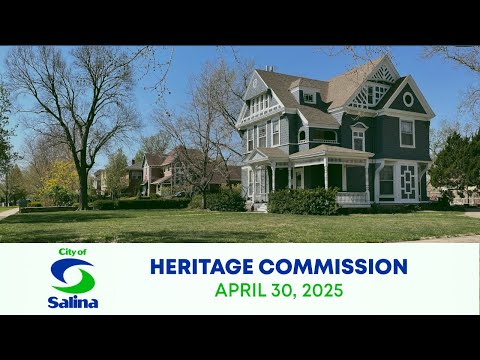
Salina — At its April 30 meeting, the Salina Heritage Commission received a staff presentation from material provided by the State Historic Preservation Office about “deconstruction” ordinances used by some U.S. cities as an alternative to mechanical demolition.
Commissioners heard that deconstruction requires disassembling parts of buildings by hand to recover materials for reuse rather than sending them to a landfill. “Deconstruction is not about preserving necessarily structures,” the staff presenter said, “but it’s more about preserving space in the landfill and also about preserving historic building materials for potential reuse.”
The presentation summarized examples from other cities, most extensively San Antonio, Texas, where staff said an ordinance phased in beginning with older homes (1920–1945, then 1945–1960) and the city has reported “120 plus buildings” deconstructed since the ordinance’s adoption in 2022. Presenters and commissioners cited programs that paired ordinance requirements with workforce training, Habitat-for‑Humanity-style reuse outlets and grant funding to subsidize the extra labor deconstruction requires.
Commissioners and staff discussed practical barriers for Salina. Staff said local landfill capacity often limits how much demolition material contractors can take in a single day — in some cases contractors reach their accepted allotment “by 9:00 in the morning with two or three loads,” which slows removal work. Staff also noted demolition contractors typically control salvage rights and decide what materials are set aside, which affects whether recovered materials are available to the public or reused by nonprofits.
Commissioners asked about logistics and market demand for salvaged materials. One commissioner warned that reused lumber may not match modern nominal dimensions, making reuse more complex than it appears. Staff and another commissioner said successful programs elsewhere required a “network” — trained labor, accepted storage/processing sites for materials, and organizations (for example, reuse stores run by Habitat affiliates) to take and redistribute salvaged items.
Staff emphasized that deconstruction can be time- and labor-intensive compared with mechanized demolition and that a citywide ordinance would require substantial operational and funding commitments. The presenter said the Heritage Commission could instead consider case-by-case measures — for instance, requiring a deconstruction plan when a particularly unique or notable historic structure is proposed for demolition, rather than adopting a citywide mandate.
Commissioners and staff also reviewed recent local demolition experience and process: city staff described two permit types (voluntary demolitions and city-initiated dangerous-structure demolitions), estimated roughly a dozen voluntary small-structure demolitions a year and about 10 full-building demolitions annually, and explained how the city may order demolition and place a lien on the property to recover costs when owners do not act.
The presentation materials and a longer panel video from the State Historic Preservation Office will be distributed to the commission for members who want more detail on program design and examples from other cities.
Staff said the materials were provided for education and discussion only; no ordinance or formal recommendation was proposed at the meeting.