Get Full Government Meeting Transcripts, Videos, & Alerts Forever!
Get email alerts on the Ppa Operational Agreement topic
No spam. Unsubscribe anytime.
Lake Agassiz meeting pauses plan to transfer PPA drafting authority after dispute with Garrison Diversion
Summary
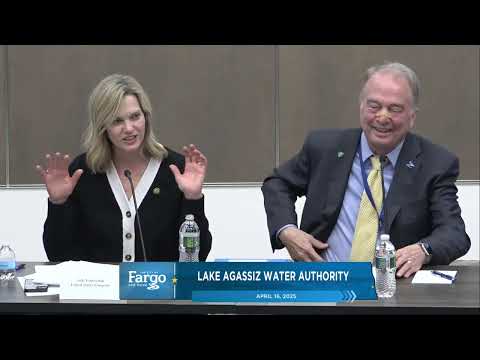
Lake Agassiz Water Authority members heard a third-party review of the project participation agreement and operating plan, considered a motion to authorize LAWA to draft key agreements and technical elements, and then rescinded the motion after objections from Garrison Diversion and their counsel over existing agreements and process.
Lake Agassiz Water Authority members heard a technical and legal critique of the Red River Valley Water Supply Project's project participation agreement (PPA) and operating plan and briefly moved to authorize LAWA to take lead on drafting project agreements before rescinding that authorization amid objections from Garrison Diversion.
The LAWA board invited water-rights attorney Brian Nazarinas and engineer Shane Coors of Precision Water Resources Engineering to present an outside review of the PPA and the draft Operational Plan 2. Nazarinas told the board that LAWA members “should have control over the project after an agreed upon break point” and recommended that LAWA contract on behalf of members with Garrison Diversion for delivery of project water to that break point. He also urged water-supply contracts with the U.S. Army Corps of Engineers for storage and release from Lake Ashtabula, and said an operational plan acceptable to LAWA members should be developed before final participation agreements are executed.
Why it matters: LAWA members and project participants will live with multi‑generational contracts and scarce water in dry years. Nazarinas and Coors told the board that unresolved items — how Thompson acre (Thompson Acker) accounts are administered, how Lake Ashtabula releases are prioritized, dispute-resolution language, and forward-looking forecasting/accounting tools — should be settled before parties sign final participation agreements.
Coors said the draft operational plan focuses on who makes decisions but lacks detailed criteria the operators would use in drought phases. He recommended modern, purpose-built water-accounting and forecasting tools instead of ad-hoc spreadsheets so participants can see forward projections for their actual water supply rather than rely solely on operator judgment.
The presentation prompted an immediate procedural response. Mayor Brandon Bochenski (Mayor of Grand Forks) introduced a motion (read into the record as “Motion 1”) directing LAWA—with assistance from Grand Forks, Fargo and LAWA counsel—to assume control of drafting agreements and technical matters for project operation, including a LAWA–Garrison agreement for delivery, a LAWA project‑participant operating agreement, and federal/state agreements for Lake Ashtabula and Thompson Acker accounts. The motion was seconded and briefly discussed.
Garrison Diversion leadership and counsel objected. Tammy Norgaard (Vogel Law Firm), who said she has worked with Garrison Diversion on the project since 2001, noted a May 8, 2020 cooperation agreement between Garrison Diversion and Lake Agassiz that assigns planning, construction, ownership and initial operations to Garrison Diversion and warned the board that an attempt by LAWA to take unilateral control of drafting or operations could be a contractual breach. Duane DeCree (General Manager, Garrison Diversion) and Jay Anderson (Chairman, Garrison Diversion) urged collaboration and said Garrison Diversion had engaged with Grand Forks, Fargo and LAWA leadership in prior meetings.
Board members and staff described disagreements about process and transparency: LAWA members said they had been used primarily for review and asked for a third‑party operational review; Garrison Diversion said it had solicited and incorporated input and that attorneys and engineers needed to work together rather than escalate governance disputes publicly. Several members raised concerns that competing engineering teams or public conflict could harm the project’s ability to secure state funding.
Outcomes and directions: After extended discussion the mover rescinded the motion and no formal vote was taken. The board directed LAWA and Garrison Diversion leadership and counsel to meet and coordinate; members asked attorneys from both sides and technical teams to engage directly and produce a shared path forward. The board asked that third‑party reviews and technical findings be integrated with Garrison Diversion’s existing materials rather than duplicated. The chair asked legal teams to begin drafting a collaborative approach to the PPA and operating agreement and to return with a progress report at the next board meeting.
What remained unresolved: presenters and LAWA board members repeatedly urged that the Water Supply Act (1958) and Corps storage/contract issues, the Thompson Acker account administration, detailed release and shepherding rules for Lake Ashtabula, dispute-resolution language and explicit forward-looking water-accounting tools be settled before a final PPA is circulated for signature.
Ending: The board concluded the session by asking staff and counsel to coordinate schedules and to bring a mutually agreed plan back to the full board for consideration. No new PPA was signed and no operational control changed hands at the meeting.