Get Full Government Meeting Transcripts, Videos, & Alerts Forever!
Get email alerts on the Community Development topic
No spam. Unsubscribe anytime.
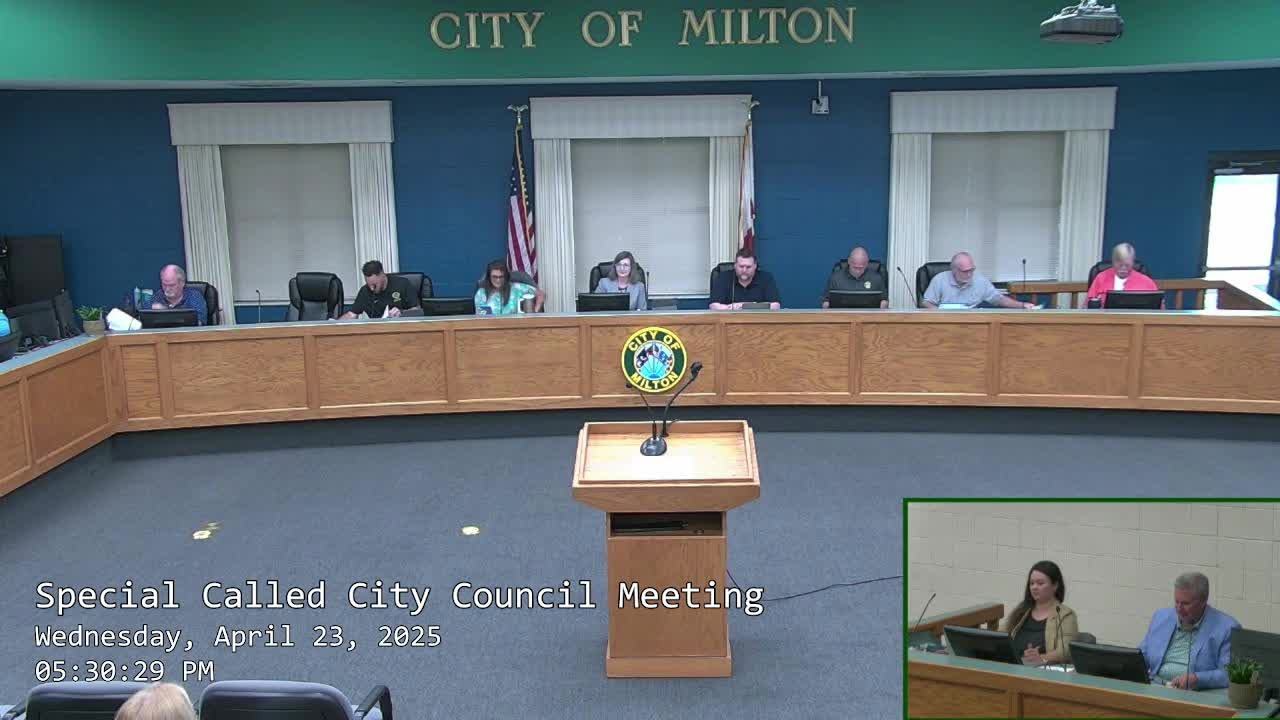
Milton council approves $2.27 million CDBG neighborhood revitalization application, pledges up to $50,000 match
Summary
The City of Milton unanimously approved a resolution to submit a $2,267,245.19 Community Development Block Grant (CDBG) Neighborhood Revitalization application to fund sidewalk and water-service improvements in downtown Milton and surrounding blocks, and agreed to pledge up to $50,000 as a local match to maximize application points.
The City of Milton City Council voted unanimously to submit a Community Development Block Grant (CDBG) Neighborhood Revitalization application requesting $2,267,245.19 to fund sidewalk and water-service improvements in a portion of downtown Milton and nearby blocks, and pledged up to $50,000 as a local match to strengthen the application.
Robin Phillips, the city’s CDBG administrator with Jones Phillips and Associates, told the council the proposed project covers an area bounded by Stewart Street (west), Elmira/Willing/Walton Streets (east), Berryhill Street (north) and Walker/Fillmore Streets (south), and includes portions of Mary, Jasmine, Caroline, Walker, Susan, Old Highway 90 and Jackson streets. Phillips said the application budget is $2,267,245.19, with administration at $165,000; engineering at $196,565.99; and construction at $1,905,679.20. The city would commit $50,000 as a match to maximize scoring points on the application.
“The application will be submitted on or before May 16 with site visits in June or July,” Phillips said, adding that the funds are federal HUD dollars administered by the Florida Department of Commerce.
The grant cycle has $40,000,000 available statewide, Phillips said, and this round temporarily waived the usual $700,000 cap so jurisdictions could submit larger projects. She said the state uses a 1,000‑point scoring system for applications and that some subcomponents—shovel‑ready designs, scope, and the number of low‑to‑moderate income residents served—carry specific point values.
Council members asked several operational and scope questions. Councilman Leake asked whether the $50,000 match is required; Phillips said it can affect up to 25 points on the application and that “sometimes one point will make a difference between funding,” calling the match worth pursuing. Ed, the city manager, said the $50,000 would be budgeted in the FY 2026 capital improvement plan, contingent on receipt of the grant.
Council members also discussed what portions of the sidewalk work would be constructed. Staff confirmed the proposal scales sidewalks to one side of most residential streets to extend funding reach, while higher‑traffic corridors such as Canal and Caroline would receive sidewalks on both sides. Jacob Hullitt, a city staff member involved in the project map and budgeting, explained the map’s colored segments align with budget line items and the spreadsheet provided to the CDBG administrator.
Public comment was supportive. Vernon Compton, a Milton resident, said the project would link downtown businesses, Jernigan’s Landing and the Blackwater Heritage State Trail while improving safety and access. David Farrow, another resident, asked whether the city’s sewer pipes would be replaced at the same time; staff said that sewer lines in the proposed area have already been upgraded and the current need is primarily water infrastructure.
After public comment, the council considered Resolution 2025‑06 (item 2025‑3237), authorizing submission of the FY 2023–2024 CDBG Neighborhood Revitalization application. Councilman Powell moved approval and Councilman Hawthorne seconded. Council discussion included whether the resolution language should say the city “will pledge $50,000” or “up to $50,000”; council members agreed the $50,000 is the maximum pledge and the city manager indicated the amount would be earmarked in the FY 2026 budget if the grant is awarded. The motion passed unanimously.
Staff outlined next steps: the state publishes a self‑scored list after the application deadline (usually within two weeks), followed by a site visit (in‑person or by Zoom) two to four weeks later; contracts typically follow within about a month, though Phillips cautioned timelines can vary. If funded, contract negotiations would set construction schedules; Phillips said typical contract completion windows are two years with possible extensions. The city also must meet public‑notice and hearing requirements for the grant application, which is why the council called this special meeting.
Votes at a glance: Resolution 2025‑06 — Motion to approve submission of the FY 2023–2024 CDBG Neighborhood Revitalization application in the amount requested and to pledge up to $50,000 as a local match. Mover: Councilman Powell. Seconder: Councilman Hawthorne. Outcome: approved (unanimous).
The council adjourned after confirming the public‑hearing requirements were satisfied and thanking Phillips for the presentation.