Get Full Government Meeting Transcripts, Videos, & Alerts Forever!
Get email alerts on the Transportation Impact Fees topic
No spam. Unsubscribe anytime.
Pasco City Council reviews draft options to update transportation impact fees
Summary
Pasco City Council heard a presentation on draft options for updating the city's transportation impact fee program and was asked to provide feedback before staff begins community outreach and returns with a final proposal.
Pasco City Council heard a presentation on draft options for updating the city's transportation impact fee program and was asked to provide feedback before staff begins community outreach and returns with a final proposal.
Deputy City Manager Ferran Pierce said the city has been working on the update for several months and that staff and the consultant team are "looking for your feedback" before wider outreach and a planned adoption target in early June. Kendra Rayland, principal and lead consultant on the study, and Jessica Bracken, project manager, presented the technical approach and district-rate options.
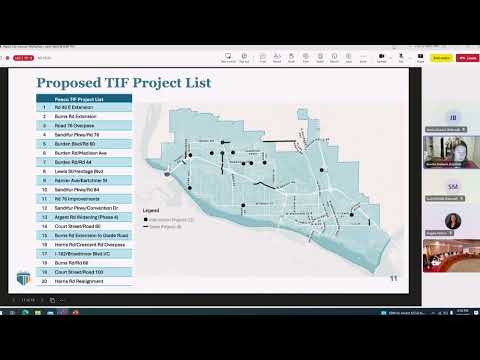
The consultants explained that the update starts from projects listed in Pasco's adopted Transportation Improvement Program (TIP), removes the portions addressing existing deficiencies, and then allocates the remaining eligible costs to future growth based on modeled trip origins and destinations. Rayland said the city has 20 capacity projects under consideration for the program and that calculations derive eligible costs by project, then divide those eligible costs by forecasted growth in PM peak-hour trips.
As an example, the consultants walked through the Rainier Avenue and Karchner Street intersection project. The full project cost was presented as $2,400,000, with the city's expected contribution listed as $1,700,000. The study removed 22% of the project cost as addressing existing deficiency and estimated that 83% of project trips originate from or serve land uses inside Pasco. After those adjustments the presentation showed $306,000 of the project (about 13% of the total cost) as impact-fee-eligible.
Two districting options were shown. A simpler two-district option would place a higher rate in the northern part of the city, where much of the new development and most of the projects are concentrated, and a lower rate for the remainder of the city; the slide presented an illustrative rate of $2,215 per PM peak-hour trip for the North district and $1,651 per PM peak-hour trip for the rest of the city. A five-district option produced more variation across neighborhoods, with the East district showing the lowest presented illustrative rate ($812 per PM peak-hour trip) and higher rates in central, north and south districts where more projects would be allocated.
Rayland noted that Pasco's current impact-fee program has been in place for about 20 years and was last updated 16 years ago, and that current rates are "significantly below" peer cities. The presentation also placed Pasco in the statewide context, saying jurisdictions across Washington use impact fees and that per-peak-trip rates vary widely (the presentation cited a statewide average of about $5,700 per PM peak-hour trip).
Council members were invited to discuss the draft service-area boundaries, the two- versus five-district tradeoffs (simplicity versus finer geographic targeting), and the city's plan for outreach to developers and the public. Pierce summarized next steps: staff will take council's feedback, revise the draft if needed, conduct public outreach and return to council for consideration with a goal of adoption in early June. No formal motion or vote occurred during the presentation.