Get Full Government Meeting Transcripts, Videos, & Alerts Forever!
Get email alerts on the Public Health Chna topic
No spam. Unsubscribe anytime.
Shawnee County health leaders lay out Community Health Needs Assessment, urge city partnership
Summary
Shawnee County health officials and LiveWell Shawnee County presented the county's 2025 community health needs assessment and urged Topeka officials to partner on implementation, highlighting behavioral health, housing and infant mortality disparities.
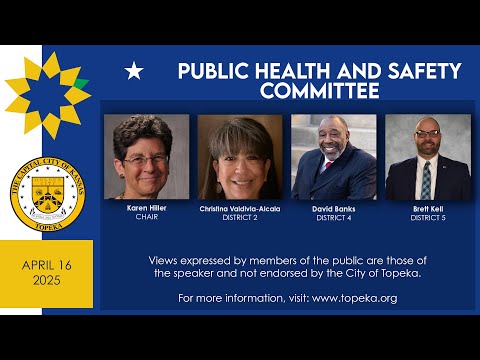
Shawnee County health officials and LiveWell Shawnee County presented results of a new community health needs assessment to the Topeka City Public Health and Safety Committee on April 16, urging closer city-county partnership to address behavioral health, housing and persistent disparities in infant mortality.
The assessment, panelists said, is the product of survey responses, focus groups and county-level health data. "We had 3,816 survey responses this year," Danielle Twemlow said, noting the count was up from 2,536 three years earlier.
The presentation described the assessment process and five county priorities that will guide a three-year community health improvement plan: behavioral health (mental health and substance use), neighborhood safety and housing, food security/healthy eating, and health equity. Theresa Fisher, director of the Shawnee County Health Department, emphasized the role of social determinants, saying, "your zip code has become more important than your genetic code." Carla Hedquist, director of community health engagement at Stormont Vail Health, described the assessment's mixed methods of perception surveys, 12 round tables with underserved residents and a town-hall review with 55 stakeholders representing 41 organizations.
Panelists highlighted infant mortality as a concrete disparity. Hedquist and Fisher said the highest recent rates were concentrated in ZIP code 66604, and that updated reporting shows an increasing disparity between Black and white infant mortality rates in the county. Fisher said the disparity has grown to "about five times the rate" for Black infants compared with white infants in recent reporting.
LiveWell Shawnee County work groups and an ongoing hospital implementation plan were described as the community's mechanism to move from assessment to action. Twemlow and other presenters cited examples including triple-dollar matching for SNAP benefits at farmers markets and Blue Cross Blue Shield-funded Pathways grants to support behavioral health and healthy eating initiatives.
Committee members discussed practical intersections between the CHNA/CHIP work and existing city priorities, especially property maintenance and neighborhood safety initiatives. Councilwoman Christina Valdivia Alcala asked how the city could formalize a partnership; the city attorney advised that a memorandum of understanding (MOU) with the county commission would be an appropriate vehicle if the county agreed to a regular staff presence at committee meetings.
Committee members and presenters agreed to continue the conversation. The committee asked staff to schedule an in-depth LiveWell overview for the next meeting and to follow up on whether the LiveWell director, Sarah Karnes, can present in May. Members also discussed scheduling at least one meeting focused specifically on aligning city policy work (including property maintenance and housing) with CHNA priorities before discussing any formal MOU.
The committee did not take a formal vote on partnership terms at the April 16 meeting; members instead asked staff and LiveWell leads to return with more detail and to identify specific intersection points for potential collaboration.