Get Full Government Meeting Transcripts, Videos, & Alerts Forever!
Get email alerts on the Election Law Public Funds topic
No spam. Unsubscribe anytime.
City attorney warns study commission public funds can only 'inform' — not advocate — on ballot measures
Summary
Bozeman’s city attorney briefed the Study Commission on Montana law limiting the use of public resources for ballot-related advocacy, including reporting requirements under the Disclose Act and rules on incidental political committees.
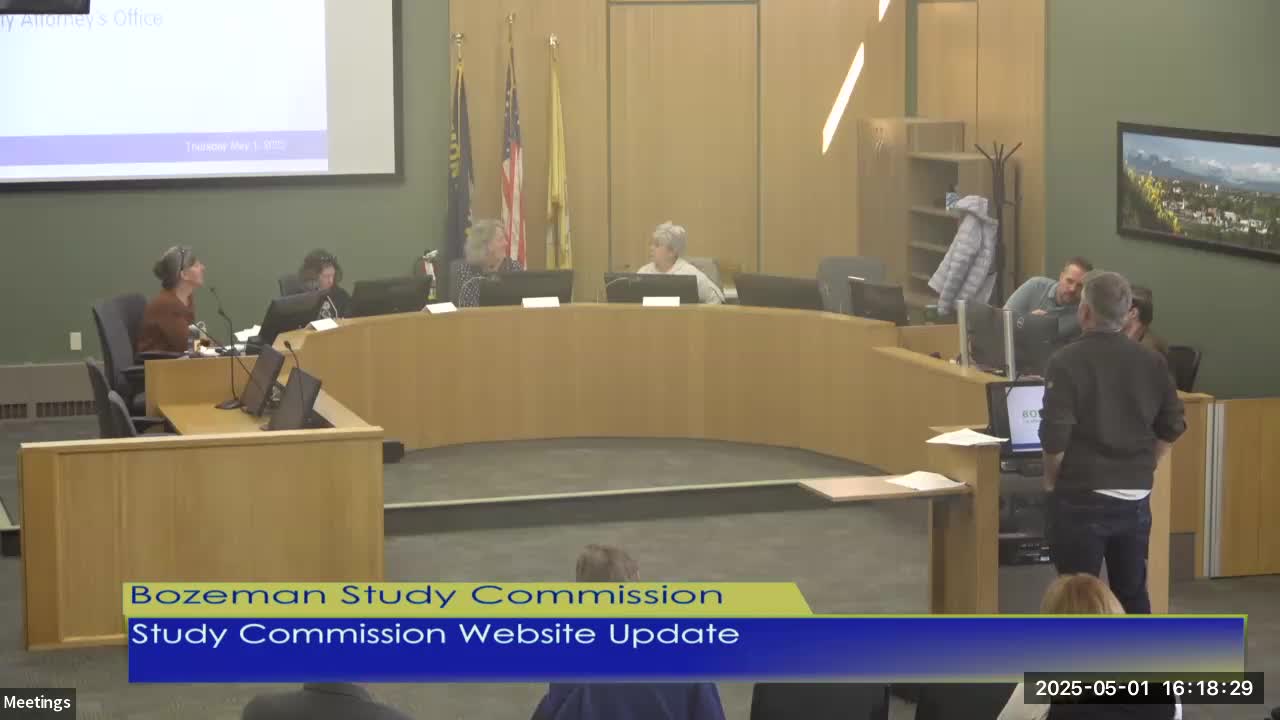
Greg, the city attorney who spoke to the Study Commission on May 1, 2025, reviewed statutory constraints on the use of public funds and other public resources for matters that might be placed on the ballot.
Greg told commissioners that whenever the city spends public money there must be a “clearly defined public purpose behind the expenditure of public money,” and he emphasized the distinction that local governments in Montana may use public resources to inform voters about the likely operational impacts of a ballot question but may not use public time, money, facilities or equipment to solicit support for or opposition to passage. He cited state ethics rules (Title 2) and campaign finance rules (Title 13) and described the Disclose Act (2015) as adding reporting obligations.
Greg explained requirements tied to the Disclose Act and the Commissioner of Political Practices: if a city engages in an education campaign about a ballot measure and the city’s electioneering communications exceed $250 (treated cumulatively), the city must form an incidental political committee and begin filing reports on the use of public money for that educational activity. He described a conservative approach the city uses to avoid litigation and cited a prior legal challenge related to a 2018 public-safety bond as an example of the costs and delays that can follow when the education/advocacy line is crossed.
Commissioners asked whether individual commissioners may speak for or against a measure; Greg said elected officials speaking on their own time and using their private resources may advocate, but commissioners may not use public time, facilities or city email addresses for advocacy. He recommended caution in the run-up to any measure and said staff will help review draft educational materials; he offered the city attorney’s office as a resource for training and pre-publication review.
Less-critical details: Greg noted that the timing matters — after a governing body formally adopts a resolution placing a question on the ballot, the limitations and reporting triggers more clearly attach; he also said some communications (for example, encouraging people to vote without endorsing a position) do not, by themselves, trigger the prohibition.