Get Full Government Meeting Transcripts, Videos, & Alerts Forever!
Get email alerts on the Historic Preservation topic
No spam. Unsubscribe anytime.
Bozeman advisory board backs Phase 1 landmark report, delays NCOD boundary changes
Summary
The Historic Preservation Advisory Board voted to recommend the City Commission approve the Phase 1 report for the Bozeman Landmark Project but amended the recommendation to remove proposed NCOD boundary changes from the Phase 2 scope and to run a design-guidelines update concurrently with proposed code revisions.
The Historic Preservation Advisory Board on Thursday recommended that the City Commission approve the Phase 1 report of the Bozeman Landmark Project while removing proposed changes to the Neighborhood Conservation Overlay District (NCOD) boundary from the immediate Phase 2 scope and asking that an update of the NCOD design guidelines run concurrently with proposed code revisions.
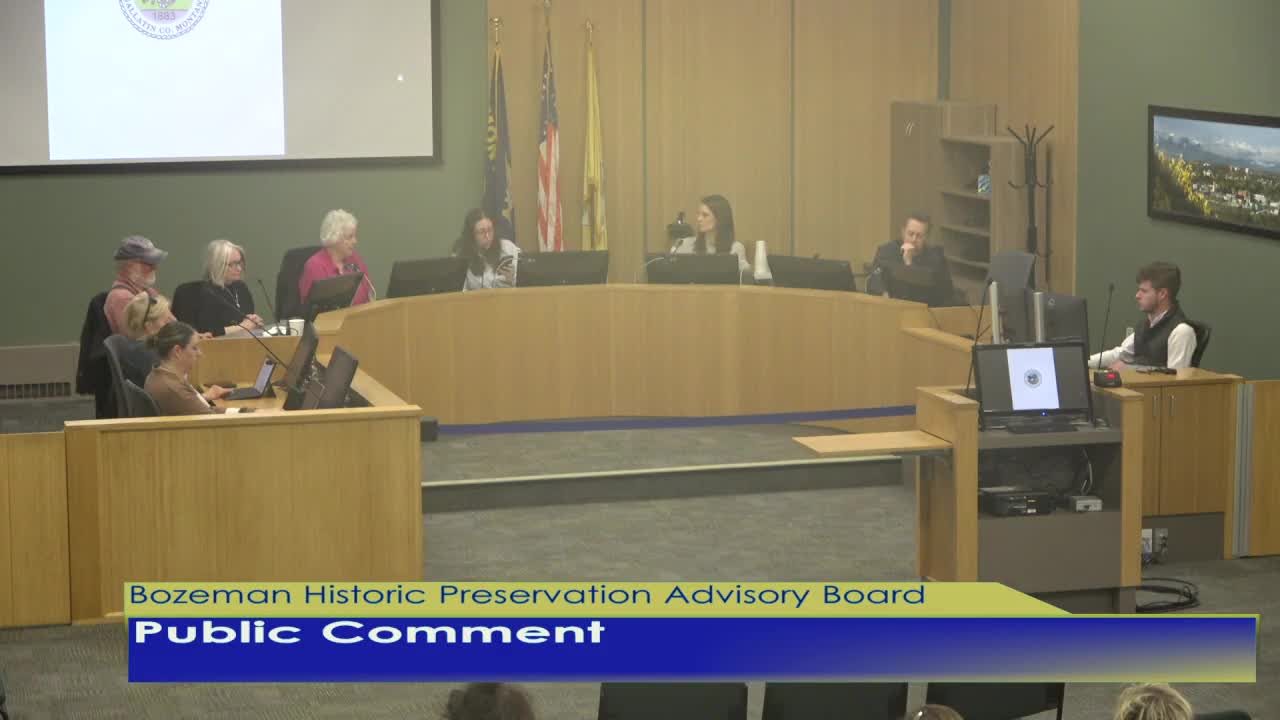
The recommendation, advanced by Board Member Wiseman and seconded by Board Member Brecky, followed a lengthy public-comment period and a consultant presentation on the report’s recommendations for code updates, demolition review, expansion of preservation protections citywide and creation of a local landmark program. The board voted unanimously to amend the Phase 1 recommendation to move NCOD boundary alterations into the report’s “future recommendations” and to coordinate a design-guidelines update with revisions to chapter 38.34.0 of the municipal code.
Why it matters: The Phase 1 report sets policy direction for Phase 2, where staff and consultants would draft specific code language. Residents and neighborhood representatives told the board the city must strengthen enforceable standards — not just guidance — for historic preservation, demolition review and certificates of appropriateness (COAs). Several speakers urged the board to prioritize clear, mandatory criteria and enforcement mechanisms before any boundary changes are pursued.
Consultants summarized Phase 1 findings and suggested next steps. Adrienne Burke, the consultant presenting the report, said Phase 2 would focus on targeted code changes to the COA process, deviation language, demolition criteria, documentation requirements and the creation of a local landmark nomination process. Burke noted that the report’s recommendations are intentionally broad to set direction for later drafting: "The report that's before you is recommendations. So this is setting the stage for the actual code work that will come in phase 2." Aaron George, community development director, told the board the report is meant to lead into Phase 2 code work and stressed there will be additional public review when staff bring ordinance language forward.
Public comments pressed for firmer rules. Lisonbee Sweeney, chair of the Jant Neighborhood, told the board her neighborhood is considering pursuing landmark designation and asked the city to clarify funding and staff support. Emily Toledo, InterNeighborhood Council representative for Midtown, criticized recent comments by elected officials about a local building and said she was "disturbed by the dismantling and castration of our citizen advisory boards" and pressed the board to defend neighborhoods and preservation staff authority. Sarah Osmond (312 Sanders Avenue) cited the municipal code requirement that COA work "must be in conformance with the most recent edition of the Secretary of the Interior standards," and urged the city to treat that requirement seriously.
Speakers and staff also raised technical issues that consultants recommended addressing in Phase 2. Adrienne Burke said demolition-review practice varies widely across jurisdictions but that Bozeman’s two-year demolition stay already is longer than many peers and could be made more effective by clarifying what documentation is required during the delay, such as efforts to sell, options for relocation, or evidence that repair is infeasible. Burke also recommended creating a local inventory form to lower the cost and speed documentation of resources (in addition to state inventory forms, which can be expensive to complete).
On the question of heritage trees and landscapes, the report recommends a local landmark category that could include cultural landscapes or individual trees with documented historic or cultural significance. Daniel Carty, speaking in favor of a voluntary heritage-tree program, asked the board to work with the city’s urban forestry staff to incorporate tree recognition into the broader project; city staff said the parks/forestry division will begin an urban-forest management plan this summer and that discussions about heritage trees will be coordinated.
Board members raised process and scope concerns during discussion. Several members and public commenters said the city needs clearer enforcement and mandatory standards ("must" vs. "consider") in code before adopting broad policy changes or adjusting NCOD boundaries. Board Member Allison urged strengthening economic-life and demolition criteria and suggested specifying when a professional analysis is required. Board Member Mike asked that the design-guidelines update be run concurrently with code revisions to avoid changing boundaries without first clarifying enforceable standards.
Votes and formal action: The board recorded a motion to recommend that the City Commission approve the Phase 1 report as submitted. Board Member Wiseman made the motion; Board Member Brecky seconded. The board then approved an amendment to the recommendation that (a) remove proposed NCOD boundary changes from the Phase 2 scope and classify them as a future recommendation and (b) require the design-guidelines update to be run concurrently with the Phase 2 code revisions to chapter 38.34.0. The amendment passed unanimously (7-0). The board then proceeded with a motion to forward the amended Phase 1 report to the City Commission for consideration at its upcoming meeting.
Background and next steps: Consultants said Phase 2 — drafting code amendments and a local landmark ordinance — is slated to begin in early June with a target completion by the end of 2025. The report recommends expanding preservation program coverage citywide, retooling COA procedures and demolition criteria, creating a local landmark nomination process (with property-owner authorization, an appeal and a de-designation process), and updating documentation practices. City staff told the board the Phase 1 report would go to City Commission on May 13 and that there will be additional public-comment opportunities and more detailed code drafting in Phase 2.
What remains unresolved: Public commenters repeatedly asked for clearer enforcement mechanisms, stronger, mandatory code language where appropriate, and better public-facing materials (for example, tracked-change versions of proposed amendments and readily available information on options such as building relocation). Several board members said they will press for clearer, prescriptive code language and staffing that can implement a more robust preservation program. The board and staff also agreed to coordinate the landmark effort with the city’s urban forestry work and with the ongoing Unified Development Code effort.
The board closed the item by asking staff and consultants to incorporate the board’s amendment and public input into materials forwarded to the City Commission and to return with a Phase 2 workplan and schedule. Adrienne Burke and community development staff said they will continue engagement with the board, the public and the City Commission as Phase 2 drafting begins.