Get Full Government Meeting Transcripts, Videos, & Alerts Forever!
Get email alerts on the Commission Governance topic
No spam. Unsubscribe anytime.
Human Relations Commission to meet every other month; members discuss outreach, subgroups and public-comment rules
Summary
The Lawrence Human Relations Commission voted to change its regular meeting frequency from quarterly to every other month and spent much of the meeting discussing outreach, the limits on advisory subgroups under city policy and public-comment procedures.
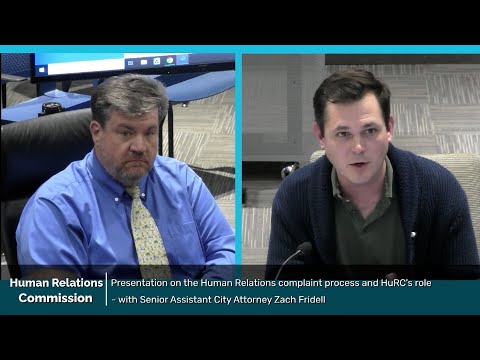
At its April 16, 2025 meeting, the Lawrence Human Relations Commission voted to change its regular meeting frequency from quarterly to every-other-month and discussed outreach strategies, the formation of subgroups, rules for inviting guests and public-comment procedures under the new advisory-board guidance.
The motion to meet every other month was moved by Commissioner Joe Mastrismoni and seconded by Chair Irving Coo; commissioners approved the change by voice vote. The commission agreed that staff would work with the chair to finalize dates that fit the city's meeting calendar.
Members said a more frequent meeting schedule will help the reconstituted advisory body build momentum, coordinate outreach and respond to community requests. "I think it would make sense to meet more regularly, particularly in the beginning since everything is getting reconstituted," Mastrismoni said.
Staff and commissioners spent substantial time discussing subcommittees and outreach. Farris Mohammed, director of equity and inclusion and the commission's staff liaison, cautioned commissioners about quorum and open-meetings constraints: "Of course, now with 7 members, then 4 would be a quorum. So, of course, you can't do 4. Probably wouldn't want to do even 3 to some degree as a group just in case somebody pops up and now you've got 4 members and now that's a quorum and now that's in violation of, sort of an open meetings act." He said the city is reviewing a recent resolution that outlines guardrails for advisory-board subgroup activity and that staff will report back with specific procedures.
Commissioners discussed how best to do outreach without running afoul of rules that limit advisory boards' use of city staff for repeated expert appearances. Kalina Coleman, organizational equity coordinator and liaison, told the panel the division can supply flyers and other materials and coordinate tabling at events. Staff noted that while the Human Relations Division does some outreach and tabling, it does not have capacity for extensive proactive training absent new funding or a legal change; the division can provide informational materials and help schedule staff participation where feasible.
The commission also discussed procedures for inviting non-city guests and neighborhood groups to speak. Mohammed said staff would research whether and how advisory boards should formally request city staff or invite outside organizations, citing a recent change in resolution language that requires certain staff appearances be approved at higher levels. He advised commissioners to coordinate requests to invite speakers through the staff liaison to avoid procedural problems.
On public comment, staff pointed commissioners to the city's resolution on public-comment protocol. Mohammed summarized the standard practice: "If public comment is allowed during the meeting, any person desiring to comment is encouraged to provide their name and ZIP code. The presiding officer may limit the time of each person based upon the number of people wishing to speak and the amount of time available." Commissioners settled on a three-minute baseline for public comments, with chair discretion to shorten or lengthen remarks depending on queue length and agenda demands.
Commissioners also discussed whether minutes should record the subject matter of public comments in more detail. Staff noted that meetings are recorded and videos are available, and that minute detail varies by city policy and available staff time; staff agreed to follow up with recommendations and clarify what can reasonably be included in written minutes.
Other items: staff reported on the city's "Balancing Act" budget-engagement tool and the timeline for the city manager's July budget proposal; commissioners noted the tool as a potential outreach and engagement channel.
Why it matters: changing frequency and clarifying outreach protocols will shape how the commission connects with residents, coordinates with city departments and avoids violations of the Kansas Open Meetings Act and related city resolutions.
Votes at a glance: - Approval of minutes from Jan. 29, 2025: approved (motion moved by Commissioner Joe Mastrismoni; second not specified in record). - Motion to change regular meeting frequency from quarterly to bimonthly (every other month): moved by Commissioner Joe Mastrismoni; seconded by Chair Irving Coo; approved by voice vote. - Motion to adjourn: approved by voice vote.