Get Full Government Meeting Transcripts, Videos, & Alerts Forever!
Get email alerts on the Complaint Process topic
No spam. Unsubscribe anytime.
Lawrence human relations staff outlines complaint intake, timelines and recent source-of-income cases
Summary
Senior assistant city attorney Zach Bridal explained how the city's Human Relations Division handles discrimination complaints under Chapter 10, described timelines and confidentiality rules, and updated the commission on ongoing litigation over the city's source-of-income ordinance and a recent $14,000 settlement.
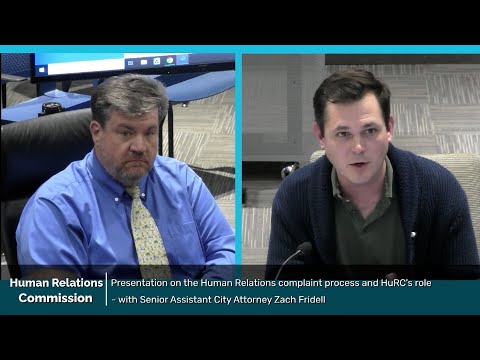
At the April 16, 2025 meeting of the Lawrence Human Relations Commission, Senior Assistant City Attorney Zach Bridal reviewed the city's complaint intake, investigation and enforcement process under Chapter 10 of the City Code and provided updates on recent housing-related cases, including an appeal of the source-of-income ordinance.
Bridal said the Human Relations Division's aim is compliance and early conciliation. "Everything we do in the human relations division is under chapter 10 of the city code of Lawrence," he said, and described a primarily complaint-driven process that begins with intake and can proceed through investigation, conciliation, a public hearing before commissioners or litigation in district court.
The intake step is handled by the division's intake attorney, Deborah Barnes, who reviews standing and jurisdictional elements, Bridal said. Investigations are contracted to an outside investigator, Laura Bridal Pabst, who may conduct site visits, interviews and document collection. Bridal said the division must meet statutory timelines: complaints must be timely (he cited 90 days for public-accommodation and employment complaints and one year for housing), and investigators must proceed according to the city code so findings hold up if the matter proceeds to court.
Bridal described conciliation as the preferred early outcome. "We're always trying to conciliate. We're always trying to resolve the situation as soon as possible," he said. If conciliation fails, the division issues notice of a public hearing before at least three commissioners; respondents may instead elect to take the matter to district court. Asked whether the district court must defer to the commission's factual findings, Commissioner Joe Mastrismoni asked, "If it does go to court, is it a trial de novo with the district court, or is the district court bound by the factual findings of the commission?" Bridal replied, "They are not bound. They're not bound. So, you start it starts all over. Right. Which is why they often just go to district court."
Bridal also reviewed possible remedies and penalties. Hearing officers may order damages, civil penalties and corrective measures; for first-offense housing penalties he cited a $10,000 fine and up to $50,000 for repeated offenses, with civil penalties remitted to the city general fund. He emphasized confidentiality rules: "Chapter 10 does lay out that cases are to remain confidential, unless and until they go to a public hearing," he said, and added that the division does not publicly release case details unless the parties waive confidentiality or the matter becomes public through a hearing or court filing.
Bridal described the division's connections with federal and state agencies, including reporting to the U.S. Department of Housing and Urban Development (HUD) for housing-discrimination matters and receiving HUD grant funding for housing discrimination work.
On case updates, Bridal said the city's source-of-income ordinance (the provision that prohibits refusing subsidized rental payments such as Section 8) has been challenged by a group of landlords. A district court ruled in the city's favor and the landlords appealed to the Kansas Court of Appeals; oral arguments were held recently. Bridal said the appeal focuses mainly on the source-of-income provision and arguments that the ordinance is unconstitutionally vague and implicates search-and-seizure concerns; the court of appeals expected to issue a ruling within 60 days of oral argument.
Bridal also described a Section 8-related district court case set for trial in June and a separate source-of-income settlement resolved at district court: "It was a young woman who was using disability vouchers at an apartment complex. The apartment wouldn't accept the vouchers ... The terms of the settlement are not confidential, so she received $14,000 and agreed to not disparage the apartment complex," he said.
Commissioners asked what role the commission itself typically plays in complaints. Bridal said commissioners most often participate in public hearings if conciliation fails; due to the time-sensitive intake and investigation deadlines, the commission generally does not participate in intake or initial investigations. He also noted the conflict-of-interest limitation: if the city is the alleged offender, the city would refer the complaint to another agency (for example, HUD or the Equal Employment Opportunity Commission) rather than investigate it internally.
Bridal and staff told commissioners the division conducts outreach (flyers, tabling at events, a City Hall display and website resources) and that the division can supply materials for the commission to use at community events. Bridal said staff's capacity for proactive training is limited and tends to be prioritized when it follows a violation or a major ordinance change, but they can provide informational handouts and coordinates on tabling opportunities.
Commissioners pressed on confidentiality, timing and whether commissioners could observe or take part in site visits; Bridal cautioned that early investigation stages are confidential and site visits by commissioners would likely not be possible. He said staff would work to provide public, non-confidential status summaries on cases where appropriate and encouraged the commission to coordinate outreach with the division.
Why it matters: Lawrence residents who believe they experienced discrimination in housing, employment or public accommodation can file complaints with the Human Relations Division; the local process can be faster and less costly than filing only at state or federal agencies, and local ordinance protections include some classifications not covered elsewhere.
Bridal and staff offered to provide more regular, publicly available status information for the commission to help guide outreach while honoring confidentiality requirements.