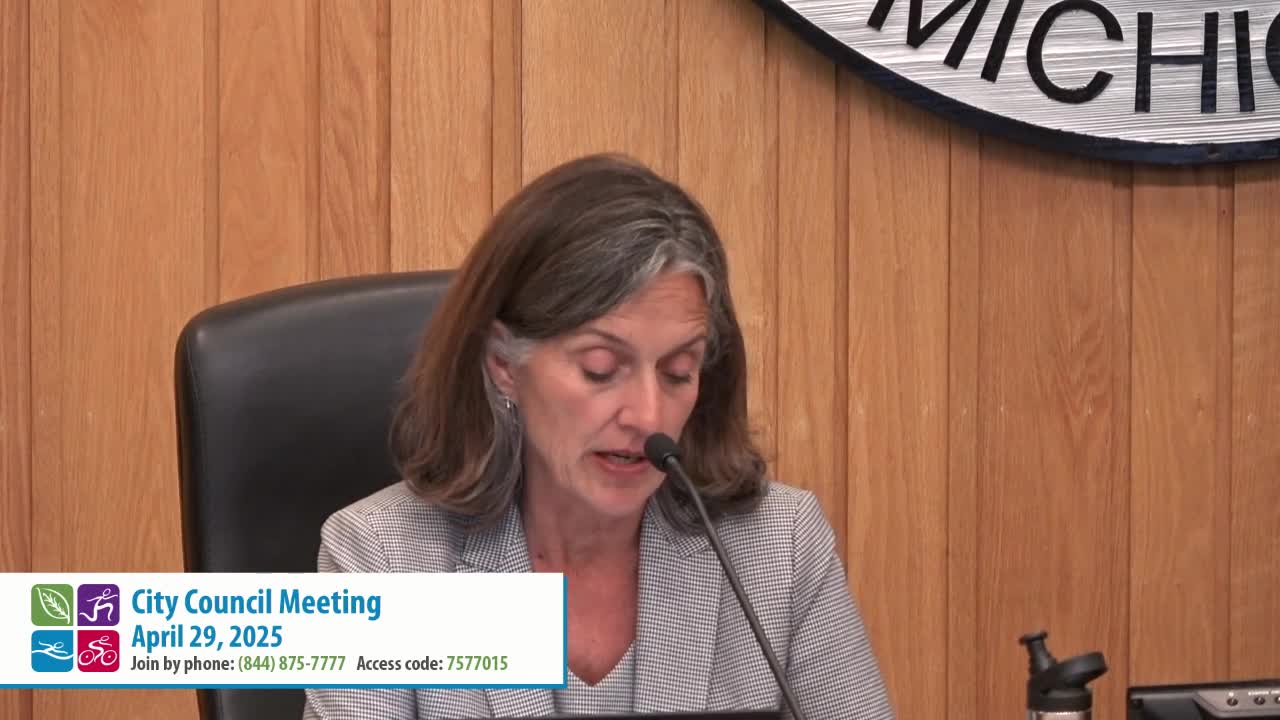
Portage council approves Stanwood Crossings Brownfield plan and starts construction on workforce homes
Loading...
Summary
Portage City Council on April 29 adopted the City of Portage Brownfield Redevelopment Plan amendment No. 14 for the Stanwood Crossings workforce housing project at 9617 Portage Road and authorized initial construction and budget steps to begin building homes on the site.
Portage City Council on April 29 adopted the City of Portage Brownfield Redevelopment Plan amendment No. 14 for the Stanwood Crossings workforce housing project at 9617 Portage Road and authorized initial construction and budget steps to begin building homes on the site. Council approved the Brownfield plan, authorized the city manager to sign a reimbursement agreement with the Brownfield Redevelopment Authority, authorized construction of the first 12 houses, and accepted a Kalamazoo County down‑payment assistance grant; all votes were recorded as unanimous (7–0).
The council and staff said the project will create 42 for‑sale homes targeted at households earning 80 to 120 percent of area median income (AMI) and will use a community land trust (CLT) model: the CLT retains title to the land and homeowners own the buildings. "We are going to sell these at 75 percent of cost," Jonathan Hallberg, deputy director of economic development and staff liaison for the Brownfield Redevelopment Authority, said, describing the discount that helps make the homes affordable.
Why it matters: the project is intended to create long‑term affordable, owner‑occupied housing for middle‑income workers in Portage. Staff described a financing package that combines grants, county millage dollars and a Brownfield tax increment financing (TIF) capture to cover infrastructure and the affordability gap. Pete Dame, the city's chief development officer, said the city has assembled outside resources for infrastructure and housing subsidies and still needs the Brownfield tool to bridge the final funding gap.
Key project details: staff said infrastructure clearing is already underway and the first phase will include up to 12 homes (with four home types and several model variations). The city reported roughly $2.5 million in outside infrastructure resources and $3 million earmarked to subsidize home costs; the Brownfield plan as presented projects capture of approximately $4.75 million over 25 years under conservative assumptions and estimated an average subsidy of about $79,858 per home. Council authorized a budget amendment to commit up to $3,000,000 from the capital improvement fund as an internal loan to cover gaps; staff said that loan will be repaid from the Brownfield capture with interest.
How the Brownfield/TIF works: Hallberg explained the Brownfield Redevelopment Financing Act (PA 381) lets the city preserve current tax values and capture incremental taxes generated by new development into a project fund. Those increments will reimburse eligible capital and program expenses (infrastructure, site work, certain financing gap costs) over the plan period; staff estimated the plan would likely retire earlier than its maximum term and included a modest interest component in repayment assumptions.
Local partnerships and operations: staff said American Village Builders (AVB) is under contract as the construction partner for the initial homes. The city will place the land into a community land trust and sell homes on leased land; the CLT model is intended to keep resale prices below market so subsequent buyers in the target AMI range can also access the homes. Pat McGinnis, city manager, said the city will charge a nominal monthly lease to the homeowner to cover CLT administration but will not profit from the land lease.
Next steps and timeline: council approved the Brownfield plan and related agreements and authorized the manager to execute construction agreements for the first 12 homes. Staff expects to begin staged construction this year and projected partial build‑out of 4–6 homes in the current calendar year; full first‑phase buildout projections were presented into 2026–2028 fiscal periods. Staff said additional program criteria and the homeowner application process will be finalized in May, and an interest list can be submitted on the city website.
Votes at a glance: • Adopt Brownfield Redevelopment Plan amendment No. 14 (Stanwood Crossings) and authorize city manager to sign the reimbursement agreement with the Portage Brownfield Redevelopment Authority; roll call: Miller, Pearson, Randall, Urban, Young, Burns, Ledbetter — yes; outcome: approved, 7–0. • Authorize construction of the first 12 Stanwood Crossings houses, authorize the city manager or designee to enter construction agreements for each house, and approve a budget amendment to use up to $3,000,000 of capital improvement fund balance to support the project; roll call: Miller, Pearson, Randall, Urban, Young, Burns, Ledbetter — yes; outcome: approved, 7–0. • Approve the Stanwood Crossings down‑payment assistance grant agreement with Kalamazoo County (county to provide up to $15,000 per eligible buyer); roll call: Randall, Urban, Young, Burns, Ledbetter, Miller, Pearson — yes; outcome: approved, 7–0.
Who spoke: Pete Dame (chief development officer) introduced the project; Jonathan Hallberg (deputy director of economic development) explained the Brownfield financing details; Pat McGinnis (city manager) outlined administration and repayment; several council members asked clarifying questions during the public hearing. No substantive opposition to the plan was raised during the public hearing; a small number of residents asked procedural questions about CLT ownership and income eligibility (80–120% AMI).
What was not decided tonight: council approved the plan and initial construction authorization but staff will return with detailed homeowner application criteria, resale formulas, CLT operating documents and a timeline for homeowner selection. The CLT operating procedures and application process will be presented to council for adoption in May.
Ending: with the votes recorded, the council gave staff direction to begin contracting and to circulate application information; staff advised interested residents to register on the city website to receive application updates.