Get Full Government Meeting Transcripts, Videos, & Alerts Forever!
Get email alerts on the Floodplain Management topic
No spam. Unsubscribe anytime.
Cape Coral staff brief council on NFIP participation and CRS points; outlines path to lower premiums
Summary
City staff explained how participation in the National Flood Insurance Program and the Community Rating System affects residents' flood insurance premiums, described the '50% rule' for substantial improvement/damage, and outlined options to raise Cape Coral's CRS score from Class 5 toward Class 4.
Cape Coral City officials used a Committee of the Whole meeting on April 23 to walk council members through the city's participation in the National Flood Insurance Program (NFIP) and the Community Rating System (CRS), describing how program rules and local policies affect flood insurance costs for residents.
The presentation, led by Shane Kintner, Building Official, and Sophia Seys, Floodplain Manager, explained the NFIP's role in offering flood insurance for residential and nonresidential properties and the CRS' point-based system that yields premium discounts. "The National Flood Insurance Program offers the insurance coverage for residential properties, personal property, nonresidential properties," Kintner said, describing the federal program's intent to reduce the financial impact of flood damage and to encourage improved floodplain management. Seys said, "When a community participates in the CRS program, they can earn points for those activities that reduce flood risk... The more points that a community earns, the higher their CRS classification or class."
Why it matters: Cape Coral's flood exposure is driven by 400 miles of canals, the Caloosahatchee River and coastal influences. Participation in NFIP preserves residents' access to federally backed insurance, disaster assistance and certain federal grants and loans. The city's CRS classification directly affects many residents' flood-insurance premiums: Cape Coral is a CRS Class 5 with 2,755 points, which yields up to a 25% discount for properties in the Special Flood Hazard Area, the presenters said. CRS discounts can reach as much as 45% for a Class 1 community; properties outside the SFHA (X zone) may receive smaller discounts (about 10%).
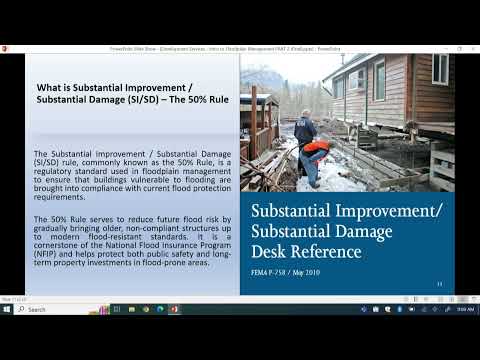
Key technical points from staff: - Minimum NFIP requirements: adopt and enforce floodplain regulations, issue floodplain development permits, maintain floodplain maps/records, conduct outreach, and participate in audits and compliance checks. - The "50% rule" (substantial improvement/substantial damage): if improvements or repairs equal or exceed 50% of a structure's market value (building value, excluding land), the entire building must be brought into compliance with current floodplain standards; the rule applies to nonconforming structures that do not meet current elevation requirements. - CRS activities that earn points fall under public information, mapping and regulations, flood damage reduction and warning/response. Cape Coral's higher regulatory standards (Florida Building Code, ASCE standards and the city's Land Development Code) contribute to its CRS points.
Council questions and staff responses focused on resident access to flood data, how CRS discounts are applied by insurers, and steps to raise the city's CRS class. Council Member Donnell asked for a demonstration of how residents can look up elevation certificates and flood-zone information online; staff showed the city's flood web page and the third-party Forerunner mapping service for address searches. Council members also pressed staff on how discounts are actually reflected on insurance bills; staff answered that discounts are eligibility-based and that the structure's compliance status (for example, active code violations) can limit the discount the insurer applies.
On improving the city's CRS rating, staff said several feasible steps could yield more points and that city officials are preparing a third presentation to analyze options and costs. "There are several things that we are doing to try to actually go to a class 4 rating," Seys said; staff identified a stormwater study and other activities as potential point sources. Council discussions emphasized a cost-benefit approach before committing resources: "It is a cost benefit analysis — what it takes to get the savings," Council Member Steinke said, urging that staff quantify costs and incremental premium savings before the city pursues higher CRS measures.
Ending: Staff said they will return with the third presentation in the series to present a prioritized list of CRS actions, estimated points and costs so council can weigh the trade-offs and decide which measures to pursue.