Get Full Government Meeting Transcripts, Videos, & Alerts Forever!
Get email alerts on the Water Quality topic
No spam. Unsubscribe anytime.
Sarasota Bay showing sustained improvement, estuary director tells commissioners
Summary
Dave Tomasco, PhD, director of the Sarasota Bay Estuary Program, told the Sarasota City Commission that nutrient loads have declined, seagrass is recovering and key nitrogen-reduction targets set in 2021 have been met; he urged continued wastewater and stormwater work and local homeowner participation.
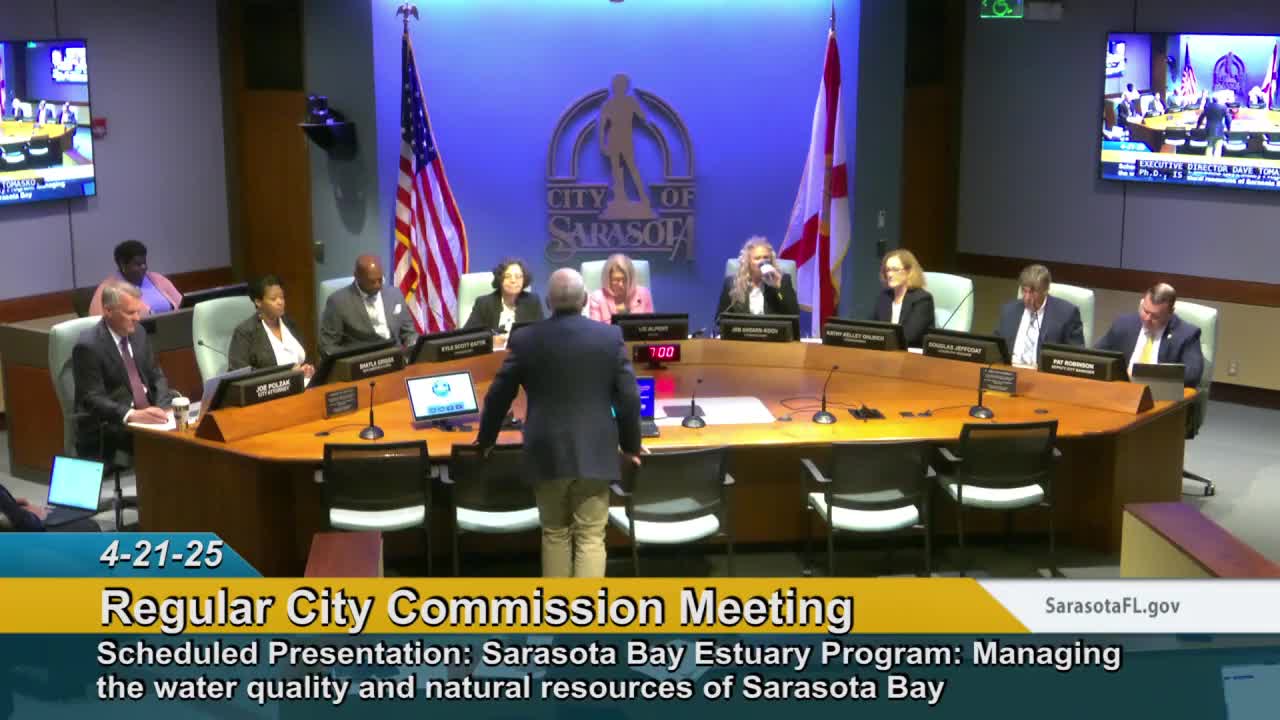
Dave Tomasco, PhD, executive director of the Sarasota Bay Estuary Program, told the Sarasota City Commission April 21 that overall water-quality measures in Sarasota Bay have improved and that the region has met its recent nitrogen-reduction goals.
Tomasco said the program set a target in 2021 to reduce the most damaging forms of nitrogen by 12 tons per year and that recent monitoring shows a roughly 22 percent decline in the worst-affected parts of the lower bay compared with the peak problem years around 2018. He credited large wastewater upgrades, stormwater retrofits and local government projects for driving the improvement.
Why it matters: Healthy bay waters support an estimated 20,000 jobs tied to water-based businesses and contribute billions of dollars in property value, Tomasco said. He warned that poor water quality reduces habitat for seagrass, manatees and juvenile fish and that warmer water and more intense storms tied to climate change increase risks from algal blooms and low-oxygen events.
Tomasco summarized the program’s findings and actions. He said the bay’s algae levels have fallen by about half from the worst years and that no part of the bay is currently out of compliance with Florida’s numeric nutrient criteria. He highlighted an increase in seagrass coverage — nearly 2,000 acres regained — and noted that the system’s response followed a period of severe stress during 2018 and 2019, when a combination of red tide and wastewater overflows coincided with large seagrass losses.
He pointed to large infrastructure investments — he cited roughly $300 million in wastewater and stormwater upgrades across the region, and singled out Sarasota County’s Bee Ridge wastewater treatment plant as responsible for a large share of past overflows — and said those investments have helped reduce conditions that drive algal growth.
Tomasco outlined specific local efforts and recommendations: continued work on wastewater treatment and stormwater retrofits; dispersed stormwater treatment such as rain gardens and median redesigns; living shoreline and kayak-launch projects planned with the city at Dr. Martin Luther King Jr. Memorial Park and City Island; and neighborhood-scale grants and vertical oyster gardens, including 600 planned at Pelican Cove. He also noted the Bobby Jones project treats runoff from about 5,000 acres of older neighborhoods developed before modern stormwater rules.
On possible utility actions, Tomasco said eliminating or reducing direct discharges of treated effluent into the bay could reduce nitrogen loads by an estimated 2 to 4 tons annually and could have co-benefits for regional water-supply permits and groundwater intrusion. He did not present a specific city decision or timetable; rather, he framed the change as a potential option for further improvements that would require utility-level choices.
Tomasco used an accessible approach during the presentation, showing the estuary report card and photos of recovered seagrass meadows and wildlife. He urged homeowner actions — such as avoiding overfertilizing lawns, not blowing grass clippings into streets or water, and limiting use of hard seawall materials that replace oyster habitat — and said the program offers outreach materials and local grants to help neighborhoods restore shoreline habitat.
Commissioners thanked Tomasco and several noted his communications work. Commissioner Ahern Koch, who said she has served on the estuary board since 2017, praised his public messaging and said the presentation illustrated regional cooperation among municipalities and the county. Tomasco also referenced program staff and partners, and provided a contact to request outreach materials.
Ending: Tomasco framed the immediate task as keeping the recovered bay healthy and resilient: "You've got this recovered bay, so it's not about attaining a healthier bay, it's maintaining a healthier bay," he said. The program will continue to monitor loads, support on-the-ground projects and work with municipalities on larger utility-level options.