Get Full Government Meeting Transcripts, Videos, & Alerts Forever!
Get email alerts on the Solid Waste Disposal topic
No spam. Unsubscribe anytime.
Council reviews large solid-waste fee increases as DEP seeks funds for incinerator repairs and planning for new recycling facility
Summary
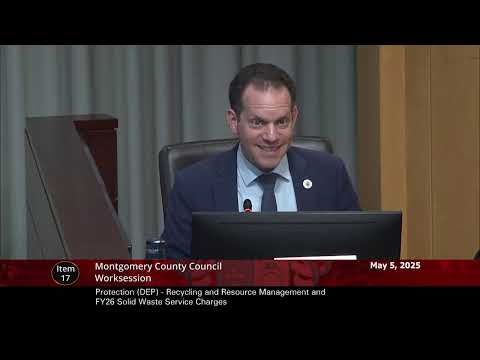
At a Montgomery County Council work session, the Department of Environmental Protection (DEP) presented the county executive’s FY26 budget proposals that would raise the county’s solid‑waste service charges to cover short‑term repairs at the Resource Recovery Facility (RRF) and Durwood transfer station and to fund planning and design for a proposed material recycling and biological treatment (MRBT) facility.
At a Montgomery County Council work session, the Department of Environmental Protection (DEP) presented the county executive’s FY26 budget proposals that would raise the county’s solid‑waste service charges to cover short‑term repairs at the Resource Recovery Facility (RRF) and Durwood transfer station and to fund planning and design for a proposed material recycling and biological treatment (MRBT) facility.
The discussion matters because the executive’s package ties large current‑year increases in the Solid Waste Disposal Fund to projects DEP describes as necessary to keep the system operating while the county plans a long‑term alternative to incineration. Staff materials cited example increases that would raise a small‑business disposal charge from $631 to $1,400 and a single‑family household charge from $310 to $419 (about an $85 increase for the latter), and DEP identified a mix of inflation, contract and labor cost increases, $28.5 million in RRF repairs in FY26 and a proposed $12 million‑per‑year CIP amendment for MRBT planning in FY26–28 as drivers of the higher charges.
Council Member Glass, chair of the Transportation and Environment Committee, framed the issue as multiple overlapping items that jointly drive higher rates and said the council needed a full briefing so all 11 members could consider tradeoffs. Glass said the committee had spent time “sorting through what the fee increases mean, where the different funding will go to,” and that the questions cut to “how we collect our trash today, how it gets picked up, sorted, and disposed of, and it has implications for how that is done years into the future.”
John Monger, director of the Department of Environmental Protection, told the council the packet (circle 49) breaks the charge increases into columns showing amounts dedicated to maintaining the current collection and disposal systems, inflationary increases in contracts and labor, and a smaller portion for advanced‑processing planning and design. Monger said the projects in the “critical repairs” category are “fundamentally necessary simply to maintain a viable MSW system in the county in the short term” and that “failing to approve funding for the projects that are listed here, risk service disruption.” He gave examples such as boiler water‑wall tube replacements and scrubber repairs at the Dickerson waste‑to‑energy facility and large compactor replacements at Durwood.
Council and DEP staff clarified the revised numbers that the executive transmitted in April. DEP and budget staff said the RRF short‑term repair request originally transmitted in March was $35.5 million for FY26 and was amended to $28.5 million for FY26 with some work moved to later years. DEP told the council the FY26 RRF/transfer‑station split under the amended request is about $25.3 million for the RRF and just over $3 million for Durwood compactors and other transfer‑station equipment.
On the MRBT proposal, Monger said the executive transmitted a CIP amendment to initiate planning and design for a new material recycling and biological treatment facility, with $12 million proposed for each of FY26, FY27 and FY28. He characterized those dollars as funding preconstruction planning and design—work that would be performed under a preconstruction services agreement with a vendor selected through procurement—and said the request reflects engineers’ estimates of the work needed over the next three years to move toward a project. DEP staff told the council they expect to issue a procurement in mid‑2025 if funding is approved.
Multiple council members said they could not support fee increases for MRBT planning without seeing the consultant alternatives analysis and a fuller briefing. Council Member Fanny Gonzalez said, “There’s no way I can approve any fee increases not knowing the plan,” and said she would vote against including MRBT in the FY26 charges until the council has a briefing. Council Member Balcom, who serves on the T&E Committee, told colleagues the committee did not make a recommendation on MRBT because committee members wanted the full council to consider the project after receiving the alternatives analysis.
DEP staff confirmed a consultant report (referred to in discussion as an Arcadis alternatives analysis) is complete and that summaries have been briefed to T&E committee members; DEP said the full report will be provided to the council and the public and that the department is available to give a public briefing. Council members repeatedly asked for the full written analysis and for more granular budget detail tying each proposed fee increase to specific projects and years.
Council members pressed for a clearer ledger of what is discretionary planning versus repairs that are unavoidable. Monger and other DEP staff maintained the list of FY26 repair projects was limited to those necessary for safe, reliable operations and permit compliance and that avoiding those repairs would risk service disruption. Staff also said that prior policy choices to limit capital spending on the RRF in earlier years helped keep rates lower historically but left a backlog of end‑of‑life equipment now requiring investment.
Several council members asked for follow‑up detail before the council’s May 14 vote on FY26 solid‑waste charges: (1) the remaining scope and expenditures from the FY25 consultant appropriation and the exact deliverables and public release date for the alternatives analysis; (2) a project‑level breakdown that ties each line of the rate‑model chart to the listed FY26 capital repairs and operating changes; (3) the procurement timeline and anticipated drawdown schedule for any preconstruction contract for MRBT planning; and (4) the debt and other nonrepair items that affect rate smoothing in the disposal fund (DEP noted a separate planned bond issuance for the Gude landfill remediation project).
Discussion versus decision: the council did not adopt fee changes or the MRBT CIP amendment at the work session. T&E members and staff recommended that the full council receive the consultant alternatives analysis and a public briefing before deciding whether to include MRBT planning funding in the FY26 charges. Council staff had suggested deferring the CIP amendment pending the alternatives analysis; council members asked staff and DEP to provide the requested follow‑up materials in advance of the May 14 rate vote.
The meeting yielded no final votes on DEP’s proposed FY26 solid‑waste charges. Council members signaled they would weigh the administration’s amended FY26 repair list and the consultant analysis before acting. The council directed staff and DEP to provide the detailed breakdowns and the Arcadis alternatives analysis to the full council and to the public ahead of the formal vote.
Ending note: council members repeatedly emphasized that while the county appears committed to closing or transitioning away from the RRF, a transparent, council‑level decision about a replacement path and its cost implications will be required before the council can responsibly adopt multi‑year fee increases tied to capital planning.