Get Full Government Meeting Transcripts, Videos, & Alerts Forever!
Get email alerts on the Fy26 Budget topic
No spam. Unsubscribe anytime.
Montgomery County Council weighs retroactive income tax increase as FY26 budget gap widens
Summary
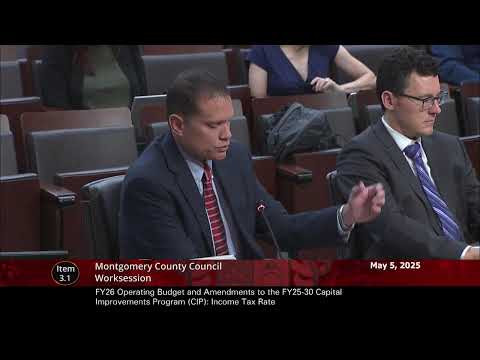
The Montgomery County Council continued its work session on the FY26 operating budget, balancing committee recommendations against a county-executive proposal to raise the local income tax rate to 3.3% and, potentially, make it retroactive to tax year 2025.
The Montgomery County Council continued its work session on the FY26 operating budget on May 5, reviewing committee recommendations and a county-executive proposal to raise the local income tax rate from 3.2% to 3.3%.
Council staff said the committees have placed $6,000,000 in reductions and $45,800,000 in additions on a reconciliation list and that the committee-recommended resource changes would produce a net decrease of $41,500,000 in available resources to fund the FY26 operating budget.
"If the council were to accept all the resource changes and only the reductions recommended to date, it will need to find an additional $35,500,000 in reductions or additional resources to approve a balanced budget," council staff told members; accepting all committee reductions and additions would require an additional $81,300,000, the staff summary said.
Why it matters: The council rejected the county executive's proposed property tax increase in committee and is now considering the executive's alternative — a proposal to raise the county income tax rate and, in the executive's recommendation, make that increase retroactive to tax year 2025.
Office of Finance staff explained how the local income tax is collected and why the county's income-tax revenue is volatile. "Most of the tax income taxes that the county receives is from the prior tax year," Mr. Smith, Office of Finance staff, told the council, noting the lag between tax-year events and county revenue receipts. Nancy Feldman of the Department of Finance added, "we look at this every day with the information that we see," and warned much county-level data is delayed compared with state data.
Staff analysis presented by Mr. Smith estimated that a retroactive increase to 3.3% for tax year 2025 would generate about $75,000,000 in FY26 revenue; if made effective January 1, 2026 instead, the estimate was about $25,000,000 for FY26 and a smaller near-term boost. Staff cautioned those figures are sensitive to taxpayer behavior and capital gains volatility.
Council members raised concerns about the proposal's timing and risk. "Numbers don't lie," Council member Fanny Gonzales said during the meeting, arguing the county lacks sufficient data now and expressing opposition to a retroactive increase. Several other members urged caution because capital gains and federal workforce layoffs could reduce income-tax collections and create midyear shortfalls that would force cuts or use of reserves.
Process and next steps: The council scheduled a public hearing on the income tax resolution for May 13. The council president said the council must act on the executive's retroactivity request by May 15 if it intends to notify the Maryland Comptroller for tax-year 2025; the council's SRAV action on council adjustments to FY26 is scheduled for May 15 and final action on May 22.
What was decided now: The council's Government Operations and Fiscal Policy committee unanimously recommended keeping the county property tax rate at $1.0255 per $100 of assessed value and retaining the county income tax offset credit (ITOC) at $692 per eligible property; the full council voted by hand to approve the committee recommendation unanimously.
Discussion items not yet decided: The council did not take a final vote on the income tax rate. Staff noted the Budget Reconciliation and Financing Act (BRFA) included a provision that waives interest and penalties incurred because of the state's changes; the BRFA and the Comptroller's reporting deadline are part of the policy timeline members must weigh.
The council's debate highlighted competing priorities: replace the rejected property tax increase and avoid deep operating cuts, or wait for clearer revenue data this fall and limit near-term tax changes. Finance staff emphasized the revenue uncertainty and recommended the council use reserves and contingency planning if receipts underperform.
Ending note: Council members signaled strong disagreement about retroactivity and the timing of any income tax action; the council will hold a public hearing on May 13 and must give the Comptroller notice by May 15 if it intends to make a retroactive change for tax year 2025.