Get Full Government Meeting Transcripts, Videos, & Alerts Forever!
Get email alerts on the Code Enforcement Community Decay topic
No spam. Unsubscribe anytime.
Council approves community decay ordinance after amendment to protect cultivated gardens and landscaping
Summary
Council approved Ordinance 19-36 updating community decay rules, adding an amendment to exempt 'maintained and cultivated gardens or landscaping.' The ordinance passed after debate over enforcement and neighbor disputes.
The Kalispell City Council approved Ordinance 19-36 Monday, amending the community decay provisions in Chapter 11 of the municipal code to clarify enforcement for tall grass and weeds and to remove the July 1 enforcement window.
Councilor Hunter successfully moved an amendment to expand the exemption language so that section f(2)(c) would read “maintained and cultivated gardens or landscaping.” Hunter said the change was intended to protect intentional native plantings and other landscaped areas from being treated as violations. The amendment passed on a roll-call vote and the ordinance, as amended, passed on final vote.
Several councilors opposed the ordinance on principle. One member argued it risked weaponizing code enforcement for aesthetic disputes among neighbors and noted that if the ordinance were intended to address fire danger or noxious weeds it would be written differently. Councilor Dowd reiterated concerns about reducing the notification period for violations; he said adopting shorter timelines that are inconsistent with other code enforcement could be problematic.
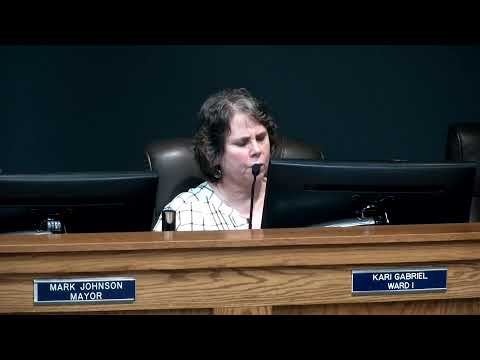
The final roll call recorded five ayes (Nunnally, Gabriel, Graham, Fisher and Mayor Johnson) and three no votes (Hunter, Dowd and Dahlmann). Councilors asked staff to ensure that enforcement focuses on public-safety or noxious-weed concerns rather than neighbor aesthetic disputes.