Get Full Government Meeting Transcripts, Videos, & Alerts Forever!
Get email alerts on the Offender Residency Exemption topic
No spam. Unsubscribe anytime.
Village review board pauses decision on residency exemption after applicant’s hearing
Summary
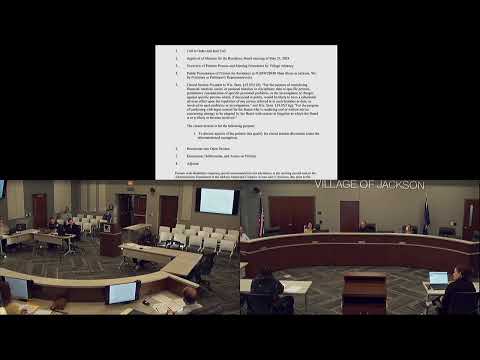
The Village of Jackson review board heard from an applicant seeking an exemption from the village’s offender-residency setback ordinance and moved into a closed session under Wisconsin Statute 19.85(1)(f) and (g) before making a decision.
The Village of Jackson review board heard testimony Tuesday from an applicant identified in the record as Mister Carson seeking an exemption from the village’s offender-residency setback, then recessed into a closed session under Wisconsin Statute 19.85(1)(f) and (g) without issuing a decision.
Matt Parmentier, the village attorney, told board members the ordinance requires individualized review and listed 15 criteria the board must apply, including the nature and date of the offense, treatment and rehabilitation status, ties to a support network, use of force in the offense, and proposed safety assurances. He said the board’s options are to approve, conditionally approve, or deny an exemption and that most outcomes are conditional approvals rather than outright approvals.
Mister Carson, the applicant, told the board he has worked and supported his fiance and stepson and said, “I made a lot of mistakes when I was young. So as growing up, I'm a different man, different guy. I've been working, taking my fiance to work and all that.” He said he completed counseling related to alcohol issues, attended Alcoholics Anonymous in the past, and that he is currently living in Milwaukee with his mother. He also said he has worked at Fleet Farm for about two years and that his fiance works at Tiny Sprout. Carson said he lived at the Jackson address for about three months before learning of the residency restriction.
Board members asked whether Carson is on supervised release; he said he is not. The police report provided to the board notes distances from the applicant’s property to nearby parks and a school; board members discussed measurements in the report (examples cited in the meeting included roughly 700–900 feet to two parks and a school located within the ordinance’s setback radius). Parmentier reminded the panel that the ordinance focuses on the likelihood of reoffending for the designated offense and that other charges might only be considered insofar as they bear on the listed criteria.
Before making a decision, the board voted to convene in closed session “for the purpose of considering financial, medical, social, or personal histories or disciplinary data of specific persons” and to confer with legal counsel, citing Wisconsin Statute 19.85(1)(f) and (g). The motion to enter closed session was moved by Patrick Prior, seconded by Michelle Clint, and passed by roll-call vote (three ayes). Earlier in the meeting the board approved minutes from its previous meeting (motion by Michelle Zach, seconded by Patrick Prior, carried by voice vote).
No final determination on the exemption was recorded in open session. Parmentier told the board that any formal decision must be announced in open session after deliberation and that the panel could approve, conditionally approve, or deny the exemption based on the 15 statutory criteria listed in the village worksheet and ordinance.
The record presented to the board included the applicant’s letter, a landlord letter, the police department report, and an application worksheet that lists the 15 criteria the board must consider. The board indicated they would return to open session to state the reasons for any decision so the applicant and public can understand the basis for the outcome.