Get Full Government Meeting Transcripts, Videos, & Alerts Forever!
Get email alerts on the Residency Exemption topic
No spam. Unsubscribe anytime.
Village residency panel denies exemption for applicant with juvenile conviction, allows reapplication in six months
Summary
The Village of Jackson residency review board denied an exemption request from an applicant with a juvenile sexual offense conviction after the police chief recommended denial; the board voted to allow the applicant to reapply after six months.
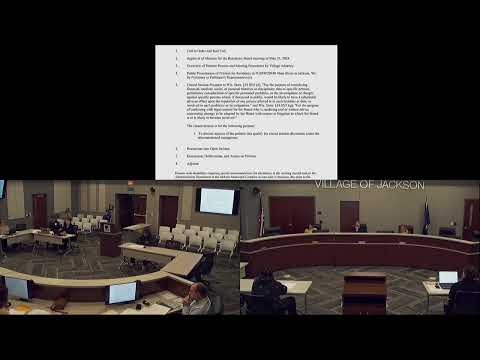
The Village of Jackson residency review board on Oct. 12 denied a request from an applicant identified in the proceeding as Mr. Carson to be granted an exemption that would allow him to establish residency after a juvenile conviction. The board voted to deny the request but voted that Carson may reapply in six months for reconsideration.
The police chief, presenting the department's investigative report, told the board the conviction was "a serious crime involving the [sexual] assault of a 7 year old," that Carson had been untruthful to investigators and the board, and that records did not support Carson's statement that he had been sober for two years. "I believe he is a danger to our community, and I ... suggest that you deny his application," the police chief said.
Why it matters: the board applies a local residency ordinance that defines when a person establishes residency and authorizes exemptions in limited circumstances. The decision affects whether Carson may move into or reside in the Village of Jackson and whether neighbors would be informed; the chief noted Carson's juvenile status means he does not appear on the public version of the offender registry, so neighbors would not automatically be notified.
Board members reviewed the application using the ordinance's checklist. The application lists the offense date as Nov. 21, 2007, and the applicant's age at the time as about 16. The police report and board discussion noted the incident involved the applicant's cousin as the victim and that the report described methods including "verbal coercion and or threats, manipulation, degradation, and hands on force, holding down and pushing," which the police chief asked be recorded on the worksheet.
Board discussion focused on public safety and whether the applicant had demonstrated sustained compliance with the law since release. The board noted a most-recent incarceration date listed in the record as Oct. 6, 2024, and that juvenile records related to the original conviction were not all available to staff. One member said the history and recent law-enforcement contacts raised doubts about the applicant's propensity to follow rules and moved to deny the exemption. Another member proposed granting a temporary, conditional approval with a six-month review tied to continuous full-time employment and proof of no law-enforcement contacts; that motion failed for lack of a second.
After further discussion, a board member moved to deny the request "with the right to reapply in six months' time." A second was made, the board held a voice vote and the motion carried. The board recorded that, under the ordinance definition given during the meeting, visits short of establishing residency remain allowed: residency is established by 14 or more consecutive days, or 14 or more aggregate days in a calendar year (or four or more days in any month), so day visits do not constitute residency absent an exemption.
The board did not adopt conditions tying residency to employer verifications or other monitoring before the denial. During discussion members suggested materials they would like to see if Carson reapplies, such as a letter from his employer confirming steady employment and a visible support presence (for example, the applicant's fiance), but no formal list of required documents was adopted as part of the vote.
The board's action was procedural: denial of the current exemption request with an explicit right for the applicant to refile after six months. The applicant and the police chief were present for the deliberation; the board adjourned after the vote.