Get Full Government Meeting Transcripts, Videos, & Alerts Forever!
Get email alerts on the Municipal Budget topic
No spam. Unsubscribe anytime.
Finance presents FY26 recommended budget; property tax, fund-balance restoration drive changes
Summary
Finance staff presented the Metropolitan Government's recommended fiscal year 2026 operating budget, highlighting a $3.8 billion recommendation that relies on higher property tax revenue, fund-balance restoration, a new budget sustainability fund and shifts after a USD/GSD study.
The Budget and Finance Committee heard a presentation from the finance director and budget staff on the mayor’s recommended fiscal year 2026 operating budget, a $3.8 billion plan that relies largely on increased property tax revenue and restorations to fund balance targets.
The presentation, delivered by Janine Reed, Director of Finance, and Erin Pratt, budget officer, outlined five pillars of Metro’s financial condition and said the FY24 audit was “clean” — an unmodified opinion from external auditors. Reed said the government and enterprise net position both increased in FY24 and that the administration received no material weaknesses from the auditor.
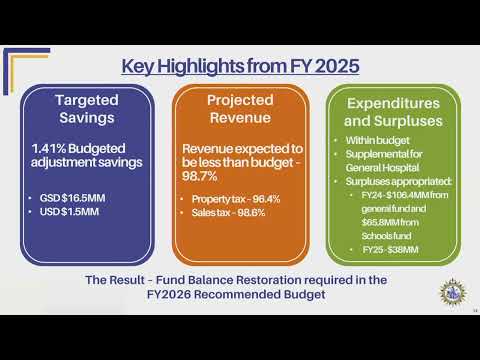
Officials said the recommended FY26 budget totals about $3.8 billion, a 15.6% increase driven by a combination of new revenue, a limited use of fund balance and accounting shifts tied to a USD/GSD study. “Our current budget stands at $3,800,000,000,” a finance staff member said. Finance said approximately $529 million of the increase is split between $20 million of planned fund-balance use and $509 million of new revenue growth.
Why it matters: Finance told council that non-property revenues are growing slowly — about 1.6% excluding property tax — and that the budget relies on property tax increases to avoid cutting services to schools, public safety and other core functions. Finance staff said about 57% of Metro’s revenue is derived from property tax, with local option sales tax and intergovernmental revenue the next largest sources.
Key changes and policy moves: the budget restores fund balance to the targets the council adopted last year, establishes a new budget sustainability reserve (funded at $74.8 million in FY26), and shifts several expenditures between the Urban Services District (USD) and the General Services District (GSD) following the USD/GSD study. Finance staff explained that many expenditures that historically sat in the USD will move to the GSD because services (fire, police) are countywide in effect; staff emphasized that “the USD rate is on top of the GSD rate,” meaning USD households still pay USD levies in addition to GSD levies.
Schools, pay plan and public safety: the recommended operating funding for Metro Schools is roughly $1.5 billion (excluding fund-balance restoration and the sustainability fund), with about $132 million in operating increases year over year. The budget includes $55.8 million for the pay plan in tax-supported funds (a 1% across-the-board adjustment and 2% merit eligibility). Public-safety and service investments called out in the presentation included $15.3 million for the Nashville Fire Department (new truck company, additional personnel and an EMS unit), increased staffing for emergency communications, continued and expanded school resource officers, and additional funding for the Office of Youth Safety and violence-prevention positions.
Risk and timeline: finance staff described economic growth as decelerating (post‑pandemic normalization rather than decline) and cited uncertainty around federal grants, inflation and national market volatility. The committee was given a schedule: departmental hearings begin May 12, first reading of the operating budget and tax levy is May 20, a public hearing and second reading are scheduled for June 3, and final (third) reading is set for June 17; the Metro charter requires adoption by June 30.
Questions from council members focused on federal grant risk, the state Board of Equalization review of the certified tax rate, the mechanics and distributional effect of the USD/GSD study, and how appeals and uncollectible property tax allowances are handled. Finance said the certified tax rate (CTR) filed with the state remains subject to concurrence by the state Board of Equalization. On appeals, staff said the CTR includes an “appeal allowance” and property-tax budget modeling includes a collection allowance (about 3%).
The committee did not adopt the operating budget at the meeting; finance staff will return for departmental hearings, work sessions and further council review in May and June.