Get Full Government Meeting Transcripts, Videos, & Alerts Forever!
Get email alerts on the Trench Safety topic
No spam. Unsubscribe anytime.
Trust trainers warn trenching is high-risk; urge stop‑work authority and simple protections
Summary
Presenters from the Utah Local Governments Trust told a virtual training that trench collapses are a leading cause of severe injuries in public‑works excavation and reviewed specific prevention steps including stop‑work authority, competent‑person inspections, spoil‑pile placement, ladder access and the use of shields or sloping.
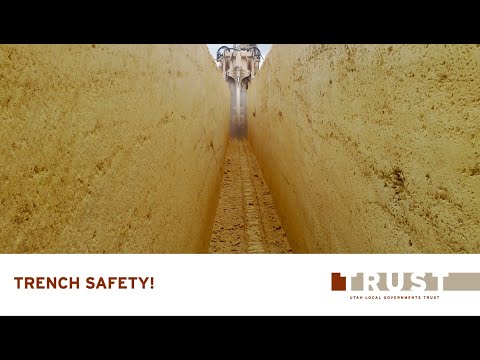
Presenters at a Utah Local Governments Trust webinar on trench safety said trench collapses are a major cause of construction fatalities and urged employees to stop work if a trench appears unsafe.
Mike, a presenter with the Utah Local Governments Trust, told attendees, “When in doubt, get out.” He said everyone on a worksite should have stop‑work authority and that a competent person must inspect trenches daily and whenever conditions change.
The trainers said excavation work is uniquely dangerous. Mike cited national figures during the session, saying “1 out of every 5 workplace fatalities is a construction worker” and that excavation fatalities are “112 percent higher than in general construction.” Jason, a presenter with the Utah Local Governments Trust, advised trainees to err on the side of caution: “Call everything type C, and we're covered and we're safe.”
Why it matters: Trench collapses can apply enormous, often fatal forces. Trainers explained soil and weight calculations to illustrate the risk, saying solid rock weighs about 67 pounds per cubic foot and typical soil about 100 pounds per cubic foot — a cubic yard of soil can weigh roughly 2,700 pounds.
Key guidance and practices emphasized
- Identify utilities before digging and hand‑dig within the marked area: Trainers said operators should stop mechanical excavation at the utility marks and hand‑dig in the immediate vicinity. They described keeping at least 2 feet from a utility mark on either side and placing spoils at least 2 feet from the trench edge to avoid destabilizing the wall.
- Know the competent person and their duties: The “competent person” must have the knowledge and authority to classify soil, perform inspections before each shift and as needed, determine whether a confined space exists, and stop work if cave‑in indicators appear.
- Ladder and access requirements: Trainers said trenches deeper than 4 feet should have an exit (ladder or ramp) every 25 feet of length to facilitate rapid evacuation.
- Depth and engineering thresholds: They noted a distinction by dimension: a trench is defined as an excavation less than 15 feet in width; any excavation deeper than 20 feet requires a registered engineer. They also cited the OSHA excavation standard that generally requires a protective system for excavations 5 feet or deeper unless a competent person’s examination shows no potential for cave‑in.
- Protective systems: Trainers described shoring, shielding and sloping as options. Shields (trench boxes) do not prevent a cave‑in but can protect workers inside; shoring can be used when collapse of the wall must be prevented for reasons such as nearby structures.
- Scene safety and rescue: The presenters warned rescuers not to enter an unstable trench and said emergency response typically requires multiple agencies and time to set up protective systems. In an exercise, trainers advised throwing a rope, providing a ladder, calling 911 and avoiding immediate entry if a collapse has already occurred.
- Other hazards: Presenters covered risks from traffic, falling loads and heavy machinery, recommending high‑visibility clothing, blocking roads with vehicles where appropriate, and staying clear of suspended loads.
Training and Q&A
Presenters demonstrated simple manual soil tests (ribbon and thread tests) and the use of a pocket penetrometer to estimate compressive strength, and they recommended treating unknown soils as type C (the least stable) when deciding protection measures.
Trainers invited questions in the webinar chat; no substantive questions were recorded during the session.
Ending
The Trust presenters closed by urging crews to confirm who the competent person is before entering trenches and to use the protections discussed so workers go home safe.