Get Full Government Meeting Transcripts, Videos, & Alerts Forever!
Get email alerts on the Facility Safety topic
No spam. Unsubscribe anytime.
Utah Local Governments Trust urges yearly inspections, code compliance for bleachers and grandstands
Summary
A Utah Local Governments Trust webinar stressed the International Code Council ICC 300 (2023) standard, annual inspections by a qualified person, and specific construction and guarding requirements to reduce falls, collapses and other serious injuries at public events.
Jason, presenter with the Utah Local Governments Trust, told a May webinar that bleachers and grandstands “can cause serious injuries” and that jurisdictions and facility operators should follow the International Code Council ICC 300 (2023) consensus standard and related codes when installing, altering or maintaining seating.
The guidance matters because the Trust has seen “very large losses” from injuries and damage connected to bleachers and grandstands, and because national data show tens of thousands of emergency‑department visits each year tied to these structures, with many injuries affecting young people.
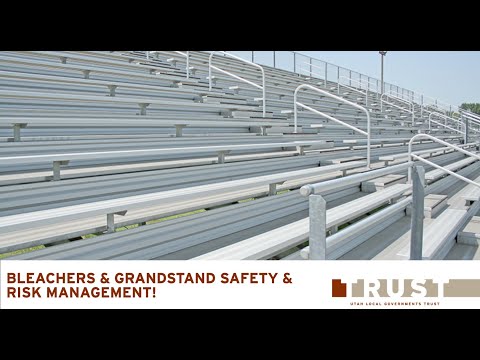
At the start of the presentation Jason defined bleachers as “tiered seating supported on a dedicated structural system and two or more rows high,” and said that the term grandstand is used interchangeably in the standard. He noted seating can be portable or fixed, indoor or outdoor, and can be constructed of wood, aluminum, steel or cast‑in‑place concrete. The webinar emphasized that standards apply to new construction and to significant alterations of existing seating and that manufacturers’ installation and maintenance instructions matter for compliance.
Jason cited several standards discussed during the webinar: ICC 300 (2023) as the primary reference incorporated into the building code; the International Property Maintenance Code for repairs and maintenance; the Consumer Product Safety Commission (CPSC) guidance for retrofits aimed at fall prevention; and National Fire Protection Association (NFPA) 102 (section 666) for folding and telescopic seating. He also noted Americans with Disabilities Act (ADA) accessibility requirements apply to seating areas and accessible routes.
The presentation called out specific code and design points attendees should check: live loads (100 pounds per square foot for seating, 50 psf for press boxes), a planning rule of roughly one person per 18 inches of bench seating, minimum egress widths (36 inches minimum, larger where occupancy requires), and accessible seating counts (for example, up to 500 seats requires 5 wheelchair spaces plus companion seating). Jason also stressed head‑clearance, anchoring or positive ballast for outdoor seating, and a general prohibition on storing or operating concession or cook areas under bleachers unless the fire code official approves.
On fall and entrapment hazards, Jason cited the standard’s dimensional limits: openings under seatboards that exceed a 4‑inch sphere present a child‑fall risk; infill openings for vertical guards should be less than 1.75 inches, and chain‑link infill should have openings no larger than 1.25 inches. Guard and railing height guidance was given as about 42 inches in many situations, with exceptions for some preexisting installations. He showed examples of severely degraded structures — including a grandstand his team ultimately demolished during an audit — to illustrate the risk of large failures.
Inspection and documentation were a central emphasis. Quoting the standard, Jason said, “bleachers shall be inspected and evaluated at least once a year by a qualified person for compliance with the provisions of the standard.” He explained a qualified person is “a professional trained in the proper and safe use, operation and repair of bleachers and knowledgeable in the requirements of the standard,” and noted telescopic or folding seating must be inspected by a competent person each time it is opened. He added that inspection records and an identification/inspection tag showing manufacturer, installation date, seating capacity and inspector are important evidence in the event of a claim: “If you don't — if it isn't documented, it never happened.”
Jason advised operators to obtain the manufacturer’s owner’s manual and any torque or maintenance specifications, and to consult their local code official before purchase or alteration so site‑specific requirements (fire protection, accessible egress, foundation/soil concerns) are resolved ahead of installation. He asked attendees to be cautious about ad‑hoc community repairs to old structures and recommended engineering analysis or removal where structures are unsafe.
Mike (moderator, Utah Local Governments Trust) agreed with the takeaways: “Great presentation, Jason. This is really good and really applicable this time of year,” and encouraged attendees to inspect and document bleachers before the summer event season.
Directions and next steps raised in the webinar were procedural rather than formal orders: inspect every bleacher system at least annually (and telescopic systems every deployment), document inspections and retain manufacturer guidance, consult the local code and fire officials about egress, anchoring/ballast and any required fire protection, and remove or rebuild structures that do not meet safety criteria.
The webinar included an anecdote about the 2002 Salt Lake Organizing Committee grandstands and a demonstration with Frasier Bullock to emphasize the need for secure guardrails; Jason said the example showed how quickly a missing or loose guardrail can create a fatal fall hazard. Attendees were told some technical thresholds (for example, the exact occupant number that triggers a public‑address requirement) were not specified during the presentation and should be confirmed with local officials.
The Trust offered follow‑up contact for questions and urged fairgrounds, parks and other venue operators to begin or complete inspections before summer events.