Get Full Government Meeting Transcripts, Videos, & Alerts Forever!
Get email alerts on the Public Safety topic
No spam. Unsubscribe anytime.
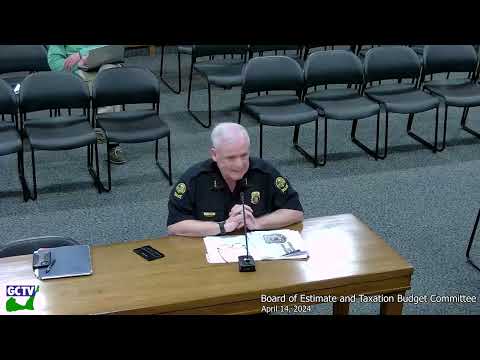
BET committee approves PD5 overtime release; police outline staffing pressures and plan for automated school-zone speed cameras
Summary
The BET budget committee voted 4-0 to release conditions on $551,000 for patrol overtime. Greenwich Police Chief Heavey described staffing and retention challenges and outlined a pending state application to install automated speed-enforcement cameras at school zones.
The Board of Estimate and Taxation budget committee voted 4-0 to release conditions tied to PD5, a $551,000 request to cover overtime in the Patrol Division, Greenwich Police Chief Heavey told the committee.
Chief Heavey described several staffing pressures that inform the overtime request, including average annual retirements of about seven officers, numerous officers with retirement eligibility, and ongoing recruiting and academy training timelines. “The academy takes quite a bit of time, over 6 months and then 3 months of field training… it’s a good 10 months, before we can put an officer on the road,” Heavey said, noting elapsed time between hiring and full patrol availability affects overtime needs.
Heavey said the department monitors assigned versus available strength and that vacancies are sometimes covered by redeploying detectives and operations officers into patrol. He also noted dispatch staffing losses and an officer resignation announced the morning of the meeting. He highlighted that 19 officers are eligible for retirement (having full service) and that 42 officers—about 28% of the force—are in a 401(k)-only plan and can leave after two years without pension penalties.
On overtime spending, Heavey said the department runs a report every two weeks and that while overtime expenditures are at roughly 95% of budgeted overtime, payroll charged year-to-date is about 75%, suggesting the department expects to cover needs without requesting an interim appropriation.
Committee members asked follow-up questions about the composition of overtime and whether patrol was the appropriate division for the request; Heavey explained overtime can cross assignments when detectives fill patrol shifts and views occasional detective coverage of patrol as beneficial.
The committee approved the PD5 release as a routine item; the motion to approve PD5 was moved and seconded (motion recorded as routine) and passed 4-0-0.
During the PD5 discussion Chief Heavey also briefed the committee on a separate initiative: a pending state application to install automated school-zone speed cameras in Greenwich. He said the town has identified 16 locations near public and private schools and initially plans cameras in 10 locations, with each designated area covered in two directions where appropriate. “For the first 30 days, they’ll get a warning,” Heavey said. After the warning period, violations become town ordinance administrative fines: Heavey said the first penalty would be $50 and subsequent fines would increase (transcript indicated $75–$100 for later fines). He said the vendor will receive half of collected fees and the town will retain the other half, and that the local traffic authority—the Board of Selectmen—voted unanimously to forward the plan to the state. Heavey said the vendor believes installations could be in place by Labor Day if the state approves the application within about 60 days.
Heavey framed the camera program as safety-focused rather than revenue-generating, noting expected speed reductions of 60–70% near schools based on statistics and that any fee revenue would be used for traffic safety engineering, enforcement support and program administration subject to subsequent BET appropriation.
The committee recorded the PD5 action and the camera briefing; by approving PD5 the BET allowed the police department to manage overtime plans without an immediate interim appropriation but did not appropriate new construction or capital funds for the camera program, which awaits state approval and further town appropriation for any purchased equipment or program expenses.