Get Full Government Meeting Transcripts, Videos, & Alerts Forever!
Get email alerts on the Career Technical Education topic
No spam. Unsubscribe anytime.
Marshall schools report CTI and ALC progress, new CNC and community partnerships
Summary
At a Marshall Public School District meeting, Dan, assistant principal for the ALC and CTI, updated the board on facility improvements, new CNC equipment and expanding career-technical course offerings, citing partnerships with local businesses and foundations.
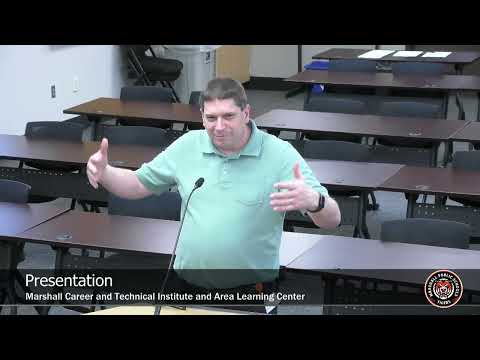
Dan, assistant principal for the alternative learning center (ALC) and the career and technical instruction center (CTI) at Marshall Public School District, told the school board the sites have become more functional learning environments after recent changes and partnerships.
He said the ALC feels ‘‘like a school’’ now that the facility has permanent walls and doors, reducing disruptive movement and making classrooms easier to manage. The CTI has added equipment and course offerings this year and is pushing to expand hands‑on manufacturing, welding and machining opportunities for students.
The update matters because district leaders are trying to connect students directly with local industry needs and postsecondary pathways. Dan said local employers and community groups have helped supply equipment and placement opportunities that the district cannot provide on its own.
Dan described classroom and equipment changes the board should expect to affect student experiences this year. ‘‘It actually feels like a school now,’’ he said, noting that the CTI received two major pieces of equipment this year: ‘‘one came over Christmas, one came in January’’ — a CNC plasma table and a CNC mill — which the program is already using for projects such as a student‑built metal fire ring. He said the plasma table is producing parts now; the CNC mill still requires assembly and set‑up.
Dan said CTI manufacturing students are learning measurement, metal fabrication and assembly and that the program aims to expose students to both certifications and real industrial workflows. He described a welding project and said the plasma table and a slip roller helped the class produce a complete, round fire ring more reliably than hand cutting.
On automotive and power‑sports work, Dan said classes remain project based and cover brakes, oil changes and engine overhaul work; he estimated roughly 30 students had signed up for an expanded powersports element but said enrollment and staffing needs may require consolidating sections. He also said the district could pursue diesel mechanics and more machining (lathes, spindles) in the longer term, but that would require additional instructors and scheduling changes.
Dan said the district is expanding allied‑health training too: the certified nursing assistant (CNA) cohort is close to completing a 16‑hour field experience, and the district has arranged clinical placements locally. ‘‘We have recently reached agreement with Avera,’’ a board member said during the meeting, noting clinical field placements will be available at that health provider rather than at a neighboring town. Dan also said the district plans to move some medical terminology and medical careers instruction to the CTI so the courses can form a Career and Technical Education (CTE) program, which the district could then ‘‘recoup 35%’’ of costs tied to program designation.
Dan credited community partners and donors for equipment and support, naming Southwest and Southwest Service Co‑op for facilities work and the Tiger Foundation for funding CNC equipment. He said the district wants ongoing guidance from employers and higher‑education partners — referenced in the discussion as SMSU, Midwest and SLSU — to shape curriculum and ensure students gain industry‑relevant skills and pathways to local jobs or further study.
Board members asked about scheduling and whether current class time allows students to make meaningful progress on projects. Dan said the existing hourly schedule provides adequate time but that a blocked schedule would be preferable for extended manufacturing work. He also stressed that student motivation and instructor capacity affect outcomes.
The presentation was a program update and did not include any board action on CTI or ALC funding or staffing. The meeting did include routine business motions: the agenda and the consent agenda were approved by voice vote earlier in the session.