Get Full Government Meeting Transcripts, Videos, & Alerts Forever!
Get email alerts on the Nonconforming Use topic
No spam. Unsubscribe anytime.
Applicant withdraws Sewell Road variance after board, counsel question ordinance citation
Summary
An application to expand two single-family structures at 180 Sewell Road was withdrawn without prejudice after the Wolfeboro Zoning Board of Adjustment and legal counsel concluded the filing cited the wrong subsection of the town ordinance; the board encouraged resubmission and waived the reapplication fee.
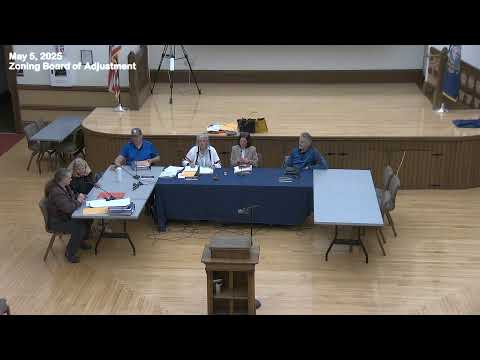
The Wolfeboro Zoning Board of Adjustment on May 7 accepted a withdrawal of the variance application for 180 Sewell Road after staff and legal counsel concluded the permit request had been filed under the wrong ordinance citation.
The withdrawal followed discussion with interim planner Shauna Saunders and the board about whether the application should proceed under the ordinance language for nonconforming structures or the separate provision for nonconforming uses. Saunders told the board the attorney had advised that because the project would rebuild the structures to meet setbacks, the structural subsection (175-43 A1C) did not apply and that the correct analysis involved the nonconforming-use provision of the Zoning Ordinance.
That interpretation mattered because the property contains two residences on one lot — a use that the Shoreland District does not allow — and because the ordinance limits expansion of a nonconforming use to 25% without a variance. Architect Amy Bentley, representing homeowner Andy Allen, said the application’s factual narrative would not change but acknowledged the filing cited the structure subsection on the published notice. Randy Tetro, who advised the applicants, said he and the applicants understood the town’s position but preferred to resubmit with the proper citation and gross-floor-area calculations.
Faced with the legal technicality — the public notice and abutter mailings referenced the wrong section — the applicant elected to withdraw without prejudice. The board said the applicant could refile, agreed to waive the application fee as a courtesy, and directed the applicant to work with the part‑time planner to resubmit with the correct citation and calculations. Saunders confirmed she is available for assistance during her regular office hours.
The board also handled a personnel item at the start of the session: it approved the reappointment of Nancy Stroman as an alternate member for a three‑year term.
Board members and staff emphasized the key technical points applicants must address on resubmission: use the nonconforming‑use provision for the expansion calculation; measure gross floor area (interior conditioned space) when calculating the 25% threshold; and document whether the calculation is based on one building or the aggregated living area of both buildings. Saunders and counsel advised that the applicant should show the gross floor area baseline, the 25% threshold, and then the proposed increase that would require a variance.
The board noted that the withdrawal preserves the applicant’s right to refile; the procedural requirement that the notice cite the correct ordinance section — and the need to re‑advertise and notify abutters — made hearing the matter tonight legally unsafe.
The applicant said they would reapply after recalculating gross floor area and working with the planner on the correct filing.
Meeting context: the Sewell Road matter was a continuance from April 7; the planning office and legal counsel met with the board earlier the same evening to review ordinance interpretation.