Get Full Government Meeting Transcripts, Videos, & Alerts Forever!
Get email alerts on the Property Tax Refunds topic
No spam. Unsubscribe anytime.
Counties say refunds often take weeks; Santa Clara reports five-week average
Summary
A Board of Equalization work group heard that some counties issue property-tax refunds in weeks while others can take months. Santa Clara County officials told the panel their department averages about five weeks to issue refunds after assessment appeals, and stakeholders proposed procedural and statutory fixes to shorten delays.
Santa Clara County and tax practitioners told a Board of Equalization work group that property-tax refunds after assessment appeals commonly take several weeks — not days — and that the time varies based on the steps required to verify payees and compute interest.
The difference matters, panelists said, because delay can create cash-flow problems for taxpayers and administrative congestion for counties.
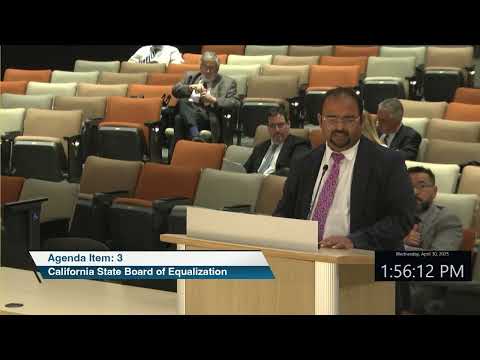
Deputy County Counsel Bhavit Madvani, who advises the Assessment Appeals Board in Santa Clara County, said County Tax and Collections data show most refunds tied to reduced secured assessments are issued on average within five weeks. "On average, we're talking about 5 weeks," Madvani said, adding that straightforward cases often take three to four weeks while more complex matters can rise to six or seven weeks.
Why it can take that long, panelists said, is that counties must confirm the correct recipient for the refund (it is sometimes an escrow company, mortgage lender, or a mailing address different from the property address), check for delinquent tax bills or taxpayer elections to apply the amount to other years, compute interest, secure managerial approvals for large amounts, and maintain documentation subject to public records requests. Madvani said manager review is required for refund amounts of $50,000 or more and that several additional clerical steps follow before a physical refund check is mailed.
Taxpayer advocates and private practitioners told the work group that in some counties the same process can take six to 12 months or longer. "There's no similar timing requirements attributable to refunds," Brad Marsh, co-managing shareholder of Greenberg Terrain LLP and vice chair of CADAA, said, noting the absence of statutory deadlines that match taxpayers' payment timelines.
Marsh described two practical problems that lengthen processing time: (1) handoffs among multiple county offices (clerk of the board, controller/treasurer, assessor, tax collector) and (2) uncertainty about who paid the tax at closing (escrow, lender or owner). He said a recent county questionnaire showed wide variation in practice and that some counties lack reliable payor records for older assessments.
Marsh urged administrative fixes including clearer rollout of Revenue and Taxation Code–style procedures (he referenced a statutory citation in testimony) and suggested adding guidance to county tax-collector manuals to require a roll correction within 30 days of an Assessment Appeals Board decision and a refund within 30 days thereafter. He also proposed expanding circumstances in which the applicant listed on an appeals form could be treated as the refund payee to reduce time spent tracing intermediaries.
Work group members asked whether refunds could be paid electronically to speed delivery. Madvani said he would follow up with the controller/treasurer office on direct deposit options; the transcript records he did not advise the controller’s office and could not confirm whether direct deposit is available but agreed to report back.
Panelists discussed interest paid on late refunds. Marsh and others noted current law entitles taxpayers to interest computed as the greater of 3 percent or the county pool-apportioned rate. A previously introduced bill (discussed in testimony as "AB 3134") would have cut off interest for refunds not paid within 90 days; Marsh said it did not advance.
No formal actions or votes were taken at the work group. The panel concluded with staff saying written minutes and a summary of recommendations would be prepared for the board’s June meeting.
Ending: Board staff will compile the day's testimony and recommendations for consideration at the Board of Equalization's June meeting and may schedule follow-up work to pursue policy or administrative changes suggested by stakeholders.