Get Full Government Meeting Transcripts, Videos, & Alerts Forever!
Get email alerts on the Open Government topic
No spam. Unsubscribe anytime.
Clay County Commission hears Missouri Sunshine Law overview from AG office
Summary
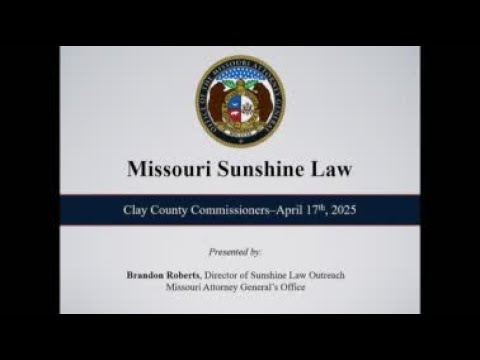
Brandon Roberts of the Missouri Attorney General's Office gave a roughly hour-long presentation to the Clay County Commission on open-meetings and public-records obligations under the Missouri Sunshine Law, covering notice, closed-session rules, electronic records, records-request timing and fees, and best practices for commissions and staff.
At a special session of the Clay County Commission, Brandon Roberts, Sunshine Director of Sunshine Law Outreach at the Missouri Attorney general's office, delivered a presentation on the Missouri Sunshine Law and answered commissioners' questions about public meetings and records.
Roberts framed the law as a presumption of openness and told the commission, “I am not an attorney… The court is the one that imposes the penalties for any infractions of the law.” He summarized the statute’s intent: “The public's business is a public's business,” and urged commissioners to treat requests for information with transparency unless a specific statutory exemption applies.
Roberts told the commissioners the sunshine law applies broadly to public governmental bodies, including municipalities, counties, special districts and advisory committees created to report to those entities. He noted electronic communications can constitute meetings if a quorum participates: “An electronic record may be considered a public record if it is sent to a quorum of officials… relating to public business.”
He reviewed notice and agenda rules: meeting notices should state date, time, location, a tentative agenda “reasonably calculated” to advise the public about matters to be considered, and be posted at least 24 hours in a prominent, accessible place (weekends and holidays excluded). Roberts said minutes must list date, time, place, members present or absent and record all votes, and that roll-call votes must identify each member's individual vote.
On closed meetings and records, Roberts said closures are the exception and must cite the statutory subsection authorizing the closure (Chapter 610 of the Revised Statutes of Missouri). He warned that deviations from the stated closed-session topic risk disclosure in litigation and advised commissions to limit closed-session discussion to the authorized subject.
Roberts covered public-records practice: the custodian must respond to a records request as soon as possible and no later than three business days after receipt; if more time is required the custodian must provide a detailed explanation and an earliest date for production. He explained fee rules: 10 cents a page for paper copies and the lowest hourly rate of an employee capable of doing the work for search and retrieval; actual costs (for example, a thumb drive) may be charged.
Roberts discussed modern issues including group texts and personal devices. He recommended that officials move public-business communications off personal phones and onto government-issued accounts or forward them to the custodian to avoid discovery risk: “If you're gonna have group chats and you're talking about public policy, get it off your phone as soon as possible. Send it to your county email or send it to your county custodian.”
Commissioners and staff asked about public-comment practice and where the line sits between answering citizens and formulating policy. Roberts advised limiting commissioners’ back-and-forth that could produce the appearance of polling: commissioners may ask clarifying questions but should avoid multi-member policy discussion during public comment; if an immediate decision is required, amend the agenda and follow the short-notice rules.
Roberts recommended written sunshine-law policies, naming a records custodian and posting agendas and minutes consistently. He said training materials and his slide deck would be made available; he left contact information for follow-up questions. After the presentation, County Attorney Kevin Graham introduced himself to the group, saying, “My name is Kevin Graham. I'm the county attorney.”
No formal votes or commission actions were taken during the special session; the event was an informational presentation and Q&A.
Materials from the Attorney General's office — including the presenter’s slides — will be distributed to the commission and to chairs of boards and committees, Roberts said.