Get Full Government Meeting Transcripts, Videos, & Alerts Forever!
Get email alerts on the Policing Racial Profiling topic
No spam. Unsubscribe anytime.
Appeals court hears challenge to denial of suppression order in stop the defense says was racially motivated
Summary
On May 5, 2025, an appeals panel heard arguments in Commonwealth v. Tom over whether evidence from a traffic stop should have been suppressed after the trial court rejected statistical and totality-of-the-circumstances evidence that the stop was racially motivated.
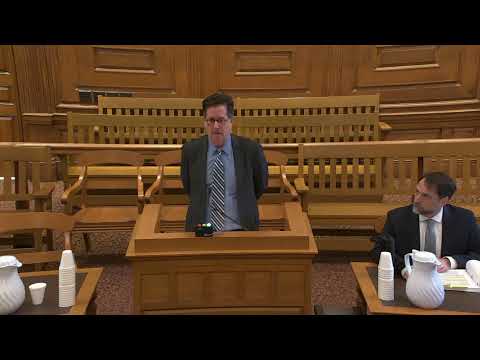
A three-justice panel of the Appeals Court heard oral argument May 5 in Commonwealth v. Tom, in which the appellant asked the court to reverse a trial judge’s denial of a motion to suppress evidence from a traffic stop the defense says was motivated in part by race.
The appellant, represented by Rebecca Kiley, told the panel that two separate statistical analyses showed Officer Monzon issued traffic citations to Black drivers at a rate far above local benchmarks and the neighborhood adult population, and that the totality of the circumstances corroborated a reasonable inference of racially motivated policing. Kiley told the court, “Mr. Tom is a Black man who presented two distinct and statistically significant analyses that both showed that he was likely stopped by Boston police because of his race.”
Kiley emphasized that one internal benchmark compared stops by Officer Monzon to other Area B3 officers and found 83.1% of Monzon’s citations went to Black drivers versus 69.6% for other B3 officers, a difference her expert said had a probability of occurring at random of about 3 in 1,000. Comparing Monzon’s stops to the adult population of Area B3 (65.6% Black) produced an even lower random-probability estimate (about 1 in 1,000), she said. Kiley argued the Commonwealth failed to rebut that statistical showing and that the judge’s short totality-of-the-circumstances paragraph (the addendum 47 paragraph cited in the record) relied on reasoning in conflict with Commonwealth v. Long and related precedent.
The assistant district attorney, Brynn Morris, told the panel the Commonwealth had met its rebuttal burden through five factors: that officers were patrolling for traffic violations, that the officer actually observed a violation, that the stop reflected the officer’s customary race-neutral practice, the seriousness of the offense, and the officers’ post-stop restraint in not arresting the defendant after finding the license was suspended. Morris argued those elements, taken together, rebutted the inference the defense claimed the statistics established.
Justices on the panel questioned the parties on several factual points the judge cited below, including whether Officer Monzon could have observed the driver’s race while passing in the opposite direction, whether windows were tinted, why the officer reportedly made a U-turn before initiating the stop, and why the officers elected to tow the vehicle when a family member later arrived. The justices also explored the interplay between statistical evidence and the totality-of-the-circumstances analysis, including whether hypotheticals raised by the Commonwealth would constitute a sufficient rebuttal absent direct accounting for missing variables.
The appellant asked the court to reverse the suppression denial, vacate the judgment of guilt, and order judgment for the defendant; the Commonwealth asked the panel to affirm the trial judge’s decision. The panel took the case under submission after argument.
The arguments turned on the legal standard for when a statistical showing combined with contextual evidence raises a reasonable inference of racial profiling and on whether the Commonwealth’s factual proffer at the suppression hearing was a sufficient rebuttal under Long, Stroman, and related decisions.