Get Full Government Meeting Transcripts, Videos, & Alerts Forever!
Get email alerts on the Sidewalk Snow Removal topic
No spam. Unsubscribe anytime.
Salem committee asks solicitor to draft ordinance edits to raise sidewalk snow-removal fines
Summary
A Salem City Council committee voted to ask the city solicitor to draft ordinance language raising sidewalk snow-removal fines after staff reported enforcement numbers, process changes and limits tied to state statute Chapter 40.
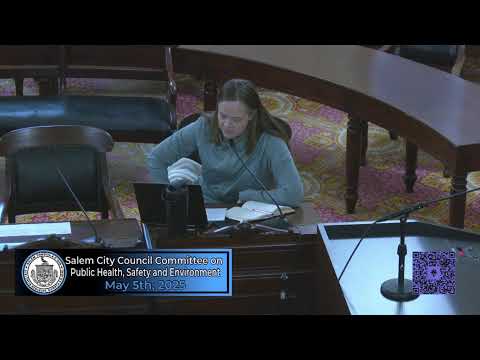
The Salem City Council Committee on Public Health, Safety and Environment on May 5 voted to ask the city solicitor to draft ordinance edits to raise fines for failure to clear sidewalks after snowstorms, following staff presentations on enforcement data, reporting channels and legal limits under Chapter 40.
The committee’s recommendation asks the city solicitor to prepare language that would change Section 38-13 fines from $25 to $50 and raise subsequent-offense amounts to $100, and to amend Section 38-14 so the first offense is $50 and each subsequent offense is $100. The committee voted to send the draft language to the full council for consideration.
Committee members said they want stronger penalties to improve compliance from repeat offenders, while staff described how enforcement and reporting worked this past winter and identified constraints imposed by state law.
“ We issued 17 snow tickets... $3,425 of tickets that were issued. $2,025 have been paid. We still have $1,135 that are still due and not paid,” Building Commissioner Orfanos told the committee when summarizing last season’s enforcement. Orfanos said some fines were abated after court appeals and that staff are taking photographs during enforcement to support appeals.
DPS Director Ray Jones described the department’s operational priorities during storms, saying the city assigns a dedicated worker to school routes and that “we end up treating and plowing, the majority of the sidewalks within 6 hours of the conclusion of the storm.” Jones said medium-priority sidewalks and park areas may be cleared later, sometimes one to three days after a storm.
City Solicitor Renard and staff explained a trade-off tied to the recently used Chapter 40 process: the Chapter 40 route allows the city to place liens on properties for unpaid fines, but it also contains a uniformity provision that prevents different fine schedules for commercial and residential properties within the same zoning unit.
Councilors and staff discussed other operational and reporting issues raised during the meeting. The city uses a single reporting channel during storms (snow@salem.com) that DPS and the building department monitor; some councilors urged the city to consider SeeClickFix or a similar tool to improve public tracking of complaints. Councilors also raised concerns about sidewalk access at curb cuts and crosswalks, repeat commercial offenders (commissioners cited Public Storage, Walgreens and a Burger King location as examples), and supports for elderly or disabled residents who cannot clear sidewalks themselves.
Resident Lydia King spoke in favor of doubling fines, calling repeat offenders the main problem. The committee also discussed education for plow drivers about corner clearing and the possibility of coordinating volunteer or school-based programs to assist older residents.
Councilor Stott moved that the solicitor prepare ordinance language reflecting the proposed fine increases; the motion was seconded and the committee voted to forward the request to the full council. The solicitor said she would file the draft for the next city council meeting and return the item to committee for further review.
The committee asked staff for additional data, including a breakdown of tickets (commercial vs. residential), repeat violations, and a report on complaints received through the city’s reporting system. Staff said they will try to produce those numbers and to implement improved tracking of repeat offenders.
Background: the committee convened on May 5 to review snow-removal practices, enforcement processes and existing ordinances after an active season of multiple smaller storms. The discussion noted that Chapter 40 provides a path to lien unpaid fines and that Chapter 40 contains a statutory cap of $300 for ordinance penalties. The committee did not adopt ordinance language at the meeting; it asked the city solicitor to draft amendments for formal consideration by the council.