Get Full Government Meeting Transcripts, Videos, & Alerts Forever!
Get email alerts on the Limited Equity Cooperatives topic
No spam. Unsubscribe anytime.
City of Eugene, co‑op residents back bill to allow older limited‑equity housing co‑ops to access property tax exemption
Summary
Witnesses told the Senate Finance and Revenue Committee House Bill 3,232 would remove a date restriction so limited‑equity housing cooperatives formed before a city's exemption program could qualify; the City of Eugene and co‑op residents said the change would help cover rising repair costs without raising member charges.
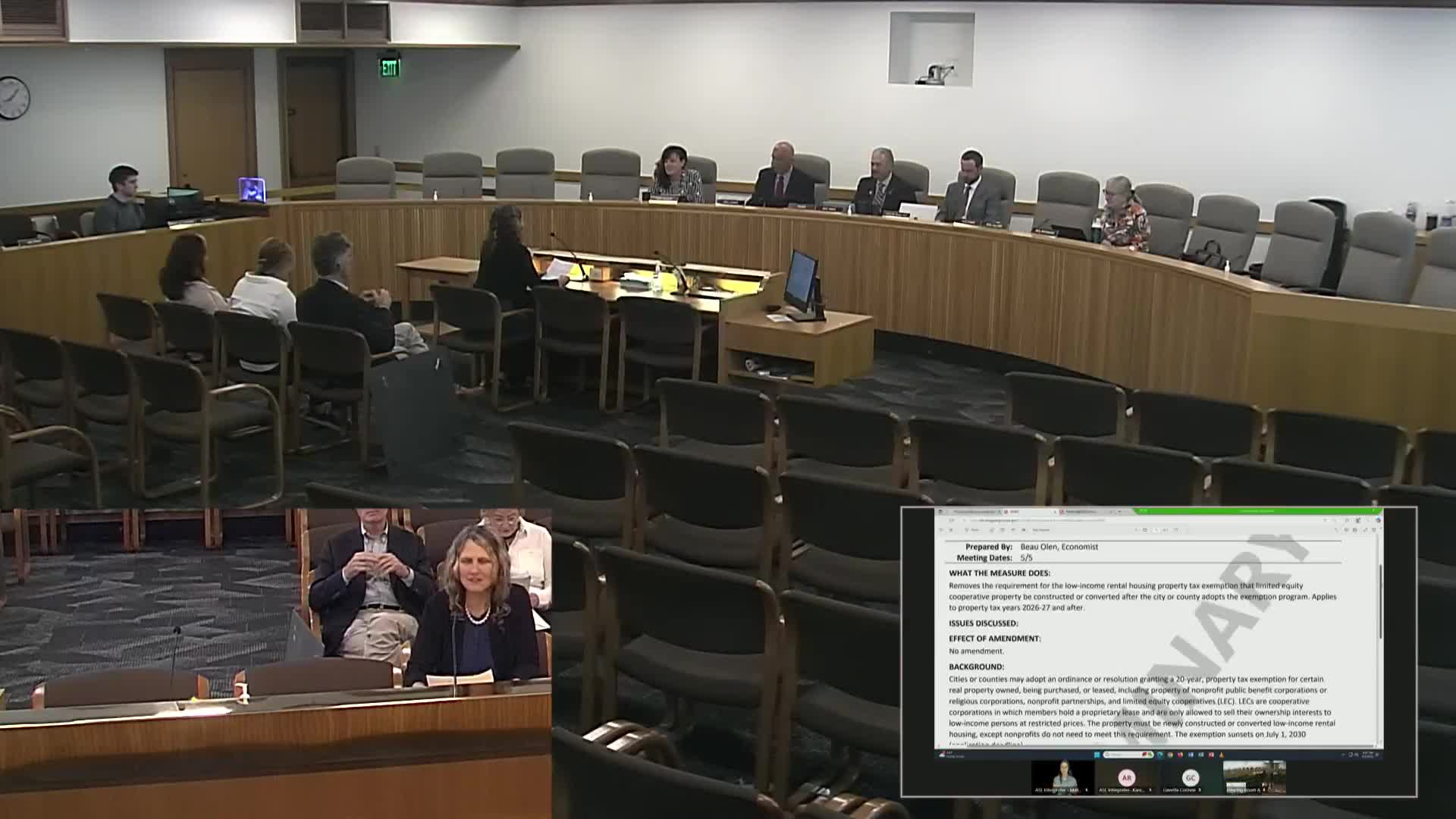
The Senate Committee on Finance and Revenue heard testimony May 5 on House Bill 3,232, a measure that would remove a date restriction from Oregon’s low‑income rental housing property tax exemption so existing limited‑equity housing cooperatives can qualify.
Kari Johnson of Eugene testified in support, saying many limited‑equity cooperatives benefited from the 2023 change in law (House Bill 2,080) and that the current bill would extend that benefit to co‑ops formed before a city or county adopted an exemption program. “Being included in the law will enable the East Blair Housing Co‑op and other similar co‑ops to make expensive infrastructure repairs without raising monthly charges beyond what members can pay,” Johnson said.
Johnson described Square 1 Villages in Eugene as an example of nonprofit cooperative housing that produced hundreds of tiny houses and said limited‑equity co‑ops create “enormous societal value by supplying low income housing in a way that strengthens villagers dignity and self determination.”
Ethan Nelson, intergovernmental relations manager for the City of Eugene, also offered the city’s support and said East Blair Housing Co‑op was founded in 1981 and has about 22 units of affordable housing; the city filed written testimony in support to the legislative record.
Chair Meek left the public hearing for HB 3,232 open briefly to allow testimony and closed the hearing later the same day; the committee did not take a vote during the May 5 session.
Why it matters: Supporters said removing the date restriction will allow long‑standing limited‑equity cooperatives to access a property tax exemption that can lower capital‑repair barriers and protect affordability. No opponents spoke at the May 5 hearing.