Get Full Government Meeting Transcripts, Videos, & Alerts Forever!
Get email alerts on the Capital Planning topic
No spam. Unsubscribe anytime.
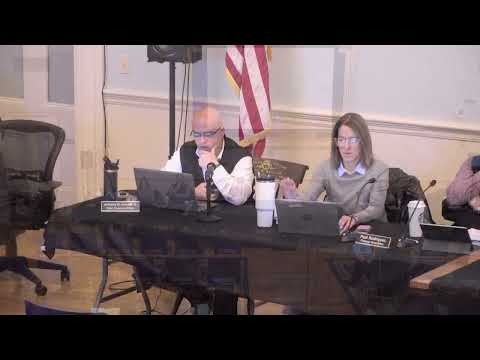
Finance committee opens public hearing on Concord capital plan; roads package and high‑school amenities get scrutiny
Summary
Town and school officials presented a draft FY26 capital plan and funding options at a finance committee public hearing; members pressed for tax‑impact modeling of a proposed five‑year roads program and urged school officials to pursue outside funding for athletics and amenities.
The Concord Finance Committee opened a public hearing on the town’s FY26 capital plan and heard brief presentations from town staff and school officials outlining proposed projects, funding sources and priorities for the coming year.
The plan as presented divides projects into three tiers and includes a mix of pay‑as‑you‑go capital outlay, revolving funds, Chapter 90 state highway funds, grant funding and proposed borrowings. Key items discussed were a proposed multi‑year pavement and street safety program, town‑facility repairs and equipment, and several Concord Public Schools projects including a proposed amenities building at Concord‑Carlisle High School.
Why it matters: the town’s capital decisions determine near‑term borrowing and excluded debt that flow into levy calculations and affect taxpayers. Several committee members asked the town and regional school officials to present tax‑impact scenarios that show the effects of likely borrowings (notably the roads plan) and to identify alternative funding or fundraising options for school projects.
Major projects and funding notes - Roads/pavement management: staff described a tier‑3 option that would authorize $5 million per year over five years (roughly a $25 million program) to raise the town’s Pavement Condition Index (PCI). Public works warned that continuing with only ~$2 million per year would let the town’s road quality decline and that delaying investment could substantially increase the total long‑term cost. The FY26 capital snapshot in the packet includes a $2.0 million contingency for roads in case the tier‑3 ballot measure fails. - Engineering and traffic/safety: the plan includes $420,000 for traffic improvements and $179,000 for road safety improvements; staff said some safety measures are implemented when roads are reconstructed to maximize efficiency. - Town facilities and equipment: the FY26 package includes several items of equipment and building maintenance across departments (examples: cemetery wall restoration $360,000 funded from cemetery funds; facilities request $750,000 focused on high‑priority studies and design rather than speculative full replacements; fire ambulance replacement $550,000 to be funded from the ambulance revolving fund when the vehicle is delivered in about two years). - School projects: Concord Public Schools presented a small FY26 package (tier‑1 and tier‑2 items) and Concord‑Carlisle Regional School District (CCRSD) summarized work at the high school and elementary schools. The high school’s top item is an amenities building (permanent masonry/concrete block option selected by the school committee), a one‑time construction cost the school estimates in a broad range (roughly $1.3–$1.8 million in schematic estimates). The school committee is pursuing multiple funding sources — Community Preservation Committee (CPC) requests, private fundraising through groups such as CC at Play, and potential regional support — and has formed a subcommittee to evaluate options.
Fundraising and outside funding Several members asked whether the town or schools have a standard policy on private fundraising and public‑private partnerships. Town staff and Select Board liaison said the select board’s role is to accept gifts but not to solicit them; the school representatives noted active fundraising discussions (including CC at Play and possible CPC requests) to reduce the taxpayer share for the amenities building and for athletics/field work.
Committee takeaways and follow up requests Committee members asked staff to: (1) model the tax impact of the five‑year roads proposal and show where excluded debt and levy capacity would change; (2) show capital scenarios that prioritize only tier‑1 projects to illustrate lower‑cost options; and (3) clarify which capital items are funded from enterprise/revolving accounts vs. general fund borrowings. Public works said the roads program is intended to return the town to a sustainable surface‑maintenance level and that delaying the investment increases total lifecycle costs. School officials asked for more time to finalize funding requests and noted some items (for example irrigation at the new middle school) could be moved between the school building project and capital requests depending on funding availability.
Quotes from the hearing - Sven Vivo, chair of Public Works: “If you continue at the $2,000,000 level per year, our roads are getting worse and worse… The $25,000,000 project would bring us in the low‑80 PCI.” - Bob (school facilities lead): “We are making choices to minimize cost — the addition of the trainers room is within the existing footprint and adds very little cost.” - Julie Viola (CCRSD, comment at meeting): “We are trying to minimize the taxpayer burden and are looking at every possible funding source.”
What happens next: the committee will keep the record open as staff refine assumptions and will ask for tax‑impact scenarios and clearer funding breakdowns before making capital recommendations ahead of town meeting.