Get Full Government Meeting Transcripts, Videos, & Alerts Forever!
Get email alerts on the Municipal Budgeting topic
No spam. Unsubscribe anytime.
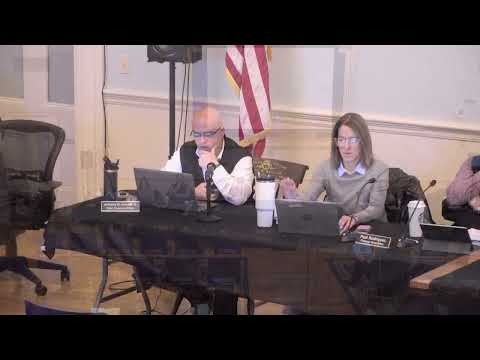
Concord finance committee reviews updated budget projection and five‑year tax impact draft
Summary
Town finance staff presented updated FY26 budget projections and a draft five‑year tax‑impact table showing a projected 6% increase in median residential property tax for FY26; committee members asked for clearer scenarios and more detail on debt and revenue assumptions.
Anthony, the town chief financial officer, presented updated budget projections that the finance committee said will feed the town’s tax‑impact table and five‑year forecast. The presentation updated revenue and expense assumptions for FY26 and the out years and highlighted several drivers that changed the town’s outlook.
The committee’s draft tax‑impact table, prepared by Finance Committee member Lindsay Liss and staff, translates those projections to a median residential tax bill. The table starts from a FY25 median tax bill the packet lists as $17,653 and shows a projected median bill of $18,713 for FY26 — about a 6% increase — before showing much smaller changes in later years under a base case. Liss said the FY26 number is the line the group has the most confidence in; she described the FY27–FY29 numbers as “base case” projections that assume no additional debt or major new revenues.
Why it matters: committee members said the FY26 increase is large enough to merit clear communication and that the out‑year “flat” projections could mislead taxpayers because they depend heavily on town‑meeting choices, new debt, and revenue variability. Members urged the staff to produce alternate scenarios (for example, including the proposed five‑year roads program and other likely borrowings) and to show how those scenarios would change levy capacity and tax bills.
Key projection details and questions - Revenues: Anthony said the town’s “total local receipts and other sources” line is lower than prior forecasts largely because interest earnings and one‑time miscellaneous receipts that supported recent results are expected to fall; he identified loss of revenue from housing prisoners at MCI Concord and lower interest income as part of a roughly $1.7 million decline versus FY25 assumptions. - Insurance and benefits: the town is carrying a 12% assumption for health insurance and a 9% assumption for “LP” (likely long‑term plan/line item) in out years; property and liability insurance is projected to rise 14.4% for the coming year and the same rate is carried forward in the model. - Schools: Concord Public Schools guideline numbers were corrected during the meeting; Anthony said the schools’ FY26 guideline is 2.4% (staff initially used 2.85% by mistake), while other out years were carried at 3.5%. - Peabody/Bridal School carrying costs: staff said carrying costs for the abandoned Bridal School are not yet modeled; insurance on a vacant building could roughly double (staff estimated moving from about $17,000 to $30,000–$35,000 annually), plus utilities and maintenance, but a precise FY26 line was “not determined.” - Overlay and abatements: committee members pressed why the forecast adds $500,000 to the overlay (property tax abatements) each year; staff explained the overlay is replenished annually to cover anticipated abatements and may be reduced if excess builds up. - Levy capacity and debt: staff and Liss noted the town’s unused levy capacity is a key metric. The draft shows unused levy capacity falling from about $5.7 million to $2.8 million between FY25 and FY26 under current projections because the forecast flips from a small surplus in FY25 to a roughly $996,000 deficit in FY26.
Committee requests and next steps Committee members asked staff for three immediate additions to the public materials: (1) a scenario that includes the proposed roads capital program (the tier‑3 $5 million/year / $25 million five‑year option) so voters can see the tax impact; (2) a reconciliation of the $2 million increase in “total local receipts” between November and the current packet (explaining line‑by‑line the $2 million difference the member identified); and (3) a line‑by‑line breakout of the FY26 debt service change that produced the roughly $1 million jump inside the levy. Anthony said staff will research the revenue question and add clarifying schedules to the forecast. Liss said she will add the levy‑capacity calculations to the tax‑impact workbook so the committee can trace the math.
Quotes from the meeting - Anthony, town chief financial officer: “This year, we’re expecting a 14.4% increase” in property and liability insurance costs. - Lindsay Liss, Finance Committee member: “We start with that $17,653 and then each of the line items after that are taking… the 2.5% levy increase and translating that back to the median taxpayer.” - A committee member (John): “If the town forecasts a deficit of a million dollars… what are the mechanics for dealing with a million dollar deficit?” Anthony replied that the town would draw on unused levy capacity and that next year’s tax levy would reflect any increase once the levy is adjusted.
What the committee will do: members agreed to schedule an additional meeting in early February (tentatively the week after Select Board’s Feb. 3 meeting) to review the FY26 budget packet as it develops and to ask staff to produce scenario tables and reconciliation details for the next meeting.