Get Full Government Meeting Transcripts, Videos, & Alerts Forever!
Get email alerts on the Wastewater Treatment topic
No spam. Unsubscribe anytime.
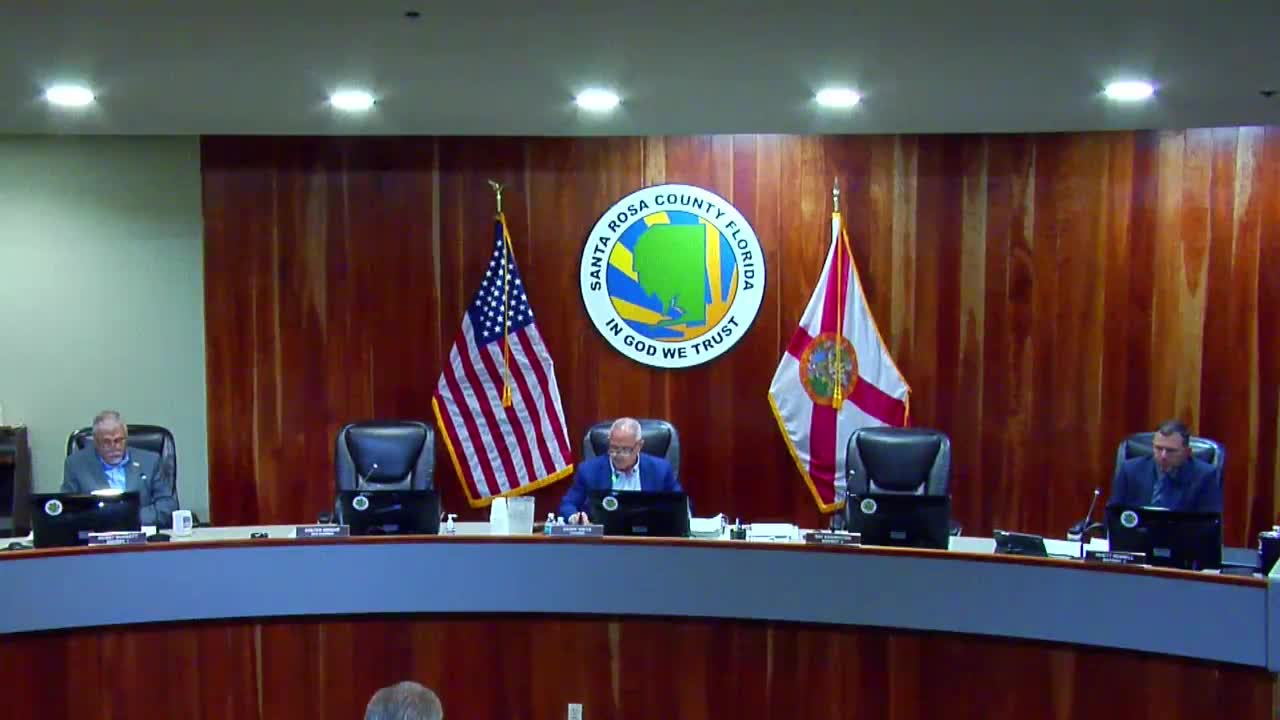
Santa Rosa County approves City of Milton conditional-use permit for new wastewater plant after months of debate
Summary
The Santa Rosa County commission approved a conditional-use permit allowing the City of Milton to build a new wastewater treatment plant and adjacent spray fields on an 80‑acre parcel, despite objections from East Milton residents and environmental concerns tied to PFAS and aquifer vulnerability.
The Santa Rosa County Board of County Commissioners voted to approve a conditional‑use permit that clears the way for the City of Milton to design and seek permits for a new wastewater treatment plant and spray fields on an 80‑acre parcel outside Milton.
The permit approval requires the county finding that the project meets county land‑development standards, a conclusion county staff reached after reviewing the city's submittal. Milton representatives said the permit is necessary to apply for construction grants and finalize plant design. "The conditional use permit will allow the city to move forward with finalizing the design of the plant and adjacent spray fields and initializing the permitting process with FDEP," a City of Milton representative said during the hearing.
The vote followed more than two hours of public testimony and technical back‑and‑forth about effluent permits, groundwater risks in the sand‑and‑gravel aquifer, and potential contamination from PFAS chemicals. Rod Mitchell, speaking for nearby residents, told commissioners that state permitting does not allow the downtown plant's effluent to be sprayed on the 17‑acre disposal site now under discussion and warned of PFAS risks: "One of the chemicals tests at over 35 times the drinking water limits," he said. Former wastewater operator Lisa Bailey said the proposed location was "in the wrong place" because of proximity to springs and the Blackwater River.
City and engineering representatives told the board the city had revised its packet and that county staff found the proposal met the county's code criteria. Richard Delp of Baskerville Donovan, the city engineer present at the hearing, said the 17‑acre spray field had previously been permitted for discharge from the downtown plant and that a permanent modification would be filed if the new plant was built: "The 17 acres was a permitted for effluent disposal from the downtown plant," he said.
Supporters — including current and former Milton city council members — said the city needs a new plant because the downtown facility is at or past its useful life and is close to the river. Council member Tom Powers told commissioners the project is needed to sustain local growth and industry. Pam Mitchell, representing Save Blackwater River, told commissioners she believed the city had met the county criteria and urged approval: "The city's met the requirements," she said.
Opponents objected on water‑quality and siting grounds. Testimony cited an older technical report concluding the local sand‑and‑gravel aquifer is "highly vulnerable to contamination" and urged more groundwater modeling and protections. Commissioners pressed city staff for specifics on funding and permitting; city representatives said funding would be a mix of city revenue, reserves and grants, and that they planned to apply to Triumph Gulf Coast among other sources.
After board discussion the commission approved the conditional‑use permit. County staff reported the city's application satisfied the county land development code criteria listed in sections 5.0702 and 8.0304 of the code, and commissioners voted to allow the city to proceed with permitting and grant applications. The board's approval does not remove state permitting steps: the City of Milton must still obtain permits from the Florida Department of Environmental Protection (FDEP) before any discharge or field expansions.
Commission members who spoke in favor emphasized the need to end current discharges to the Blackwater River from the overloaded downtown plant, while opponents emphasized unresolved PFAS testing and aquifer vulnerability. The county's approval enables the city to continue design and grant work but leaves regulatory safeguards and monitoring to state agencies and future permits.
The decision ends a multi‑year local dispute over plant location and follows a December decision referenced during the hearing about a previously proposed site. The county record shows staff recommended the project meet most relevant LDC criteria; the board's approval formalizes that administrative finding and allows Milton to pursue the next steps of design and state permitting.