Chino Valley commission unanimously approves APS substation expansion at Jerome Junction
Loading...
Summary
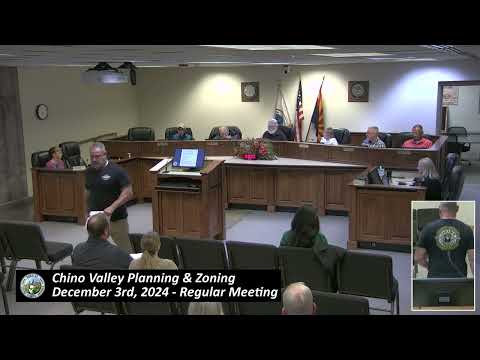
The Chino Valley Planning and Zoning Commission voted unanimously Dec. 3 to approve Conditional Use Permit CUP 2024-04, allowing Arizona Public Service (APS) to expand an existing substation on about 2 acres at 3011 Jerome Junction in the Jerome Junction area of Chino Valley.
The approval follows a staff presentation by Jessica Berrigan, Development Services senior planner, who said the property lies in the AR-4 (agricultural residential, minimum 4-acre) zoning district and that the town's Unified Development Ordinance (section 3.7(c)(0.6)) requires a conditional use permit for a public utility service in that district. Berrigan told the commission that properties within a 1,000-foot radius were mailed notice, a public notice sign was posted on site, and staff had received no written opposition. "Staff does recommend that the Planning and Zoning Commission forward to town council a favorable recommendation of approval for the conditional use permit CUP 2024-04," she said during the presentation.
Paul Murphy, the project manager for consultant Cohen Van Liew representing APS, told the commission the work is an equipment upgrade and an expansion to add a control house and newer electrical gear for future capacity. "This is not related to any solar project at all," Murphy said. He described the project as "to upgrade the existing equipment, the addition of a control house, the addition of newer electrical equipment, more efficient equipment, and for future expansion should [happen] in the area." Murphy said APS will supply graphic renderings of proposed materials and colors to town staff before formal submittal and will follow the town's dark-sky ordinance for any exterior emergency lighting.
Public comment focused on safety, maintenance and notice. Jim Wagner, a resident who identified himself as living in unincorporated Yavapai County, said he had questions about the project's purpose, the decision to waive landscaping because potable water is not available on site, and emergency access if an electrical fire occurs. Wagner asked whether owners of private property within the 1,000-foot notice radius had been invited to a neighborhood meeting. Berrigan and the applicant replied that the neighborhood meeting was waived because surrounding parcels are primarily town-owned but that notices were mailed to property owners in the radius and a sign was posted on site.
Commissioners and the applicant addressed security and emergency response. Murphy said APS requires a 10-foot block wall for facilities that the Department of Homeland Security classifies as "critical infrastructure," and that the existing wall on site already meets that 10-foot minimum. He explained APS policy on on-site access: the utility does not allow outside personnel to enter an energized substation unattended, so fire crews would normally coordinate with APS staff in an emergency. "APS does not allow any outside people to get into their facility unattended," Murphy said. He added that typical commercial Knox box arrangements exist for many buildings but that substations require escorted access because of electrical hazards. The commission also heard that any exterior lighting on the control house would be emergency-only and comply with the town's dark-sky ordinance.
After discussion, a motion to approve CUP 2024-04 "as presented, subject to the staff report and the conditions of approval in Attachment A" was made and seconded. The commission conducted a roll-call vote: Commissioner Penn ' Yes; Commissioner Meadors ' Yes; Commissioner Switzer ' Yes; Commissioner Zamudio ' Yes; Vice Chair Pesiak ' Yes; Chair Merritt ' Yes. The motion passed unanimously.
Berrigan and the applicant indicated next steps will include submission of construction documents and finalized design details to town staff; Murphy said APS will provide a graphic representation of the chosen wall and facade colors to staff in advance of formal submittal. The commission did not take separate action on any related solar ordinance; staff later noted that the town's solar ordinance discussed in November did not move forward and there were no additional items to report to the commission that night.