Get Full Government Meeting Transcripts, Videos, & Alerts Forever!
Get email alerts on the Zoning And Land Use topic
No spam. Unsubscribe anytime.
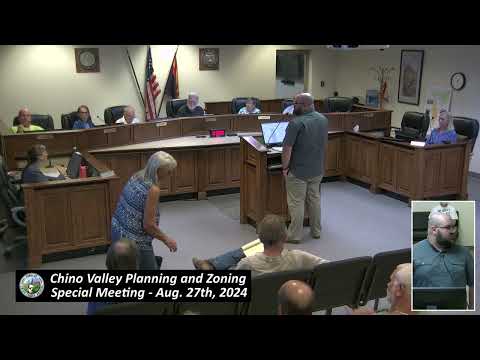
Chino Valley planners forward metal storage-container rules to council, set limits and grandfather existing units
Summary
The Planning and Zoning Commission voted unanimously to forward a text amendment to the Town Council that would allow metal storage containers as permitted accessory uses in select zones, add a new UDO section for regulations, cap containers in commercial/industrial zones and grandfather existing units with limited compliance requirements.
The Chino Valley Planning and Zoning Commission voted unanimously to forward text amendment TA2024-01 to Town Council on a recommendation to allow metal storage containers as a permitted accessory use in select zoning districts and to add a new section to the Unified Development Ordinance establishing standards for those containers.
The change responds to public input and Town Council direction and would create UDO section 4.32 with rules on placement, quantity, color, screening and grandfathering. The commission approved the staff recommendation “as reflected in Attachment 1 as amended by the commission and staff at tonight’s meeting,” and directed staff to carry the commission’s edits into the ordinance before Council consideration.
Why it matters: the amendment would legalize many existing shipping-container uses that are currently not permitted, set limits and design rules for new containers, and create an administrative path for businesses and homeowners to seek exceptions. Planning staff said the move aims to balance property-owner needs for low-cost storage with neighbor protections.
Key actions and rules agreed - The commission asked that metal storage containers be treated as customary accessory structures so they follow accessory-structure setbacks when a commercial or industrial property abuts residential property; that protection was to be explicit in the draft language. - Commissioners agreed to prohibit stacking of containers as a default; stacking could be allowed through a conditional use permit (CUP). - For commercial (CL, CH) and industrial zones the commission set a working cap of five containers per acre for new installations, with the CUP process available for applicants seeking more. - The commission directed staff to include a temporary-use pathway for short-term seasonal or construction storage (six weeks was discussed) processed administratively. - The ordinance as drafted would grandfather existing containers present at adoption; commissioners asked that existing residential containers be repainted to comply with the color/screening standard within one year.
Discussion and public comment Planning staff summarized the process: the item first appeared before the commission in March, was continued by Town Council twice, and produced two open houses on June 5 (one morning session, one evening) that drew roughly 20 participants per session, staff said. The public input favored few quantity limits and opposed strict setback limits; paint and graffiti removal were the most divided topics.
Residents and property owners speaking during public comment raised safety and usability questions. James Walker warned that “without adequate ventilation, the air can become, not real safe to breathe” in deep containers and asked about permitting for electrical and insulation. Kathy Mittelsted said she had used 40-foot containers elsewhere and favored at least an electrical outlet for lighting and ventilation. Planning staff and the building-permit staff explained that electrifying a container as a structure currently lacks a clear building-code pathway; staff said an electrical pedestal with a permit could be used now while the town waits for model building-code appendices expected in the next code cycle.
Staff and commissioners repeatedly emphasized that cosmetic, nonstructural facades (for example, siding or covering that does not alter the container’s engineered structure) would likely be allowed, but structural additions or modifications that alter load-bearing or engineered elements would trigger building-code review and may not be permitted without meeting standard building requirements.
Vote and next steps A motion forwarding TA2024-01 to Town Council “as reflected in Attachment 1 as amended by the commission and staff at tonight’s meeting” carried unanimously on roll call: Commissioner Welker — yes; Commissioner Penn — yes; Commissioner Matters — yes; Commissioner Switzer — yes; Vice Chair Pesiak — yes; Chair Merritt — yes. The commission’s action sends the revised text to Council for final consideration.
What remains unresolved Staff will incorporate the commission’s edits (setback language that protects adjacent residential, the five-per-acre cap in commercial/industrial with CUP exceptions, stacking prohibition with CUP option, temporary-use language, and the one-year repaint requirement for existing residential containers) into the ordinance to be included with the transmittal to Town Council. The specific numeric limits and exact temporary-use timeframe were discussed at the meeting and recorded for insertion into the draft; the ordinance language will be finalized by staff for Council review.
Ending The commission closed the public hearing after two residents spoke and instructed staff to prepare the amended TA2024-01 for Town Council consideration. Council will receive the ordinance at a future meeting for final action; the Planning and Zoning Commission’s motion and the meeting minutes will be part of the public record for that Council hearing.