Get Full Government Meeting Transcripts, Videos, & Alerts Forever!
Get email alerts on the Conditional Use Permit Olsens Events topic
No spam. Unsubscribe anytime.
Chino Valley planning panel backs Olsen’s Events conditional-use permit with limits on nights and total events
Summary
The Planning and Zoning Commission voted unanimously March 4 to recommend approval of CUP2024-05 for Olsen’s Events at 34344 S. State Route 89, attaching limits on total events, night events, hours and operational conditions; the permit now moves to the Town Council for final action.
The Chino Valley Planning and Zoning Commission voted unanimously March 4 to recommend approval of Conditional Use Permit CUP2024-05, allowing Olsen’s Events to formalize and expand activities at its arena at 34344 S. State Route 89 while imposing limits on hours, event frequency and operational mitigation.
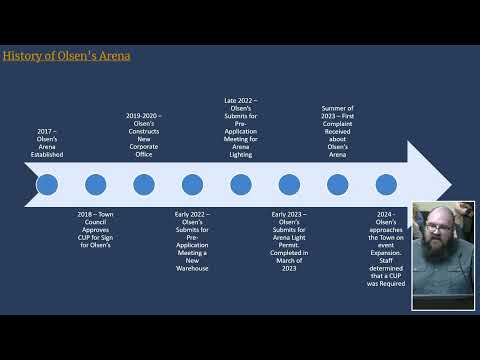
Town staff told commissioners the request has two parts: to recognize the arena as a conforming use and to expand permitted activities to include community gatherings, weddings, adoption events and a limited motorsport called dirt‑bike barrel racing. "As read, tonight's item is a requested conditional use permit for Olsen's event, rodeo, and event arena that began operation in 2017," said Will Dingey, assistant director of Development Services, in the staff presentation.
The commission’s recommendation includes several conditions drafted by staff and discussed at the hearing: a cap of 90 total events per calendar year (resetting Jan. 1), no more than 40 night events per year, no more than four events per week with up to three of those at night, and a requirement that lights be turned off within one hour of the conclusion of events except for security lighting. Staff also proposed a noise limit tied to the town code and additional operational rules: intermittent high‑noise activities (mounted shooting and dirt‑bike barrel races) are restricted to daylight hours; vehicular access from State Route 89 is prohibited per ADOT; eastern easement access will be reserved for emergency access only during events; and the owner must provide adequate off‑street parking and dust mitigation.
Neighbors raised concerns about noise, lighting glare, trespass and traffic. Kim Hennessy, who identified herself as a nearby resident, opposed the permit as written and told the commission: "Approval of this permit would be a serious breach in public trust and would make it very difficult for the police to enforce code going forward." She asked for a one‑year review rather than a longer term, stricter event limits, earlier cutoff times (lights off by 9 p.m.) and a ban on dirt‑bike motorsport events in the residential area.
Staff presented results of noise and lighting mitigation the applicant had already implemented. Dingey said Olsen’s replaced and redistributed its public‑address system to allow lower volumes and that staff’s measurements showed a reduction at the southern property line from about 70 decibels to roughly 50 decibels after the upgrade. He also described adjustments to the six arena light fixtures — "tilted down roughly 15 degrees" — and staff’s site visit on Feb. 10 that found no light trespass at the impacted neighbor’s western property line. The staff report notes the arena parcel covers roughly 12 acres across two zoning districts (Commercial Light for the front ~300 feet and Agricultural Residential‑5 for the remainder).
The applicant, Mike Olsen, one of the owners of Olsen’s Grain and the parent company of Olsen’s Events, said he had "nothing to add to what Will presented" but emphasized community demand for family events and that a temporary use permit for a dirt‑bike barrel race held last summer was "a huge success." Olsen said the dirt‑bike format runs one bike at a time and that organizers would limit the number of such events.
More than a dozen members of the public spoke. Several nonprofit and community representatives urged approval, citing youth programming, adoption events and community economic benefit. Jim Holt, speaking for the Equine Emergency Evacuation Group, said the Olsen family and staff are "honest, trustworthy, and ... have a great deal of integrity." Taylor Shoemake and Melinda Davis from Yavapai Humane Trappers described adoption events held at Olsen’s (one event led to seven adoptions), and Helen Fuller, president of the Tri City Speedsters, said of the dirt‑bike trial: "I was expecting it to be way louder than it was, and it wasn't." Supporters highlighted that events draw families who spend locally and provide youth activities.
Commissioners debated balancing the community benefits with the impact on the closest neighbor. Chair Chuck Merritt urged a specific closing time to give the impacted household predictability, saying he had learned "a new word last week called, quiet enjoyment of your property." The commission ultimately added a condition that events generally conclude by 11 p.m.; the applicant said he would agree to that.
The commission also discussed enforcement and a separate approval the town attorney says is needed: the noise ordinance exempts amplified sound only if the police chief grants an exemption. Dingey said the chief had expressed verbal support, but any formal exemption must be pursued separately with the police department and cannot be folded into the CUP per the town attorney’s advice. Commissioners noted they could ask the applicant to secure written confirmation from the police chief before the item goes to Town Council.
After public comment and commission discussion, a motion to approve CUP2024‑05 as presented — subject to the staff report, the conditions in Attachment A and the commission’s added 11 p.m. curfew — passed on a unanimous roll call vote. The Planning and Zoning Commission’s action is a recommendation; final approval rests with the Town Council. The council hearing and any required police‑department action on amplified sound will determine the permit’s final scope and enforceable exemptions.