Get Full Government Meeting Transcripts, Videos, & Alerts Forever!
Get email alerts on the Utility Scale Solar Ordinance topic
No spam. Unsubscribe anytime.
Chino Valley planning commission forwards utility-scale solar ordinance to council after heated public comment and amended setback language
Summary
Chino Valley, Ariz. — The Planning and Zoning Commission on Jan. 7 voted to forward TA2024-04, a proposed amendment to Chapter 4 of the Town of Chino Valley Unified Development Ordinance that would set procedures and standards for utility-scale solar projects, to the Town Council with a recommendation of approval “as presented by staff and as amended at this meeting.” The motion passed 5-1.
Chino Valley, Ariz. — The Planning and Zoning Commission on Jan. 7 voted to forward TA2024-04, a proposed amendment to Chapter 4 of the Town of Chino Valley Unified Development Ordinance that would set procedures and standards for utility-scale solar projects, to the Town Council with a recommendation of approval “as presented by staff and as amended at this meeting.” The motion passed 5-1.
The amendment would not approve any specific solar farm or change property zoning; it would create rules that a future developer must meet if a project is proposed. Will Dingy, assistant director for development services, told the commission, “This is not a request for a zone change. This is not a project approval.” He described the draft ordinance as a package of standards and permitting steps that include a refined solar facility use permit process, a required water-usage plan, a property- and weed-maintenance plan, drainage and stormwater pollution-prevention requirements and provisions for decommissioning and financial surety.
The town packet included comment letters from developers and trade groups — Prospect 14, LightSource BP and the Arizona Solar Energy Industry Association — asking for looser limits on acreage, smaller setbacks, taller panel heights, fewer noise restrictions and more flexible construction hours. Developers argued that utility-scale projects can bring jobs and local revenue. James Lestrange, a developer with LightSource BP, told the commission his company is “evaluating bringing a solar energy project to Chino Valley” and said construction would create “450 to 500 jobs” and long-term property-tax revenue and operations spending that could support local services.
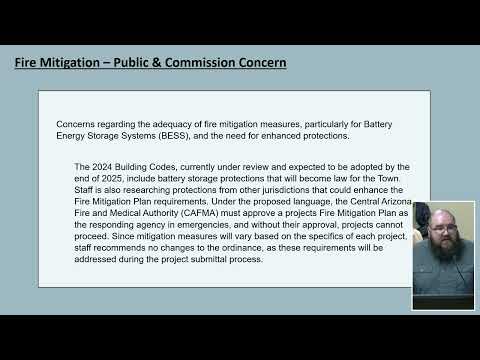
Public commenters overwhelmingly urged caution or rejection. Residents and property owners raised concerns about groundwater, well impacts and water used for dust control during construction; potential devaluation of nearby homes; loss of open-land views and wildlife habitat; dust and public-health risks; and fire safety related to battery energy storage systems (BESS). Rhonda Ceremony, a Chino Valley resident, urged that fire and public-safety planning happen before ordinance adoption, saying, “It is unclear whether a consult consultation with CAFMA has been conducted regarding fire suppression measures and other public safety concerns.” Other speakers described wells that have recently shown signs of trouble and cited large water uses at some installations elsewhere.
Staff and developers offered measures in the draft ordinance to address those concerns. Dingy said the town will require a project-specific fire-mitigation plan that must be acceptable to the Central Arizona Fire and Medical Authority (CAFMA), and that projects could not proceed without CAFMA approval. The draft also adds a dedicated water-usage plan requirement (section F.11) and a property-maintenance/weed-control plan (section F.10), plus a drainage plan and stormwater pollutant-prevention provisions (section F.1C), all to be reviewed as part of permitting.
Setbacks and separation distances were the meeting’s most contested technical items. In the draft as presented, panel fields were to be set back a quarter mile (1,320 feet) from the property line of developed residential lots, with smaller internal setbacks in limited circumstances; battery energy storage systems were to be located centrally within a project or maintain a minimum separation of one mile from developed residential property, whichever is greater. Commissioners debated increasing panel separation to a half-mile, three-quarters of a mile or one mile; some commissioners indicated a preference for a one-mile standard but also raised concerns about legal and practical limits if the town adopts too large a minimum and thereby forecloses projects or invites litigation. The commission worked during the discussion to amend the ordinance’s siting language; staff recorded that members proposed replacing a 50-foot internal setback clause with larger minimum separation language and removing an independent separation clause (2C) so the ordinance’s siting rules would be clearer.
Commissioners also pressed staff about financial and decommissioning protections. Staff said developers must provide surety — escrow, bonding or other financial security — for decommissioning and cleanup, and that the town could require a developer to secure community-benefit commitments before selling a project to another entity. Staff estimated town revenue at roughly $500 to $1,000 per acre per year and said a full build-out at the ordinance’s 3,800-acre cap would generate roughly $2 million to $3 million annually for the town while the projects remain in service; staff noted revenue projections depend on specific proposals and underlying agreements.
The commission vote forwarded TA2024-04 to Town Council with the recommendation of approval “as presented by staff and as amended at this meeting.” The roll-call vote: Commissioner Welker — yes; Commissioner Penn — yes; Commissioner Zamudio — yes; Commissioner Meadors — yes; Vice Chair Passiak — yes; Chair Merritt — no. Chair Merritt explained his dissent, saying he opposed allowing utility-scale solar in Chino Valley and did not want the town to facilitate such projects.
The ordinance next goes to the Town Council. Staff told commissioners they will supply maps and details about eligible parcels, and will continue coordination with CAFMA and other agencies on fire and public-safety requirements before any project application can be accepted.
A vote on the ordinance by the Town Council will decide whether the town adopts these rules as the baseline for future project reviews; the commission’s recommendation is advisory.