Get Full Government Meeting Transcripts, Videos, & Alerts Forever!
Get email alerts on the Consolidated Plan Cdbg Home Esg Hopwa 2025 topic
No spam. Unsubscribe anytime.
New Haven committee approves draft 2025–29 consolidated plan, hears nonprofit requests for kitchen, food and housing services
Summary
The Joint Community Development, Health and Human Services Committee on April 16 approved an order to adopt the city's draft Consolidated Plan 2025'—2029 and the 2025'—2026 Annual Action Plan for submission to HUD, and heard presentations and funding requests from city departments and local nonprofits.
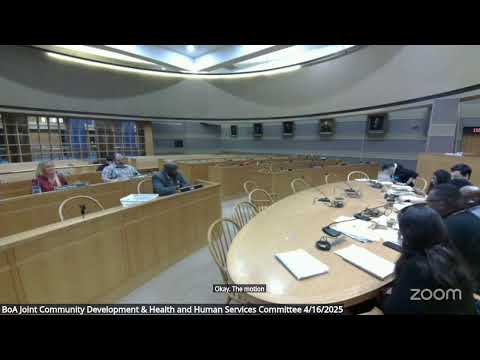
NEW HAVEN, Conn. ' The Joint Community Development, Health and Human Services Committee approved an order (LM-2025-0179) April 16 to adopt the City of New Haven's draft Consolidated Plan for 2025'—2029 and the 2025'—2026 Annual Action Plan and to submit those documents to the U.S. Department of Housing and Urban Development for review.
The vote followed a presentation from city staff on program rules, public outreach results and proposed allocations across the four primary federal funding streams covered by the plan: Community Development Block Grant (CDBG), HOME Investment Partnerships (HOME), Emergency Solutions Grants (ESG) and Housing Opportunities for Persons With AIDS (HOPWA). Presenters also summarized requests from nonprofits and city departments for capital and program funding.
Why it matters: The consolidated plan and annual action plan set local priorities and guide how federal HUD funds are distributed to housing, homelessness, public‑service and neighborhood improvement projects. The staff presentation estimated level funding of about $6,165,000 for the coming program year and roughly $34 million over the five-year plan period if federal allocations remain unchanged.
City staff reviewed legal and program requirements for applicants and funding caps. Ron Gizzi, senior staff presenter, noted the city is building a five-year strategy and that HUD requires substantial public outreach and a formal submission schedule. "We are anticipating level funding right now," Gizzi said during the presentation.
Public outreach and survey results: City staff said 88 resident surveys were received (87 English, one Spanish) and 31 agencies completed an agency survey. Residents ranked affordable rental housing as the top housing need; respondents also prioritized supportive services to prevent homelessness and expanded services for people with mental disabilities. Street improvements and trash removal were cited as top infrastructure and neighborhood concerns. Agency respondents rated supportive, affordable housing and neighborhood stabilization among their highest priorities; 70% of agencies said current city programs do not adequately meet community needs.
Funding rules and program details: Staff reviewed caps and eligible activities: CDBG public service is capped at 15% of the CDBG allocation, planning and administration at 20%; ESG shelter and prevention allocation guidelines; HOME administrative caps; and HOPWA planning/administration limits. Staff described a new contingency clause included in the draft to allow adjustments if federal funding is cut before final allocations are announced.
City program presentations: Michael Piscatello, the city's economic development administrator, and Kathy Schroeder, director for housing administration and development, outlined city uses of federal funds including project delivery, residential rehab programs, down payment assistance and energy efficiency repairs. Schroeder reported the housing pipeline (excluding housing authority projects) includes roughly 5,487 units (about 1,230 designated affordable) with about $1.2 billion in private and public investment under active development or construction. City staff also reported program outcomes since 2020: the security deposit program has processed 1,023 applications and closed 680; the below‑market registry lists about 4,952 units; down payment assistance had 20 applications and 18 closings; the energy efficiency program received 36 applications and closed 24.
Equitable contracting and small businesses: Will Snyder and staff described the Small Contractor Development Program and related business support services. Program staff said New Haven'based contractors received 38% of city construction dollars in 2024 and minority contractors received 20%; program leaders called those gains substantial and said their long-term goal is to raise minority and local contractor participation toward 50% of city construction spending.
Nonprofit requests during public comment: Several local nonprofits presented funding requests tied to the consolidated plan.
- Laurie McLean, development coordinator for Marrakesh, requested CDBG support for a kitchen renovation at Marrakesh's Whaley Avenue group home serving five residents with intellectual and developmental disabilities. "The kitchen at Whaley Avenue is the heart of the home," McLean said, adding the facility supports daily living and life‑skills development.
- Jennifer Baron Bayer of the Towers Foundation (Towers at Tower Lane) asked for funding to replace aging kitchen equipment at the building's commercial kitchen. She said the site serves very low‑income elderly residents (the average age cited by the presenter was 80 and average annual income about $18,900) and that the kitchens help the operator prepare tens of thousands of subsidized meals annually.
- Christopher Clark of the Agency on Aging of South Central Connecticut described programs that provide grocery gift cards and home grocery deliveries to New Haven seniors with mobility or emergency needs. Clark said the program also uses volunteers to store and deliver groceries and to link seniors with food pantries.
Committee questions and next steps: Committee members pressed staff on several implementation details: how funding caps operate across categories, program delivery costs for Main Streets and how rollover balances are being used, and staff counts supported by federal grants (city staff corrected the residential rehab program personnel count from four to three during the meeting). Staff said a remaining balance in the Main Streets account is about $350,000 and that a $200,000 proposal in the draft would use roughly $129,000 of that balance for program delivery while leaving funds available for project loans.
Votes at a glance: The committee moved and seconded approval of the order LM-2025-0179 (the draft Consolidated Plan 2025'—2029 and the 2025'—2026 Annual Action Plan) and approved it by voice vote; specific roll‑call tallies were not recorded in the meeting transcript.
The committee signaled additional public outreach: staff asked members to help distribute survey QR codes to increase resident participation before the public comment cutoff. Committee co‑chairs said the committee will reconvene for additional hearings and deliberations on April 29 at 6:30 p.m. and May 20 at 6 p.m., and staff said the statutory submission deadline to HUD for the consolidated plan is mid‑August.
The committee hearing included technical detail on federal program rules, numeric program outcomes, and a series of nonprofit appeals for capital and operating assistance. The consolidated plan and action plan will move forward to the next steps in the city approval process and to HUD for review.