Get Full Government Meeting Transcripts, Videos, & Alerts Forever!
Get email alerts on the Advance Care Planning topic
No spam. Unsubscribe anytime.
MOLST slide deck revised to clarify eligibility, disability and language guidance
Summary
Members of a Department of Public Health committee reviewed and revised the provider slide deck for the Medical Orders for Life‑Sustaining Treatment (MOLST) form, focusing on wording about who is eligible for MOLST, the appearance and dating of the 2025 form, and how to present guidance for patients with disabilities and limited English proficiency.
Members of a Department of Public Health committee reviewed and revised the provider slide deck for the Medical Orders for Life‑Sustaining Treatment (MOLST) form, focusing on wording about who is eligible for MOLST, the appearance and dating of the 2025 form, and how to present guidance for patients with disabilities and limited English proficiency.
The committee decided to remove pediatric material from the overview slides and place it with the provider presentation, replace some screenshots with short bullet summaries, and change how the form year is displayed so slides use a “last revised: [date]” line rather than a hard year. Scott, a committee member, said the group should emphasize inclusivity in presentation: “It’s for people of all races, ethnicities, age, gender, socioeconomic position. It’s really an an inclusive initiative.”
Why it matters: the slide deck will be used to train clinicians and to inform other stakeholders about when and how to use MOLST. Committee members said language and formatting choices could affect how clinicians interpret eligibility and the tool’s purpose, and therefore how it is offered to patients.
Key decisions and discussion points
- Scope and slide placement: The pediatric slide will be removed from the public overview and retained in or moved to the provider-facing slides so the overview remains general. Committee members agreed to match slide language with whatever the full committee decides and to consolidate some content boxes to reduce clutter.
- Date and versioning: Members recommended removing a hard year (for example, “2024”) from the visible form graphic and instead showing “Last revised: [date]” or a similar revised‑version label so the deck will not appear immediately out of date when the calendar year rolls over.
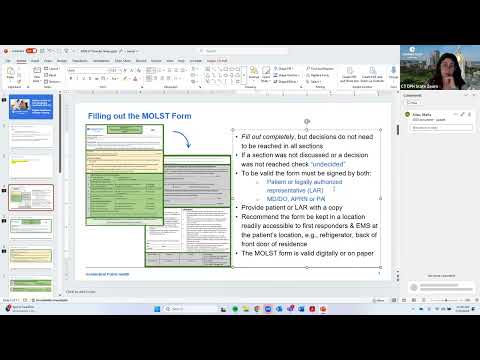
- Visuals vs. summaries: The group agreed to replace at least one screenshot of the electronic MOLST display with a concise bullet summary to make slides easier to read. One member said the screenshot made the slide “very busy” and preferred the summary.
- Language and cultural guidance: Committee members debated the title and tone of a slide that lists groups or factors to be aware of when discussing MOLST. After discussion they moved from language framed as “influential factors” toward phrasing such as “be aware that different patients may require special considerations” and recommended emphasizing cultural nuances and language barriers. Cindy, a committee member, recommended changing the slide title to language like “Most may be appropriate for any patient regardless of …” to avoid implying exclusion.
- Disability and eligibility wording: Members worked to avoid phrasing that could be read as excluding people with significant disabilities. The committee agreed the presenter text should make two points: (1) MOLST is a tool that can be used by many patients with qualifying conditions, and (2) having a significant disability by itself is not a qualifying reason for MOLST. Several members recommended restructuring bullets and using sub‑bullets to clarify that some individuals who use life‑support technologies (ventilators, feeding tubes, etc.) may nonetheless choose MOLST in certain circumstances.
- Emphasis and formatting: The group suggested bolding a few high‑priority words (for example, “legal medical orders,” “upon signing,” “can be revoked at any time”) rather than bolding many items, to preserve emphasis. They also recommended spacing and font adjustments to reduce dense text blocks.
- Interpreters and accessibility: Committee members confirmed interpreter guidance belongs in the provider deck and agreed to spell out abbreviations such as “LAR” (legally authorized representative) in key places. They also agreed that slide notes should include any regulatory or statutory citations used as the basis for the guidance.
- Video placement: Kathy, a committee member and presenter of a short video discussed during the meeting, has a recorded piece the group found “impactful.” The committee did not decide to place the video in the overview; instead members asked everyone to rewatch the video and then decide whether it belongs in the provider deck, a separate consumer deck, or both. The idea of creating a separate public/consumer slide deck was discussed as a way to tailor language and examples for patients and families.
Next steps and schedule
The committee will circulate watermarked draft slides to the group and bring the revised language, revised slide screenshots, and proposed placement of Kathy’s video to the next meeting. Members agreed to schedule the next meeting for May 13 at 11 a.m., and to share the first two decks to reviewers in advance.
Quotations in context are taken from committee remarks during this meeting and attributed to committee members who spoke during the slide review.